Among Detroit’s late muscle cars, the 1970 AMC Rebel Machine never tried to blend in. It arrived with billboard graphics, a towering hood scoop, and a big-block V8 that put American Motors directly into the horsepower war. More than five decades later, the Machine’s limited production, quirky engineering choices, and unmistakable look have turned it from oddball to blue-chip collectible.
What happened
For 1970, American Motors Corporation took its mid-size Rebel and turned it into a factory drag-strip contender called the Rebel Machine. The project combined a heavily optioned Rebel hardtop with a performance package centered on AMC’s 390 cubic inch V8, rated at 340 horsepower and 430 pound-feet of torque in Machine tune. Engineers paired the engine with a 10.0:1 compression ratio, a high-flow intake, and a four-barrel carburetor, then backed it with either a Borg-Warner four-speed manual or a three-speed automatic.
The most famous configuration used the four-speed manual with a Hurst shifter and a 3.54:1 or 3.91:1 rear axle, which let the Machine run quarter-mile times in the low 14-second range in period tests. To keep that power usable on the street, AMC specified heavy-duty suspension, front disc brakes, and a limited-slip differential, creating a package that could handle as well as it accelerated for a full-size muscle coupe.
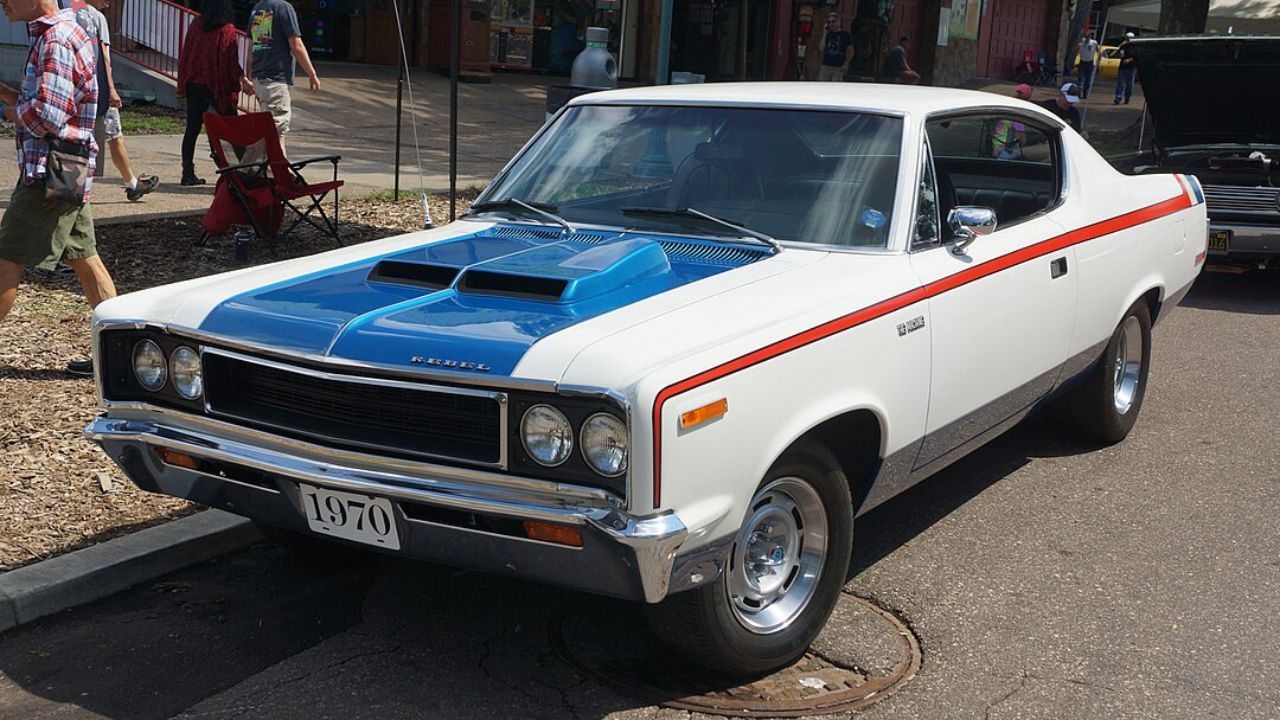
Visually, the Machine package started with a Rebel two-door hardtop, then added a functional hood scoop that fed cold air to the carburetor, along with a hood-mounted tachometer that sat in the driver’s line of sight. Many cars were finished in an attention-grabbing red, white, and blue paint scheme with contrasting stripes that wrapped over the hood, roof, and decklid. The scoop itself carried “390” callouts that advertised the engine’s displacement to anyone who pulled up alongside.
Buyers who preferred a lower profile could order the Machine in more subdued colors, but the majority of surviving cars wear the patriotic scheme that became its visual signature. Period marketing leaned into that image, presenting the Machine as a brash, all-American alternative to better known rivals from Chevrolet, Ford, and Chrysler.
Production only ran for a single model year. Estimates place total output at roughly 2,326 units, making the Machine one of the rarer factory-built muscle cars from a major domestic manufacturer. AMC based the package on the Rebel SST hardtop, then added unique trim, badges, and interior details such as high-back bucket seats and Machine-specific instrumentation.
That short production window and limited volume help explain why individual survivors attract attention when they surface. One example, a restored Rebel Machine finished in the signature red, white, and blue and equipped with a four-speed manual, has been highlighted as a rare muscle car headed to auction, underscoring how infrequently well-preserved cars change hands publicly.
Another featured car, documented as one of a small group built with specific color and equipment combinations, has been showcased as a particularly rare Rebel Machine. Its survival with original-style drivetrain and graphics intact illustrates how collectors now treat these cars as historically significant rather than disposable used performance coupes.
Values have followed that shift in perception. While exact sale prices vary with condition and originality, auction listings and private sales place high-quality Machines in the same conversation as better known muscle icons from the era. Cars with matching-numbers drivetrains, factory documentation, and original paint schemes tend to command the strongest interest.
Why it matters
The Rebel Machine matters first as a statement of intent from a company that was not supposed to build cars like this. American Motors had a reputation for compact, economical models such as the Rambler, and for practical family cars that prioritized efficiency over speed. By 1970, however, the muscle car market had grown too large to ignore. The Machine represented AMC’s decision to compete directly with the likes of the Chevelle SS 396, GTO, Road Runner, and Torino Cobra.
On paper, the Machine’s 340 horsepower placed it squarely in that field. The 390 V8 delivered torque that matched or exceeded some larger displacement rivals, and the car’s curb weight undercut several big-block competitors. Period road tests recorded 0 to 60 miles per hour in the mid 6-second range, which put the Machine among the quicker showroom cars of its time.
Yet the car’s importance goes beyond its numbers. The Machine captured AMC’s willingness to embrace humor and personality in its performance branding. The oversized hood scoop, the in-your-face graphics, and the tongue-in-cheek marketing created a distinct identity that did not simply copy the formula from Detroit’s Big Three. In a market crowded with stripes and spoilers, the Machine still looked different.
That difference extended to its engineering. The use of a relatively compact big-block, combined with a heavy-duty suspension tuned for both acceleration and cornering, gave the Machine a more balanced feel than some nose-heavy rivals. AMC’s decision to include front disc brakes as part of the performance package also reflected an understanding that stopping power mattered as much as straight-line speed.
Collectors and historians now view the Machine as a snapshot of the muscle era at its late peak. By 1970, insurance premiums were rising, emissions regulations were tightening, and fuel economy concerns were starting to surface. The Machine arrived just before compression ratios and advertised horsepower figures began to fall across the industry. In that sense, it represents one of the last unrestrained efforts to squeeze maximum performance from a big-displacement V8 in a mid-size shell.
The car’s rarity adds another layer of significance. With only a few thousand built and far fewer surviving in original condition, each documented Machine helps fill in the story of AMC’s performance ambitions. Enthusiast clubs track production details, color breakdowns, and option combinations, building a community around preserving what remains of the run.
Within that community, the Machine often serves as a gateway to broader interest in AMC performance models. Owners and fans tend to branch out into related cars such as the SC/Rambler, the Javelin AMX, and later Hornet-based specials. The Machine’s high-profile graphics and auction results draw attention that can lift the profile of the entire AMC muscle portfolio.
From a design perspective, the Machine also illustrates how far manufacturers were willing to go to stand out in a crowded showroom. The hood-mounted tachometer, while not unique to AMC, gave the driver a race-inspired view that connected directly to the car’s drag-strip marketing. The cold-air induction scoop, with its prominent intake opening, delivered both functional airflow and a visual cue that this was not a standard Rebel.
Inside, the Machine blended everyday usability with subtle performance cues. High-back bucket seats, full instrumentation, and optional console-mounted shifters created a cockpit that felt more purposeful than a basic family sedan, yet still offered space for four adults. That balance between practicality and performance mirrors the broader appeal of mid-size muscle cars, which could serve as both commuter vehicles and weekend racers.
In the current collector market, the Machine’s combination of rarity, visual drama, and legitimate performance gives it a distinct position. While it may not command the same headline-grabbing prices as a Hemi-powered Mopar or a top-spec LS6 Chevelle, it offers a unique story and a level of exclusivity that many more common models cannot match. For enthusiasts who value standing apart at a show or cruise night, the Machine delivers exactly that.
The car’s significance also extends to discussions about brand identity and risk-taking. AMC could have continued to focus solely on economy and practicality, but the decision to launch the Machine signaled a willingness to experiment. That spirit would later surface in other unconventional projects, from compact 4x4s to sporty hatchbacks, which helped define AMC as a company willing to challenge norms.
What to watch next
Looking ahead, several trends will shape how the 1970 Rebel Machine is perceived and valued. The first is the continuing shift in collector demographics. As younger enthusiasts gain buying power, interest sometimes moves away from traditional muscle icons toward cars that feel distinctive or underappreciated. The Machine fits that profile, with its limited production and offbeat styling, which suggests that demand could remain steady or even grow as new collectors discover the model.
Another factor is the increasing emphasis on documentation and originality in the muscle car market. Machines with factory build sheets, original drivetrains, and intact graphics packages tend to attract the most serious bidders. Restorations that faithfully replicate factory colors and stripe layouts can also perform well, but buyers are paying closer attention to details such as correct hood scoops, tachometer placement, and interior trim.
The supply of high-quality cars is unlikely to expand significantly. Many Machines were driven hard in their early years, modified for drag racing, or simply worn out as used cars. That history means each newly surfaced example with strong paperwork or low mileage can make waves among enthusiasts. Auction houses and online marketplaces are likely to continue highlighting these cars as headline lots within AMC or niche muscle segments.
There is also growing interest in how classic muscle cars adapt to modern expectations around drivability and sustainability. Some owners choose to upgrade braking systems, cooling components, or ignition setups to make their Machines more usable in modern traffic while still preserving the original engine and appearance. Others explore restomod approaches that add fuel injection or overdrive transmissions, trading strict originality for comfort and reliability.
How the community balances those approaches will influence the car’s long-term reputation. If most surviving Machines remain close to factory specification, the model will likely be remembered primarily as a historical artifact of 1970 performance culture. If restomod builds become more common, the Machine could gain a second life as a platform for creative reinterpretation, similar to what has happened with some Mustangs and Camaros.
Regulatory and cultural shifts around emissions and fuel use may also play a role. While classic cars typically see limited annual mileage, public attitudes toward high-displacement V8s can affect how comfortable owners feel driving and displaying them. Enthusiast groups and event organizers may respond by emphasizing education about responsible use, including limited driving and careful maintenance to minimize environmental impact.
On the historical side, continued research into AMC production records and dealer practices could refine understanding of how many Machines were built in specific colors or option combinations. That information would help collectors identify particularly rare configurations and might reveal previously undocumented patterns in how the cars were ordered and sold.
Finally, the broader narrative of American Motors is gaining more attention among automotive historians. As books, documentaries, and online archives revisit the company’s contributions, the Rebel Machine is likely to feature prominently as one of its boldest statements during the muscle era. That visibility can reinforce the car’s status as a key chapter in the story of American performance cars rather than a quirky footnote.
For now, the 1970 AMC Rebel Machine stands as a vivid reminder of a moment when a smaller automaker decided to go all in on speed and spectacle. Its bold styling, serious V8 performance, and scarce production numbers have carried it from showroom curiosity to sought-after collectible, and the next chapters in its story will be written by the enthusiasts determined to keep these machines on the road.
More From Fast Lane Only: