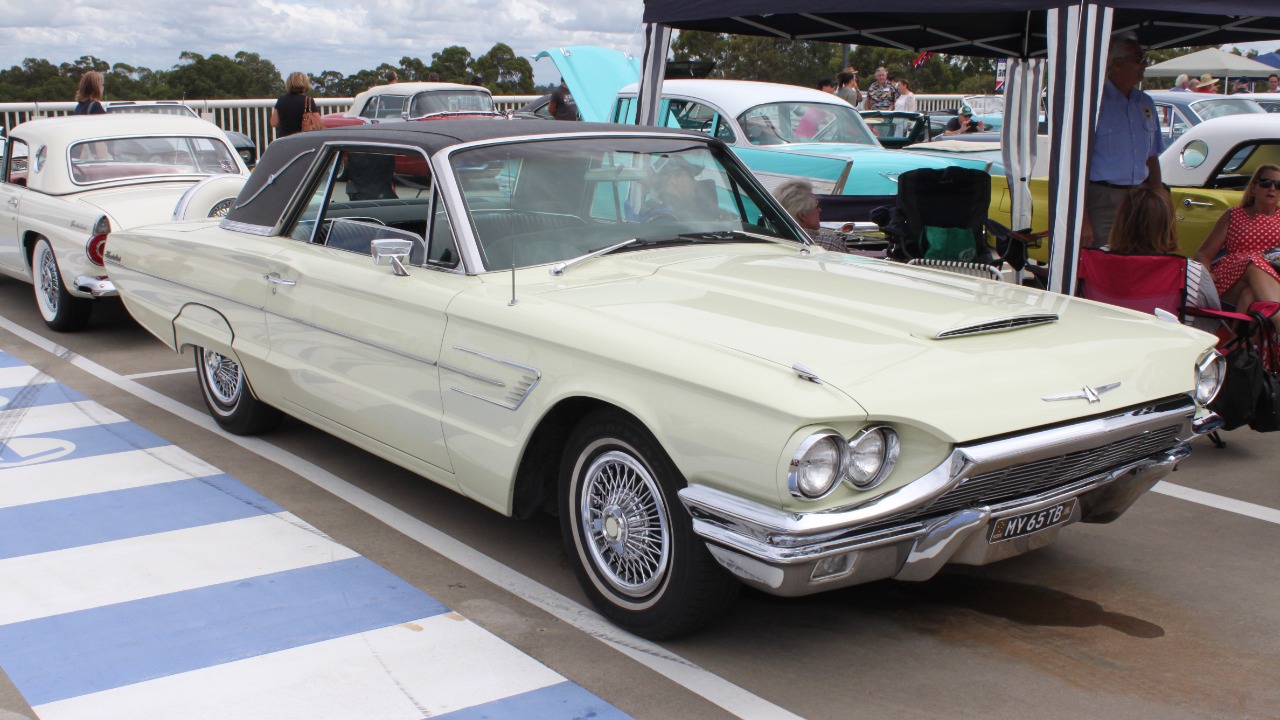
Ford’s 1965 Thunderbird arrived at a turning point for American cars, when brute power began to share the spotlight with comfort, style, and convenience. The model kept a muscular V8 under the hood yet wrapped it in an interior and feature set that felt closer to a personal luxury coupe than a traditional performance machine. That blend of speed and sophistication helped define what many enthusiasts now recognize as the classic Thunderbird identity.
What happened
By 1965, the Thunderbird had already traveled a long way from its two-seat origins in the mid 1950s. Ford had repositioned the car as a four-seat personal luxury model, and the fourth generation, introduced for 1964, crystallized that move. The 1965 version refined this formula with updated styling, more standard equipment, and a focus on comfort that did not abandon V8 performance.
The car rode on a unitized body with a long hood and short rear deck, a layout that emphasized both presence and performance potential. Styling featured a crisp, formal roofline and deeply sculpted sides that made the Thunderbird look substantial even at rest. Up front, a full-width grille and quad headlights set the tone, while the rear integrated large taillights into a broad panel that visually widened the car. These cues reinforced the impression that the Thunderbird was not just another mid-size coupe, but a premium statement.
Underneath the sheet metal, the 1965 Thunderbird relied on big-cube V8 power. Ford offered the car with a 390 cubic inch V8 that delivered strong torque and smooth acceleration, suited to the car’s weight and mission. The engine worked with an automatic transmission, matching the car’s luxury positioning and allowing the driver to lean into effortless cruising rather than manual shifting. Together, they gave the Thunderbird confident highway performance that felt relaxed rather than frantic.
The chassis favored comfort but still provided capable handling for the era. A relatively long wheelbase helped ride quality, while wide tracks and a low stance contributed to stability at speed. Power steering and power brakes were common features, and the 1965 model year expanded the availability of front disc brakes, which improved stopping performance and aligned the car with the expectations of buyers who wanted modern safety and control.
Inside, the Thunderbird leaned heavily into its personal luxury mission. The cabin featured deeply contoured front buckets and a sweeping center console that ran from the dashboard to the rear seats. This layout created four defined seating positions and gave every occupant a sense of being in a special environment rather than a basic bench-seat coupe. High-quality materials, bright trim, and carefully styled switchgear reinforced the premium feel.
Instrumentation and controls were arranged with a driver-focused mindset. The dashboard grouped key gauges directly in front of the steering wheel, while secondary controls sat in a stylish center stack. Many cars included power windows, power seats, and air conditioning, features that were still aspirational for much of the market. The Thunderbird also offered advanced touches such as swing-away steering, which moved the steering wheel aside when the transmission was in park to ease entry and exit.
Ford supported this product direction with marketing that positioned the Thunderbird as a personal statement rather than a family workhorse. Advertising leaned on themes of individuality, success, and taste, suggesting that the car belonged to drivers who valued comfort and style as much as acceleration. The 1965 model’s mix of V8 power, distinctive design, and upscale equipment fit that narrative and helped sustain the Thunderbird’s reputation as a leader in the personal luxury segment. Enthusiast references to the broader Ford Thunderbird line often point to this era as a turning point in that evolution.
Why it matters
The 1965 Thunderbird matters because it captured a shift in American automotive priorities. Muscle cars were gaining momentum, yet a growing group of buyers wanted performance wrapped in comfort and visual drama. The Thunderbird did not try to outgun the pure performance models in raw numbers. Instead, it offered a more mature take on speed, one that emphasized quiet power, smooth ride quality, and a sense of occasion every time the door closed.
That strategy helped define the personal luxury coupe as a distinct category. While earlier Thunderbirds had already moved in that direction, the 1965 car solidified the template. It showed that a V8-powered car could be aspirational without being overtly aggressive. This balance influenced competitors that followed, including models from General Motors and Chrysler that blended strong engines with plush interiors and distinctive styling. In that sense, the Thunderbird did not just participate in a trend; it helped set it.
The car’s design also demonstrated how styling could communicate both performance and luxury at once. The long hood suggested power, while the formal roofline and restrained ornamentation signaled refinement rather than flash. Details such as the full-width rear treatment and sculpted sides gave the Thunderbird a presence that distinguished it from more utilitarian Fords. That visual identity helped the car command higher prices and reinforced its role as a halo product for the brand.
From a technology and features standpoint, the 1965 Thunderbird illustrated how equipment once reserved for high-end sedans could migrate into a sporty two-door. Power accessories, sophisticated climate control, and advanced safety features such as front disc brakes turned the car into a showcase of what a well-equipped American coupe could offer. Buyers who chose the Thunderbird were not simply paying for a bigger engine; they were buying a full package that integrated comfort, convenience, and style.
This approach had broader implications for how automakers thought about value. Instead of measuring performance only in quarter-mile times or top speed, Ford framed the Thunderbird’s appeal around the overall driving experience. The car’s V8 provided ample power for passing and highway travel, but the brand emphasized how relaxed and controlled that power felt. That messaging helped shift consumer expectations, encouraging drivers to see performance and luxury as complementary rather than competing priorities.
For Ford, the 1965 Thunderbird also served as a brand-building tool. It sat above mainstream models in price and exclusivity, yet shared enough design language and engineering with the rest of the lineup to cast a favorable glow over the brand. Shoppers who saw a Thunderbird in a showroom might not buy one, but the car’s presence elevated their perception of Ford as a company capable of producing aspirational vehicles. This halo effect has long been a strategy in the auto industry, and the Thunderbird was one of Ford’s most effective tools in that role.
The model’s legacy can be seen in later generations of personal luxury cars that continued to prioritize comfort and style alongside performance. Cars such as the Ford Torino-based Thunderbirds of the 1970s, the Chevrolet Monte Carlo, and the Chrysler Cordoba all drew from the idea that a two-door could be both powerful and plush. While each brand interpreted the formula differently, the 1965 Thunderbird stands out as a clear early example of how that balance could resonate with buyers.
From a collector and enthusiast perspective, the 1965 Thunderbird represents a sweet spot in the model’s history. It retains the clean, mid-1960s styling that many enthusiasts favor, along with the substantial V8 power that gives the car real-world usability on modern roads. At the same time, its focus on comfort and equipment makes it easier to live with than some more stripped-down performance cars from the same era. That combination of drivability and character helps explain why interest in mid-1960s Thunderbirds has remained steady among fans of classic American iron.
The car also illustrates how American manufacturers in the 1960s navigated changing safety and comfort expectations. As regulations and consumer awareness grew, features such as improved brakes, better lighting, and more supportive seating became selling points rather than afterthoughts. The Thunderbird’s adoption of disc brakes and advanced convenience features shows how a performance-oriented car could lead, rather than lag, in these areas. That approach foreshadowed the modern expectation that even powerful coupes should offer strong safety and comfort credentials.
Finally, the 1965 Thunderbird highlights the importance of character in automotive design. Many cars of the period offered V8 engines and two-door bodies, yet relatively few combined those elements with such a distinct identity. The Thunderbird’s blend of muscular proportions, upscale interior, and advanced features created a personality that owners could connect with. That emotional connection, as much as any specification sheet, explains why the car continues to attract attention decades after it left showrooms.
What to watch next
Looking ahead, interest in mid-1960s Thunderbirds is likely to track broader trends in the classic car market. Enthusiasts who grew up around these cars are now at an age where nostalgia and disposable income intersect, which tends to support demand. At the same time, newer collectors are discovering that personal luxury coupes offer a different experience than muscle cars, one that emphasizes cruising comfort and style. The 1965 Thunderbird sits squarely in that niche, which gives it a stable base of admirers.
Potential buyers and restorers will continue to pay close attention to originality and condition. Cars that retain their factory V8s, correct interior trim, and period-correct options tend to command more interest. Given the Thunderbird’s emphasis on features, working power accessories and intact interior components can make a significant difference in value. As parts for some of these systems become harder to source, well-preserved examples may stand out even more.
There is also growing attention on how classic personal luxury cars fit into modern driving habits. Owners increasingly look for vehicles that can handle occasional highway trips and local events without excessive compromise. The 1965 Thunderbird’s combination of strong V8 torque, comfortable ride, and reasonably advanced brakes gives it an advantage in this respect. Enthusiasts who want a classic that feels substantial and relaxed at modern speeds often find this era of Thunderbird appealing.
Another factor to watch is how evolving attitudes toward fuel consumption shape interest in large V8 coupes. As fuel prices and environmental concerns influence buying decisions, some collectors may gravitate toward smaller or more efficient classics. Others, however, view occasional use of a V8-powered car as an acceptable indulgence within a broader mix of vehicles. The Thunderbird’s role as a special-occasion cruiser rather than a daily driver may help it maintain relevance even as efficiency expectations shift.
In the restoration and modification world, the 1965 Thunderbird presents a choice between preserving originality and updating for modern convenience. Some owners focus on factory-correct restorations that highlight the car’s historical significance and period character. Others explore subtle upgrades such as improved suspension components, modern radial tires, or discreet electronic ignition systems that enhance drivability without dramatically altering the car’s appearance. How the community balances these approaches will shape the typical experience of owning and seeing these cars in the years ahead.
Clubs and enthusiast groups will likely continue to play a central role in sustaining interest. Organized events, online forums, and regional meets give owners a place to share knowledge, locate parts, and showcase their cars. The Thunderbird’s long production history, with multiple distinct generations, creates natural subgroups of fans who specialize in particular eras. The 1965 model’s position as a refined, mid-1960s example gives it a strong identity within that broader community.
More From Fast Lane Only: