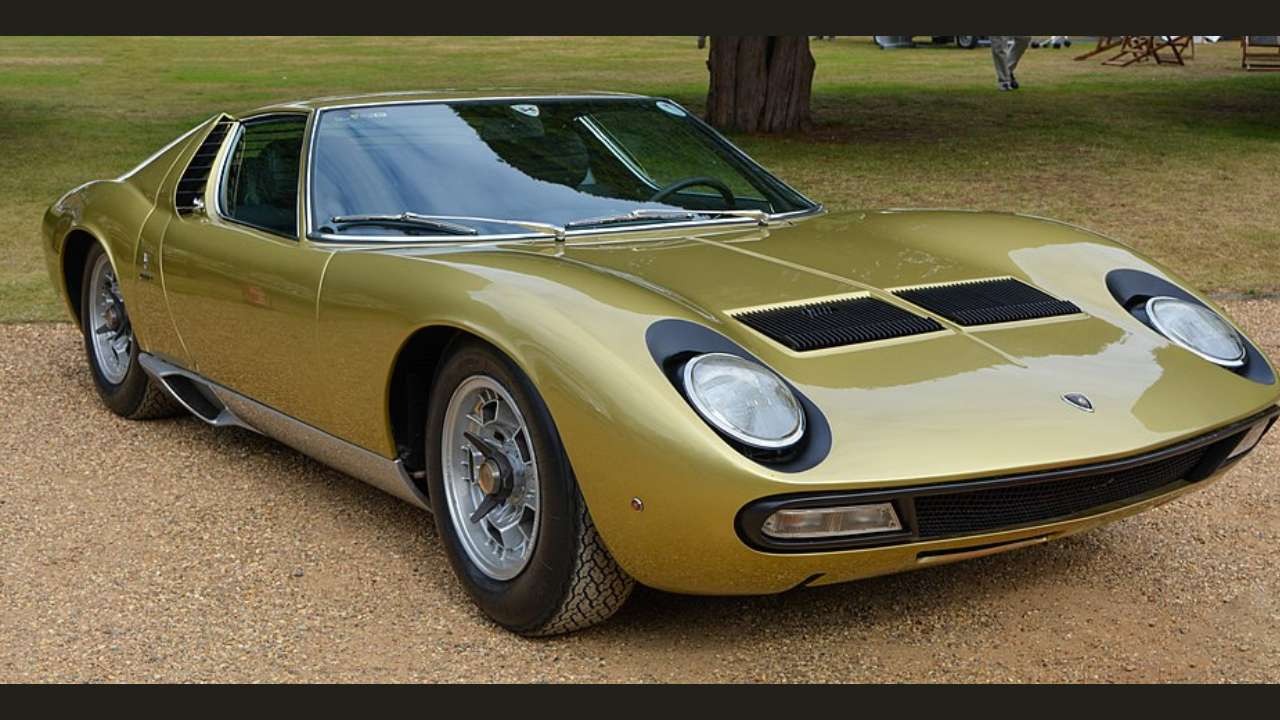
The Lamborghini Miura SV arrived at the dawn of the 1970s with the attitude of a concept car and the discipline of a production machine. Before anyone spoke about “hypercars,” this low, mid‑engined coupe from Sant’Agata Bolognese reset expectations for how fast, how dramatic, and how technically ambitious a road car could be. The 1971 Miura SV was not just a faster version of an already famous model; it was the moment Lamborghini quietly defined the template that modern exotica still follows.
What happened
When Lamborghini introduced the Miura in the second half of the 1960s, the company presented something radically different from the front‑engined grand tourers that dominated European roads. Instead of a long‑bonnet layout, the car used a transversely mounted V12 placed behind the seats, a configuration that had been associated with racing prototypes rather than road‑legal coupes. The factory later described the Miura as the first supercar in history, a recognition of how thoroughly it broke with convention.
The Miura SV, introduced in 1971, represented the final and most developed evolution of that concept. While the basic silhouette remained familiar, the SV featured a reworked version of the 3.9‑liter V12 that delivered higher output than earlier Miura variants. Engineers revised the cylinder heads, carburetion, and internal tuning to sharpen throttle response and increase power, which in turn pushed top speed and acceleration figures into territory that rivaled contemporary racing machinery.
Chassis changes were just as significant. Lamborghini widened the rear track and fitted broader rear wheels and tires, which improved stability at speed and gave the SV its characteristic “hips” over the back axle. Suspension geometry was refined to reduce the nervousness that could appear in earlier Miuras at very high speeds. Together, these mechanical updates made the SV feel less like a wild experiment and more like a thoroughly sorted performance tool, even while it kept the raw soundtrack and immediacy that defined the original car.
Styling details marked out the SV as the ultimate Miura. The famous “eyelash” trim around the headlights disappeared, replaced by cleaner surrounds that made the nose look lower and more aggressive. Subtle changes to the front and rear valances, along with new side vents and badging, signaled that this was not simply a cosmetic package. Inside, Lamborghini upgraded materials and finish, recognizing that buyers paying for the brand’s flagship expected more than race‑car austerity.
Production numbers for the SV remained very limited, which was typical of Lamborghini at the time. The company built only a small fraction of the Miura run to SV specification, and each car required extensive hand assembly. That scarcity has contributed to the model’s mystique, but in period the low volume also reflected how ambitious the concept was. Building a mid‑engined V12 coupe with such complex packaging and finish pushed the capabilities of a young manufacturer that had been founded only a few years earlier.
Contemporary tests highlighted how the Miura SV combined speed with usability. It could cruise at very high velocities on European motorways while still offering a reasonably comfortable cabin, luggage space for weekend trips, and civil behavior in traffic once the driver learned the clutch and gated shifter. This dual personality, brutal performance paired with a measure of refinement, would become a defining trait of later high‑end exotics.
Why it matters
The Miura SV matters most because it crystallized the idea of a road‑going car that used racing architecture and delivered performance previously associated with the track. Lamborghini itself later framed the original Miura as the first supercar, and the SV took that foundation and pushed it closer to what enthusiasts now recognize as hypercar territory. It showed that a mid‑engined V12 layout could be made livable, not just spectacular.
Modern hypercars typically share several core traits: extreme engine output, advanced chassis engineering, dramatic styling, and a focus on exclusivity. The Miura SV anticipated each of those elements. Its V12 delivered towering performance for the period, its chassis used a racing‑inspired mid‑engine configuration, and its styling by Marcello Gandini at Bertone turned the car into a moving sculpture. The limited production and high price completed the picture, placing the SV in a rarefied space even before such cars were treated as asset‑class collectibles.
Technically, the SV also illustrated how manufacturers could refine a radical concept across several iterations rather than starting from scratch. The original Miura had been praised for its speed but criticized for high‑speed stability and cabin heat. By widening the rear track, adjusting suspension geometry, and improving cooling, Lamborghini turned the SV into a more composed car without diluting the sense of drama. That process of incremental, data‑driven improvement over a model’s life cycle is now standard practice for performance brands.
The car’s influence can be traced through Lamborghini’s own lineup. Later models such as the Countach, Diablo, Murciélago, Aventador, and the more recent V12 flagships all adopted the core formula of a mid‑engined twelve‑cylinder layout, theatrical design, and limited production. While each generation added new technology, from all‑wheel drive to carbon fiber monocoques and active aerodynamics, the philosophical starting point remained the same blueprint that the Miura SV had already drawn.
Beyond the company, the SV helped push rivals to rethink what a road car could be. Ferrari, which had long favored front‑engined layouts for its grand tourers, expanded its own mid‑engined range and gradually moved its flagship performance models behind the driver. Other manufacturers, from Maserati to smaller boutique builders, began to explore mid‑engined architectures for road‑legal cars, seeking the same combination of balance and visual impact that the Miura demonstrated.
The Miura SV also shifted expectations around automotive design. Its low nose, sweeping fenders, and cab‑forward stance were not just stylistic flourishes; they were functional responses to the mid‑engine layout and the need for airflow to the V12 and brakes. That integration of engineering and aesthetics paved the way for later cars where the bodywork is effectively an aerodynamic shell over complex mechanicals. Hypercars today rely on active wings, diffusers, and sculpted channels, but the idea that a performance car’s shape should be inseparable from its function was already embedded in the Miura’s form.
From a cultural perspective, the SV helped solidify the association between exotic cars and a certain vision of glamour and excess. The Miura appeared in films, magazines, and celebrity garages, becoming a shorthand for indulgent speed. That image has carried through to modern hypercars, which often serve as rolling symbols of technological bravado and financial success. The SV’s blend of beauty and menace helped define that archetype at a time when sports cars were still relatively modest in both performance and presence.
There is also a preservation angle that matters today. Surviving Miura SVs are now treated as historically significant artifacts, restored with painstaking care and traded at values that reflect their status as milestones. The attention devoted to these cars has encouraged broader recognition of how formative early supercars were for automotive engineering. Museums and collectors use the SV to tell a story about the transition from postwar grand tourers to the high‑tech exotics that dominate the upper end of the market.
For engineers and designers working on current projects, the Miura SV remains a reference point for how to balance purity and progress. The car did not rely on electronic driver aids, active suspension, or hybrid assistance. Its impact came from layout, mechanical tuning, and weight distribution. In an era where software and complex systems increasingly define performance, the SV serves as a reminder that fundamental architecture still matters as much as, or more than, digital overlays.
What to watch next
The legacy of the Miura SV continues to shape how manufacturers approach their most extreme models, and several trends suggest that its influence will persist even as the industry moves into electrification and alternative powertrains. One key area to watch is how brands reinterpret the idea of the “ultimate” car when internal combustion engines face tighter emissions rules and potential phase‑outs in key markets. Lamborghini and its peers are already developing hybrid and fully electric flagships, and the question is how they will preserve the raw emotional appeal that defined the SV.
Design language provides one obvious link. Future halo models are likely to borrow proportions and cues from the Miura lineage, even if their powertrains differ completely. Low, cab‑forward silhouettes, strong rear haunches, and dramatic side intakes remain effective visual signals of performance. As aerodynamics become even more central to efficiency and range, the integration of engineering and styling that the SV pioneered will only grow more important. Designers are likely to reference classic mid‑engined shapes while sculpting bodywork around battery packs, cooling circuits, and underfloor airflow.
Another area to monitor is how manufacturers handle exclusivity and production volume. The Miura SV was rare because Lamborghini’s capacity was limited and the car was expensive to build. Modern brands now use strict caps and numbered series to manage demand and create scarcity by design. As hypercars incorporate costly materials and complex hybrid systems, production runs may stay low, reinforcing the Miura‑style model of a flagship that is more statement than staple. The balance between technological showcase and financial viability will remain delicate.
Heritage programs and continuation projects are also likely to keep the Miura SV in the spotlight. Manufacturers have discovered that customers will pay significant sums for factory‑sanctioned restorations, certified rebuilds, and even newly constructed cars that echo historic models. Given the SV’s status, any official effort to celebrate or reinterpret it, whether through special‑edition modern cars that borrow its name or through curated restoration services, will attract attention from both enthusiasts and investors.
Collectors and auction houses provide another barometer of the car’s ongoing influence. Values for Miura SVs have climbed as awareness of their historical significance has grown, and each high‑profile sale reinforces the perception that early supercars are not just beautiful objects but also key chapters in the story of performance engineering. Watching how these cars perform at major auctions offers clues to how the market values heritage relative to cutting‑edge technology such as hybrid hypercars and electric performance flagships.
On the engineering side, the shift toward lightweight construction and advanced materials has clear parallels with the priorities that shaped the Miura SV. While that car relied on a steel chassis and bodywork appropriate to its era, its relatively low mass contributed significantly to its performance. Future hypercars will likely use carbon fiber, aluminum, and potentially new composites to replicate the same power‑to‑weight advantage in a world where batteries add considerable heft. The underlying lesson that reducing mass amplifies every other performance metric remains as relevant as it was in the early 1970s.
There is also a growing conversation about how to keep historic cars like the Miura SV usable as regulations and fuel formulations change. Some owners and specialists are exploring sympathetic upgrades that preserve originality while improving safety and drivability, such as modern tires that match original dimensions or subtle cooling enhancements. The way the community negotiates that tension between preservation and practicality will influence how often these cars appear on public roads rather than remaining static museum pieces.
More from Fast Lane Only