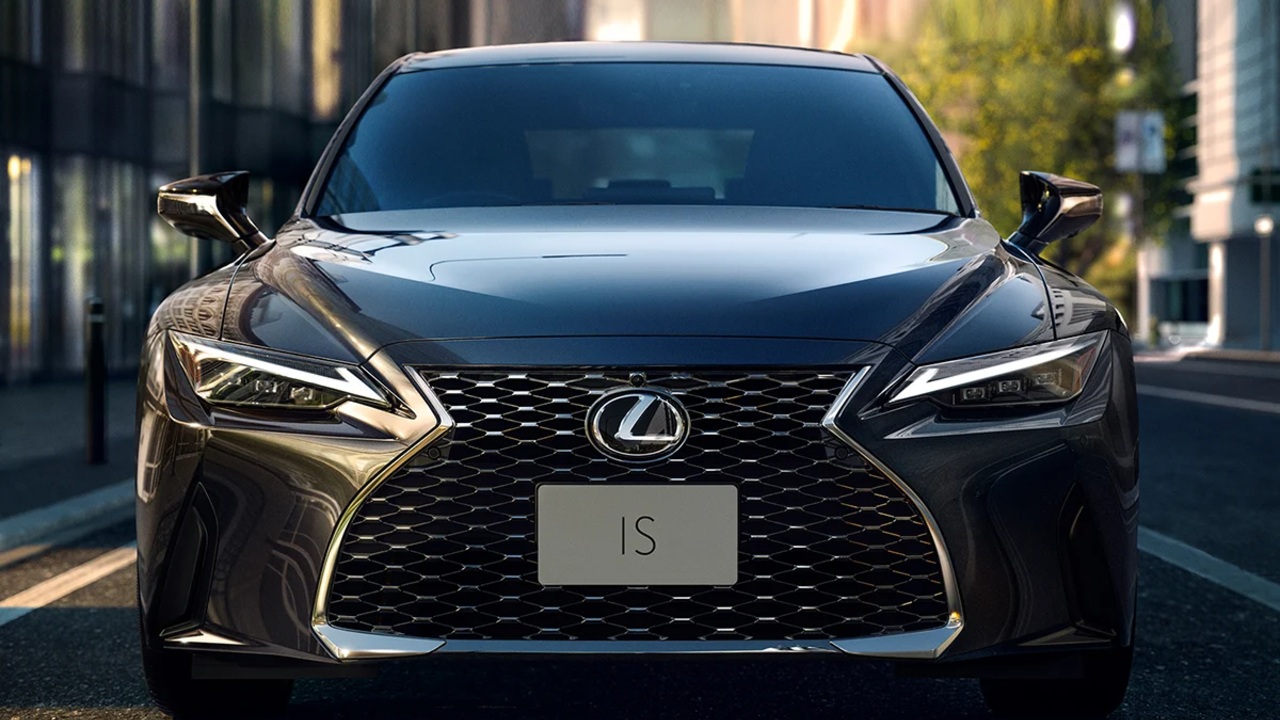
Sporty sedans have been written off more than once, yet the Lexus IS keeps finding ways to stay relevant in a market obsessed with crossovers. The latest twist is a wave of attention around a budget-friendly entry point, framed around “Only $36K for a legend,” that underscores how much performance and refinement buyers can still access without stepping into an SUV. Even as Lexus leans heavily into hybrids in other parts of its lineup, the IS remains a conventionally powered sedan that shows why this format still matters.
Rather than a single new hybrid variant, what emerges from the current Lexus range is a broader story about how electrified technology and traditional sports-sedan dynamics are being balanced. The IS continues as a gas-only model, while hybrid power is concentrated in models such as the UX and ES, and that split reveals how Lexus is trying to keep driving enthusiasts engaged without abandoning its efficiency push.
The $36K talking point and what the IS actually offers
The “Only $36K” hook that has circulated around the Lexus IS taps into a real consumer concern: how to access a premium badge and engaging dynamics without a luxury-car price spiral. Recent pricing breakdowns for the 2025 lineup show the base IS 300 starting at $41,830, which is significantly higher than that attention-grabbing figure but still undercuts many European rivals while preserving the core appeal of the nameplate. That entry model, identified simply as IS 300, anchors a range that climbs through more powerful trims, yet the fundamental proposition is the same, a compact rear-drive sedan with a focus on balance and refinement rather than headline-grabbing horsepower.
What the current reporting makes equally clear is that the IS remains a gasoline sedan only, with no hybrid variant confirmed or detailed in official materials or dealer pricing. References to the IS 300 and IS 350, along with performance-focused versions like the IS 500, consistently describe conventional powertrains rather than electrified ones. Even as Lexus prepares to wind down production of several IS configurations, including the IS 350 and IS 300, the company has not announced an IS hybrid, and any suggestion that such a model is already on sale or delivering specific hybrid-system outputs is unverified based on available sources.
A sports sedan in a shrinking segment
The Lexus IS occupies a shrinking corner of the market, one where compact luxury sedans have been steadily displaced by crossovers. Yet the brand has chosen to keep the IS in play through the 2025 model year, with reporting on the final run underscoring that this is a deliberate last stand rather than a quiet fade-out. The decision to continue offering the IS 300 and IS 350, even as production of these variants is scheduled to end by Nov 2025, signals that Lexus still sees value in serving drivers who prefer a low-slung, rear-drive chassis to a taller, heavier utility vehicle.
That commitment is particularly striking given that Lexus has already confirmed that nearly every IS and RC variant, including the IS 350 and IS 300, will be on the chopping block for some markets by late 2025. In other words, the IS is not being reinvented as a hybrid sedan to extend its life, but rather is being allowed to complete its run as a traditional sports sedan. For enthusiasts, that makes the current generation a kind of last call, a chance to buy into a format that is becoming rarer even as it remains dynamically compelling.
Where Lexus puts its hybrid tech instead
While the IS stays firmly in the gasoline camp, Lexus has been aggressive in electrifying adjacent segments, particularly compact crossovers and larger luxury sedans. The UX line is a prime example, with the UX 250h and UX 300h positioned as small, urban-friendly hybrids that deliver the efficiency many buyers now expect. Official material on the 2026 UX 300h highlights a fifth-generation hybrid system with 196 horsepower, packaged in what Lexus itself describes as a POWERFUL HYBRID HATCHBACK that is Powered by this updated drivetrain. Earlier reviews of the UX have also emphasized Affordability and Value, noting that the subcompact crossover has been available in a price band from $36 to $50 thousand, which helps explain why hybrid technology has been concentrated there rather than in the IS.
Higher up the range, the Lexus ES Hybrid shows how the brand marries electrification with a more traditional three-box silhouette, but in a comfort-oriented rather than overtly sporty package. The 2025 Lexus ES Hybrid is listed with starting prices from $44,835 and climbing to $54,940, positioning it above the IS in both size and cost. Technical breakdowns describe a 2.5-liter inline-4 hybrid engine working with an electric motor, tuned for smoothness and efficiency rather than track-day theatrics. Even the more athletic ES 350 F SPORT Handling models, which feature a SPORT TUNED SUSPENSION and a 302 HORSEPOWER V6, rely on conventional power rather than hybrid assistance. The pattern is clear: Lexus deploys hybrid systems where comfort, efficiency, and urban practicality are the priorities, while leaving the IS to carry the torch for classic sports-sedan character.
How the IS stacks up against Lexus’s own hybrids
Set against the UX and ES hybrids, the IS occupies a distinct niche that is less about fuel-sipping credentials and more about driving feel. The UX 300h, with its 196 horsepower hybrid system and compact HATCHBACK footprint, is aimed at buyers who want a nimble city car with strong efficiency and the elevated seating position of a crossover. Interior details such as Birch NuLuxe seat surfaces with Black washi trim and features like Drive Mode Select reinforce its role as a tech-forward, lifestyle-oriented model. The IS, by contrast, is a lower, more traditional sedan, with rear-drive dynamics that appeal to drivers who prioritize steering feedback and chassis balance over cargo flexibility.
The ES Hybrid, meanwhile, offers a different kind of alternative to the IS. With its larger footprint, higher base price of $44,835, and emphasis on TECHNOLOGY, PERFORMANCE, and SAFETY within a more relaxed chassis, the ES Hybrid is designed for long-distance comfort and quiet commuting. The Lexus ES Hybrid powertrain, centered on that 2.5-liter engine and electric motor combination, is tuned for serenity rather than sharp turn-in or rapid weight transfer. For a buyer cross-shopping within the brand, the choice becomes philosophical: accept the higher fuel consumption of the IS in exchange for a more engaging drive, or move to a UX or ES hybrid and trade some dynamic edge for efficiency and, in the case of the ES, additional space.
Why the sports sedan still matters, even without a hybrid badge
In an era when hybrid badges often serve as shorthand for modernity, the Lexus IS shows that there is still room in the market for a conventionally powered sedan that focuses on feel rather than fuel economy. Pricing that starts at $41,830 for the IS 300 keeps it within reach of buyers who might otherwise default to a similarly priced crossover, especially when they realize that the UX, despite its Affordability and Value positioning between $36 and $50 thousand, offers a very different driving experience. For those who grew up associating the Lexus IS with rear-drive poise and compact-sedan agility, the current generation represents continuity rather than reinvention.
At the same time, the broader Lexus lineup makes clear that the brand’s long-term trajectory is toward more electrification, not less. The expansion of the UX 300h, the refinement of the ES Hybrid, and the focus on Specs, Performance, and Capabilities in those models all point to a future in which hybrid and eventually fully electric powertrains dominate. Within that context, the IS’s role is almost archival, preserving a particular kind of driving experience for as long as regulations and demand allow. Any suggestion that a new IS hybrid is already on sale, complete with specific hybrid outputs or launch timing, is unverified based on available sources, but the direction of Lexus’s product planning suggests that if the IS nameplate returns in a new form, electrification would be central to its identity.
More from Fast Lane Only