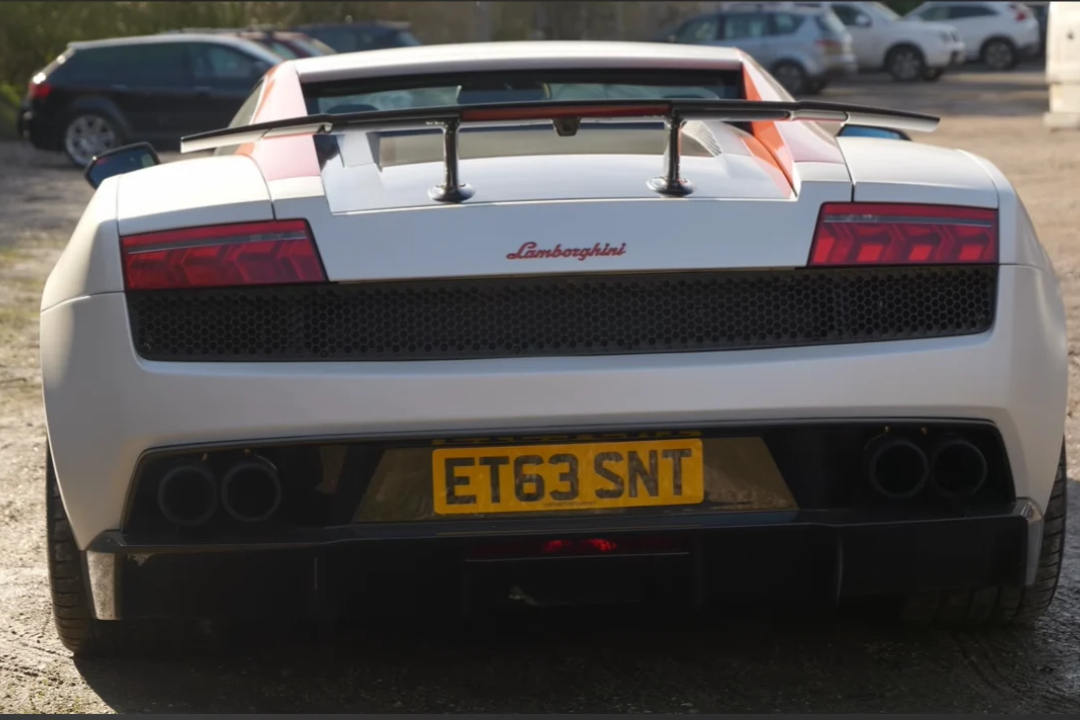
Some cars you drive because you love them. Others you drive because you owe them a second chance. For automotive host JayEmm, a Lamborghini Gallardo Superleggera belongs firmly in the second category, a car he never quite got along with the first time around, borrowed once more from a friend who’s about to let his own example go.
The friend, known online as Ant, bought his 2014 LP570-4 Edizione Tecnica roughly two years ago. Since then its value has more than doubled, climbing toward £300,000, the kind of number that turns owning a car into a source of anxiety rather than joy. That math is what put the Gallardo back in JayEmm’s hands for a day, this time in ideal weather, on quiet roads, with nothing wrong with the car to distract from actually judging it.
The verdict that emerged wasn’t really about horsepower or lap times. It was about temperament, and how differently two cars built for the same job can turn out to behave.
A car that fights you for every mile
JayEmm owns a Ferrari 430 Scuderia, a car built on a similar formula to the Gallardo: mid-engine, stripped down, track-focused. On paper the two should feel like siblings. In practice, they’re closer to opposites. The Ferrari’s full-bore shifts arrive at 5,000 rpm; the Lamborghini waits until 6,000, which JayEmm frames not as a weakness but as extra speed banked before the car lets go. He rates the Gallardo’s shifts as brilliant in their own right, roughly the equal of the Ferrari’s, just delivered a beat later and with more violence behind them.
Where the two genuinely diverge is trust. Despite being all-wheel drive against the Ferrari’s rear-wheel setup, the Gallardo is the twitchier, less predictable car of the two, feeling perched “up on its toes” in a way that makes the driver lean on the all-wheel-drive system just to stay out of trouble. JayEmm draws a clear line between a car that demands respect and one that’s simply poorly sorted, and he never fully resolves which side of that line the Gallardo sits on. He calls it a car you have to respect at all times, and in the same breath describes it as feeling like it’s barely being kept in check. Both things seem to be true at once.
The parts of the experience that have nothing to do with driving
Some of the Gallardo’s flaws aren’t dynamic at all. Rear visibility disappears behind the car’s wing, the turning circle is unhelpfully large, the boot is almost comically small, and the exhaust, fitted with an aftermarket Capristo system, is loud enough to feel genuinely awkward around horses and pedestrians on narrow country roads. None of that stops the car from being a piece of theater the moment you’re inside it. The carbon fiber, the dials, the view down that absurdly styled door mirror, all of it sells a fantasy that the driving experience doesn’t always back up.
Ownership costs add another layer of friction, and by JayEmm’s account it isn’t just an old-car problem. A Lamborghini dealership quoted Ant £2,500 for a full service on a car that didn’t need one, reasoning that if they hadn’t seen it before, a full service was the only option regardless of actual condition. JayEmm is explicit that this pattern isn’t confined to older, harder-to-support models like the Diablo or Countach. Even the current-production Aventador, he says, can be tricky to own for the same reasons.
Why the comparison keeps circling back to character
What makes the Ferrari-versus-Lamborghini question interesting isn’t which car is objectively better. It’s that despite sharing a formula on paper, the two end up feeling like they came from entirely different worlds. JayEmm’s own description says it best: the Ferrari went to French finishing school, cultured and sensitive in how it communicates with the driver. The Lamborghini, in his telling, went to Boston, did good for itself, and became a boxer, refined just enough to warn you before something goes wrong rather than to prevent it entirely.
That’s not necessarily a compliment, and it’s not necessarily an insult either. It’s closer to an honest description of what a Gallardo actually is: a car built on flamboyance and noise first, with the driving experience treated as a secondary concern. JayEmm’s own history bears that out. His previous Gallardo, an earlier 5.0-liter example, was riddled with mechanical problems significant enough that he eventually gave up on making it into the car he wanted it to be.
A car he still can’t quite talk himself out of
None of the Gallardo’s flaws seem to have cured JayEmm of wanting a Lamborghini again. If anything, the day spent in Ant’s well-sorted example, free of the mechanical gremlins that plagued his own car, only reinforced the pull. He’s still drawn toward an early Aventador despite knowing full well it carries many of the same practicality problems, just wrapped in a design he considers genuinely great.
That’s probably the most honest thing to take from a day spent driving a car he doesn’t fully trust, owned by a friend who’s decided it’s time to sell. The Gallardo was never really about winning arguments on a spec sheet. It’s about the kind of car that gets under your skin precisely because it refuses to behave, and stays there long after a more sensible car would have talked you out of wanting it.
More from Fast Lane Only
- Unboxing the WWII Jeep in a Crate
- 15 rare Chevys collectors are quietly buying
- 10 underrated V8s still worth hunting down
- Police notice this before you even roll window down
*Research for this article included AI assistance, with all final content reviewed by human editors.