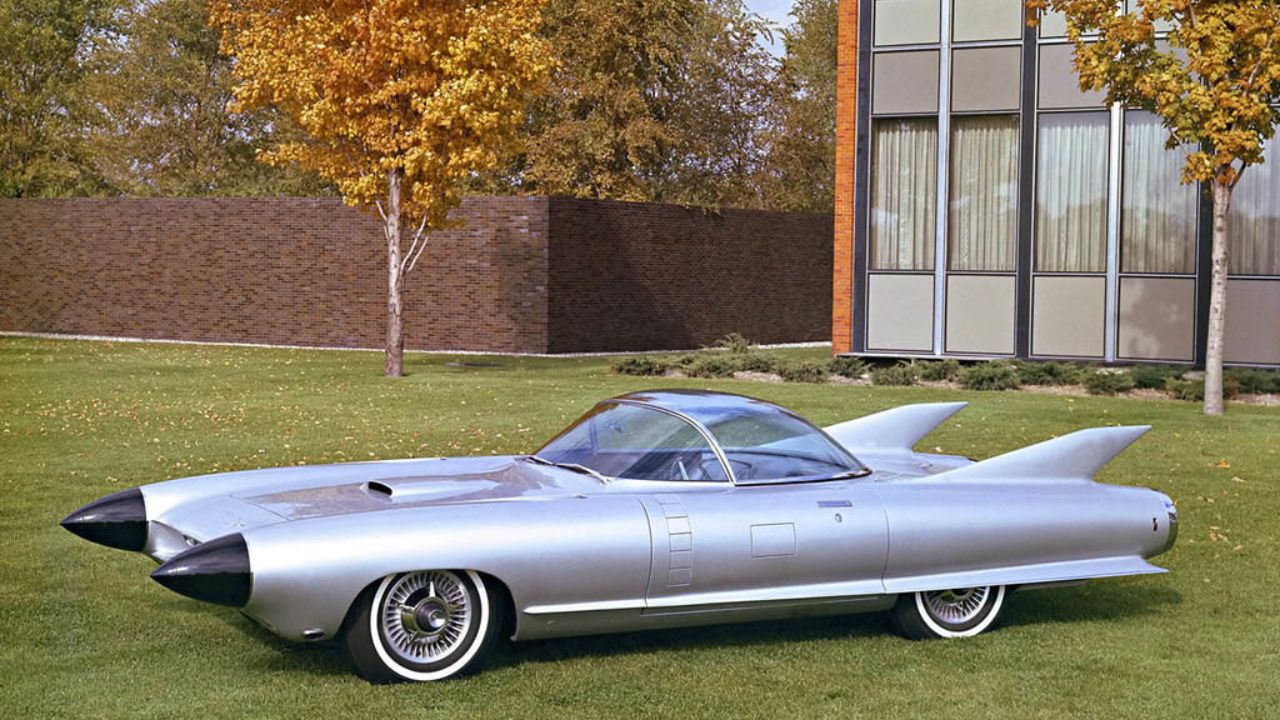
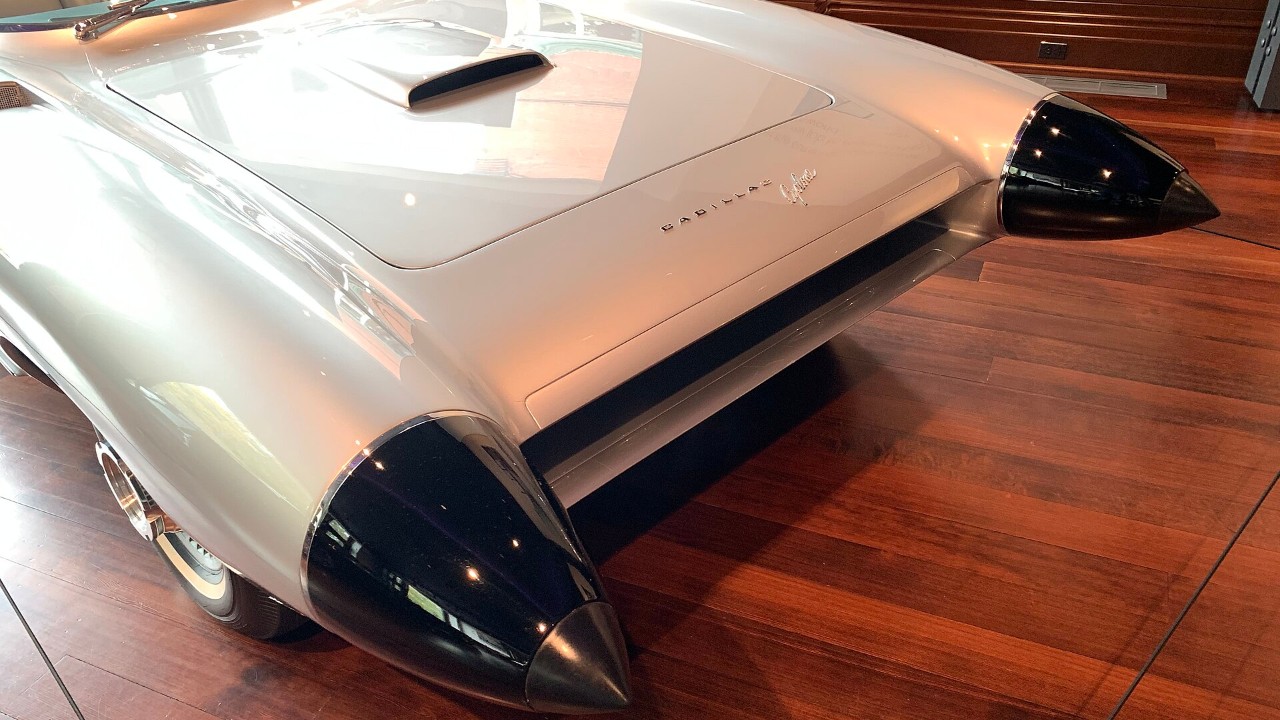
The 1959 Cadillac Cyclone carried a pair of black nose cones that Cadillac meant to sense objects ahead and warn the driver. In 1959, that was science fiction on wheels. The Cadillac Cyclone was one of the last cars Harley Earl designed, and it packed a bubble canopy, sliding doors and an intercom into a two-seat show car.
The warning system never really worked. Even so, the idea behind it reads like an early sketch of today’s forward collision warning. That makes the Cyclone one of the most forward-looking dream cars of the jet age, even if its hardware was far ahead of the electronics of its day.
Here is what Cadillac built, how the radar cones should have worked and what became of the car.
Harley Earl’s last dream car
The Cyclone was among Harley Earl’s final projects at General Motors. Model histories describe it as a testbed for futuristic styling and technology, drawn from 1950s aircraft and rocket design. According to Below the Radar, the car carried the internal code XP-74. It rode on a 104-inch wheelbase, shorter than that of the 1959 Series 62 convertible underneath it.
Earl retired before the team could finish the car. Below the Radar says Carl Renner took over the design, and Bill Mitchell, Earl’s successor, later reworked it. The Cadillac Database gives the car’s length as 197 inches and its height as just 44 inches. In other words, it was low and short by Cadillac standards.
The car made its first public appearance at Daytona Beach, Florida, on February 21, 1959. The Cadillac Database says Earl drove it there, and it adds that various malfunctions plagued the car that day. It then toured the show circuit, including the 1960 Chicago Auto Show. That rough start didn’t stop the car from becoming one of the most talked-about Cadillac dream cars, in our view, because the ideas outran the hardware.
How the Cadillac Cyclone’s radar was meant to work
The headline feature sat in the nose. Two large black nose cones, nicknamed “Dagmars,” housed the sensing units. Cadillac described them as proximity sensors. According to the period press release quoted by the Cadillac Database, they would “electronically alert the driver with both an audible signal and a warning light” when the car approached an object.
Below the Radar adds more detail. It says Cadillac designed the units to report the distance to an object ahead and the car’s stopping distance, both in feet. The Audrain Automobile Museum describes the same audible signal and warning light.
However, the system was more promise than product. Below the Radar states that the crash-avoidance system didn’t function. Meanwhile, the Cadillac Database says nobody ever tested the proximity warning in practice. So the Cyclone showed the idea of collision warning, rather than a working version of it. Still, the concept is easy to recognize today. Modern systems also measure the gap to the car ahead and warn the driver with a sound and a light. The difference is that today’s sensors are small enough to hide behind a grille or windshield, while Cadillac’s needed two big cones.
Bubble canopy, sliding doors and an intercom
The cockpit was just as ambitious. A one-piece plastic canopy covered both seats and gave a 360-degree view. Its inside carried a coating of vaporized silver to block ultraviolet rays. When the driver wanted open air, the canopy hinged at the rear and retracted under the rear deck. Model histories say it rested there on an air-bag base.
Below the Radar says a sensor in the console could detect rain and raise the top automatically. Cadillac also fitted a two-way intercom. As a result, the occupants could speak with people outside without opening the top.
The doors were equally unusual. At the press of a button, each door moved outward about three inches, the Cadillac Database says. Then it slid back along the side of the car. Below the Radar adds that the side windows couldn’t open, so small side ports let in fresh air instead. Taken together, the canopy, the doors and the intercom turned a simple two-seat roadster into a sealed capsule. In our view, that was the point. The Cyclone was meant to feel more like a cockpit than a car.
A 390 V8 in the nose, exhaust at the front
Power came from a front-mounted 390-cubic-inch Cadillac V8. Both Below the Radar and the Cadillac Database rate it at 325 horsepower. Model histories describe a rear-mounted automatic transaxle and independent suspension at all four wheels. Below the Radar, by comparison, describes a three-speed Hydra-Matic paired with a two-speed differential for six ratios in all. The two accounts differ, so we’d treat the exact gearbox as an open question.
The exhaust layout was one of the oddest details. Instead of running pipes to the rear, Cadillac put the muffler in the engine bay. The exhaust then exited just ahead of the front wheels. The Cadillac Database also lists a low-profile carburetor, a cross-flow aluminum radiator and twin fans.
Styling matched the hardware. The car first wore tall tailfins, and model histories say they carried the logo of the General Motors Air Transport Section. We looked at that era’s thinking in how the 1959 Eldorado had opinions about the future.
What became of the Cyclone
Cadillac never planned to build the Cyclone for sale. Instead, Bill Mitchell’s studio updated it after Earl left. According to the Cadillac Database, the studio cut the tall fins down to the height of the front fenders. It also says the air suspension gave way to coil springs, and the tail lights moved into new housings. Below the Radar adds that the white paint later changed to silver.
The car survived. General Motors kept it in its Heritage Collection. It has appeared at the Meadow Brook and Pebble Beach shows and at the 2013 Amelia Island Concours d’Elegance, according to the Cadillac Database.
The Audrain Automobile Museum in Newport, Rhode Island, has also displayed the Cadillac Cyclone in its “Styling the Future” exhibition.
More from Fast Lane Only