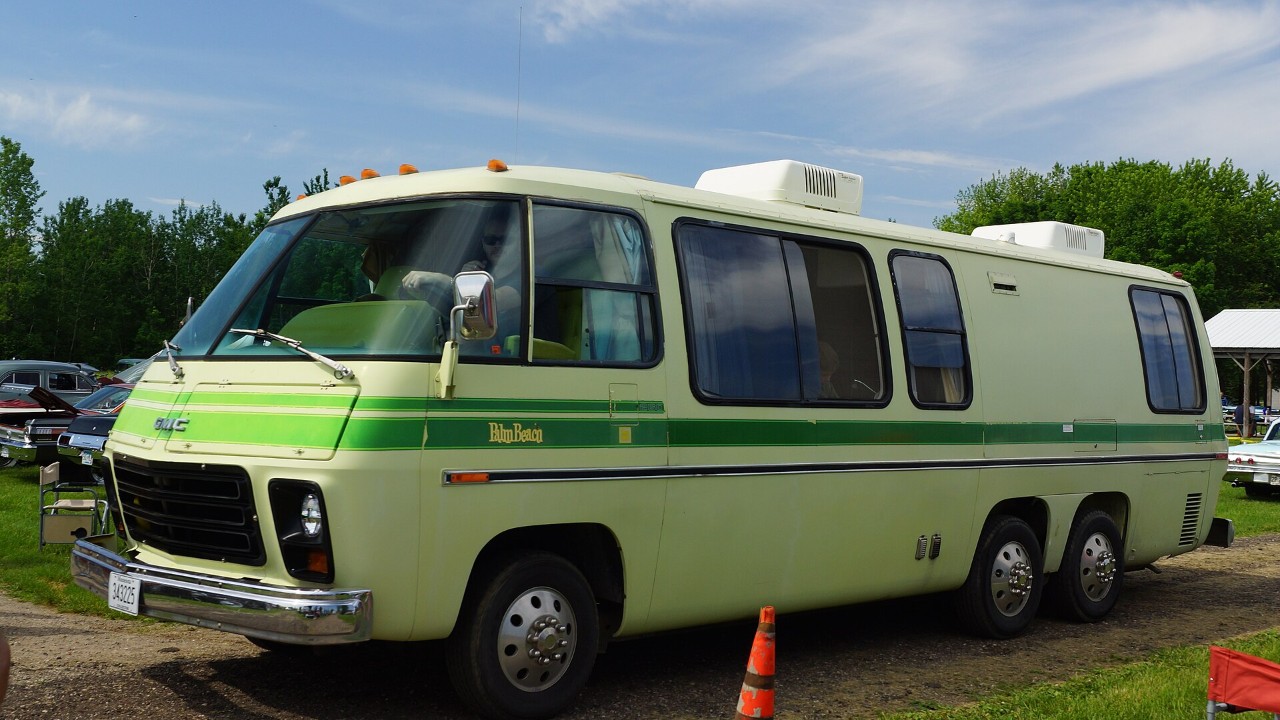
General Motors built 12,921 GMC Motorhomes from 1973 to 1978, and GMC Motorhome production never looked like anything else on an RV lot. Instead of a box on a truck frame, GM drew a low, rounded coach and drove it through the front wheels. The heart of it came straight from the Oldsmobile Toronado: a front-drive 455-cubic-inch V8.
That choice shaped everything about the coach. Because nothing had to run to the back axle, GM could drop the floor close to the road. As a result, owners stepped in without climbing stairs, and the coach ended up with an unusually low floor.
GM’s own brochure put it plainly. It promised “a motorhome that doesn’t look like a box or ride like a truck.” Here is how the company built it, how many it made each year and why so many are on the road today.
How GM built a motorhome around the Toronado’s drivetrain
GM first showed its motorhome idea at Transpo 72, a transportation show at Dulles International Airport. Then, in January 1973, the press got its first look at the production version at Anaheim Stadium in California. According to GM’s own history of the coach, Martin Caserio, then vice president and general manager of GMC Truck & Coach, announced its features.
The drivetrain did the heavy lifting. Mac’s Motor City Garage says GM took the Toronado’s whole front-drive module. That included the 455 V8, the Turbo Hydra-Matic 425 automatic and the torsion-bar front suspension. The engine sat lengthwise, with the transmission alongside it.
GM changed the engine late in the run. For 1977, the 455 gave way to a 403-cubic-inch V8. Consumer Guide says the 455 was originally rated at 250 horsepower, while the 403 made 200. Fuel economy was never the point, though. GM puts it at about 10 mpg, depending on load and roads, and Mac’s says owners reported 9 to 11 mpg.
The look came from GM’s own design studio. Mac’s credits Michael Lathers, chief of the GM Design Center, with the exterior. It also says GM President Ed Cole encouraged bright colors, and GM’s history names two of them: Parrot Green and Pineapple Yellow.
A low floor, an aluminum frame and air at the back
The GMC Motorhome rode on a conventional steel ladder frame. On top of it, GM built an aircraft-like structure of extruded aluminum, then covered it with fiberglass and aluminum panels. Because of the front-drive layout, the floor sat about 14 inches from the road, GM says. So there were no steps at the door.
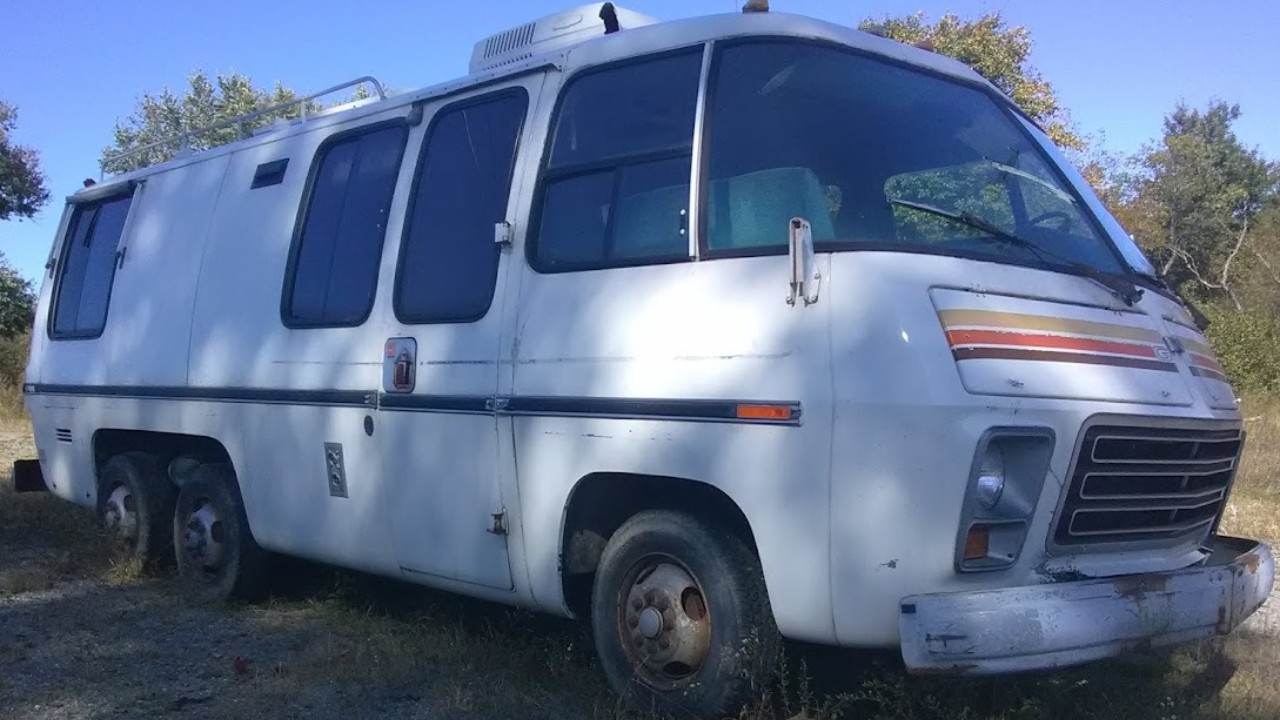
The rear end was just as unusual. The coach rode on six wheels, and the four at the back did not drive. Instead, GM paired them side by side in a tandem setup with air suspension rather than traditional shocks. Mac’s describes the rear wheels as having independent air suspension. Meanwhile, the front kept the Toronado’s torsion bars.
Buyers had two lengths to choose from. Mac’s lists a 140-inch wheelbase for the 23-foot model and 160 inches for the 26-footer. The gross vehicle weight ratings were 10,500 and 12,500 pounds. Inside, GM offered four floor plans in the shorter coach and 11 in the longer one. Some coaches even used Frigidaire appliances, because GM owned Frigidaire until 1979.
Prices started at $13,569 for the 23-foot model and $14,569 for the 26-footer in 1973. However, they climbed fast through the decade. By 1978, Consumer Guide says, the shorter coach cost $34,500 and the longer one $39,250.
GMC Motorhome production by year
Demand started strong. GMC Motorhomes International, the owners’ club, says GM introduced the coach to more than 100 journalists on January 3, 1973. By March of that year, it had over 1,750 orders. Then, by June, backorders reached 3,000, with production running near 20 coaches a day.
The club’s year-by-year table shows how the numbers moved:
- 1973: 2,059
- 1974: 1,664
- 1975: 1,656
- 1976: 3,260
- 1977: 2,403
- 1978: 1,879
The club ties the 1974 dip to the gas shortage. Then sales peaked in 1976, the best year of the run. Those six years add up to the 12,921 total that GM itself quotes. The club also counts 55 Coca-Cola GadAbout special editions, most of them built in 1977.
Why GM stopped, and why so many survive
On November 11, 1977, GMC announced that the motorhome would end. The club says the company needed the space to expand truck operations. Mac’s adds that the Pontiac, Michigan, plant went back to truck and bus assembly. It also suggests the coach may not have made money for GM. Production finally stopped in July 1978.
The fans never left, though. GM’s 2025 history quotes owner Larry Weidner, who has driven his 1978 Royale about 200,000 miles with his wife, Lucy. “It floats along like an old Cadillac,” he told GM. A Facebook group for the coaches also has more than 16,000 members, GM says. We looked at the coach’s odd backstory before in the strange story behind the GMC Motorhome, and at the car that lent it a drivetrain in our look at the 1966 Toronado.
The survival rate is the most striking number of all. GM cites registration data from one enthusiast group showing close to 9,000 GMC Motorhomes in operation as of 2023. That is about 70% of everything GM built in Pontiac half a century ago.
More from Fast Lane Only