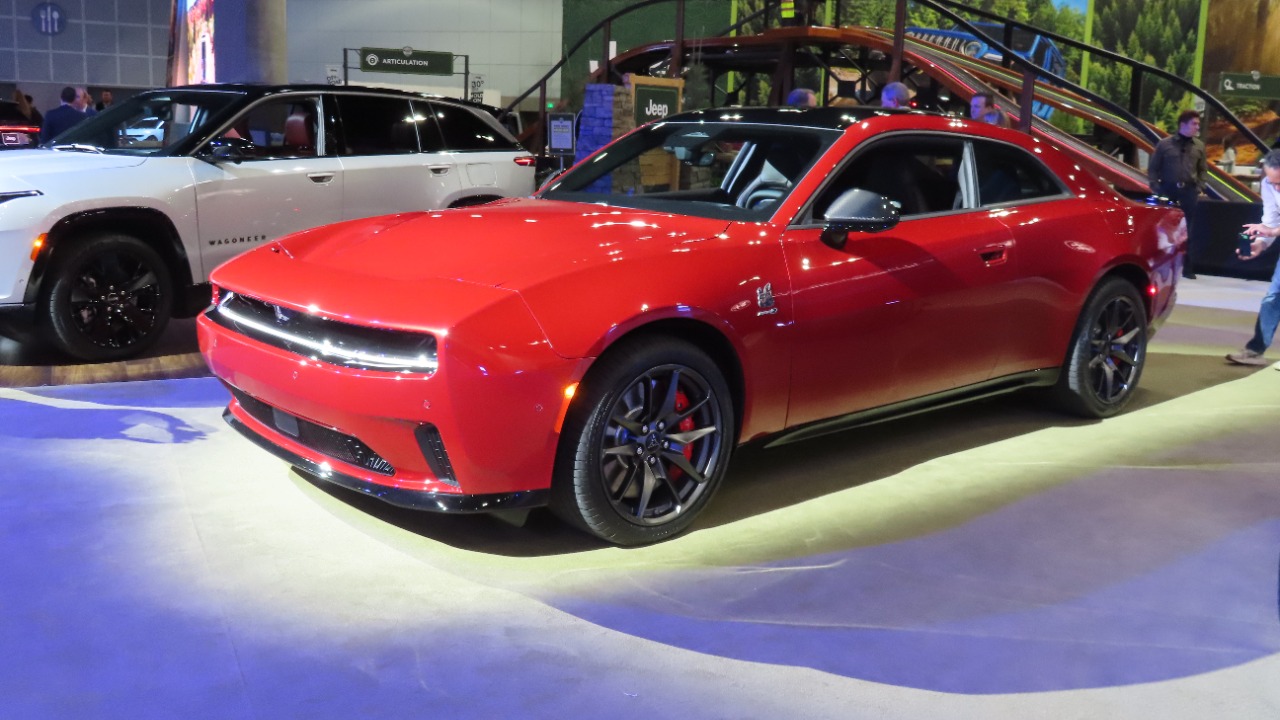
After years of declaring the internal combustion engine finished, carmakers are quietly reloading their arsenals with fresh V8 power for 2026. You now sit in a market where electric vehicles are no longer the default future but one choice among several, and the familiar eight‑cylinder soundtrack is being positioned as both a business tool and an emotional hook.
As EV demand cools and costly battery programs are scaled back, you are seeing brands revive V8s in trucks, muscle cars, luxury sedans, and SUVs, often paired with hybrid tech rather than replaced by it. The result is a powertrain reset that gives you more variety than at any point in the past decade.
Why EV optimism cracked and V8s slipped back in
You were told that pure battery power would rapidly dominate new car sales, yet by 2026 the story looks very different. Major groups such as GM, Ford, Stellantis and Honda have recorded about 50 billion dollars as ambitious volume forecasts failed to materialize and expensive factories sat underused. At the same time, Stellantis is taking a 26 billion dollar charge as it pulls back from a full EV strategy and retools at least five of its United States plants, a move that signals to you that management no longer sees a one way road to electrification.
Policy has shifted in ways that directly extend the life of gasoline power. Congress decided to eliminate California’s authority to set its own emissions rules, which had effectively forced stricter standards nationwide and accelerated EV targets. With that constraint removed, gasoline engines are, and automakers are rebalancing their powertrain mix accordingly. You benefit from that shift in the form of more internal combustion options, including V8s, returning to dealer lots.
How policy and buyer behavior opened the door for V8s
Regulation created the pressure to go all in on EVs, but the combination of softer rules and your own buying habits has created space for a different answer. Dealers are already warning you that Sales of electric in 2026 as incentives fade and early adopters are already in the fold. That leaves a large group of you who want lower running costs and cleaner tech but still prefer the familiarity of gasoline or hybrid systems.
Federal policy has also changed in ways that make it easier for automakers to keep investing in eight cylinders. Reporting on V8 engines making links the revival directly to a softer regulatory trajectory that gives engineers more flexibility on displacement as long as fleet averages stay on track through hybrids and efficiency gains. You are effectively being offered a trade: accept more electrification in daily commuters and crossovers, and you can still buy a V8 truck, sports car, or luxury model without it being priced out of reach by compliance costs.
The new V8 roster: from pickups to performance icons
If you are a truck buyer, the clearest expression of this shift shows up under the hood. Ford’s 2026 half ton lineup offers a Quick Overview of that includes multiple turbocharged V6s alongside a V8 choice, and you are told exactly which engine is best for towing, work duty, or fuel economy. RAM is going even more directly after your nostalgia, with a 2026 RAM 1500 HEMI V8 that brings back the after customer backlash against smaller turbo engines.
Performance brands are making the same calculation. Ford has already committed to keeping the V8 in The Mustang, and a senior executive went so far as to say that Ford will make, a line aimed squarely at you if you see a sports car as something that must have eight cylinders. On the European side, Mercedes and AMG are preparing a new C Class performance model with a flat plane crank V8 that revs beyond 7,000 rpm, a configuration that brings high revving back to a segment that had pivoted to four cylinder hybrids.
Hybrids, HEMIs and the Toyota playbook
Even as some brands retreat from aggressive EV plans, you are not being offered a simple rewind to the past. Instead, the most interesting V8 projects treat electrification as an enhancer rather than a replacement. Toyota is a prime example. Analysts describe how Why Toyota Is on a new V8 in 2026 even as others downsize, with Proshots Lexus LFR Prototype Spy Shots showing a twin turbo eight paired with hybrid assistance. A separate report confirms that Toyota Is Developing a New Hybrid V8 that uses twin turbochargers and an electric motor, a layout that lets you enjoy a visceral soundtrack while still cutting emissions and improving response.
American brands are following a similar path with their own spin. Coverage of Technology Maturity describes how Carmakers Pivot to Hybrids as Full EV Strategy Falters, with timelines for mass adoption pushed out toward 2034. In that context, Stellantis is not only writing down EV investments but also bringing back V8s in Chrysler, Dodge and Jeep products, a move that aligns with a dealer blog celebrating Return of the Engine in Which CDJR Models Are Bringing Back the Classic Engine at Chrysl stores. You are being offered plug in and conventional hybrids for daily duty, while V8s sit at the top of the range as aspirational choices.
What the V8 revival means for your next purchase
For you as a buyer, the immediate effect is more choice and more complexity. A detailed Every Automaker Bringing Engines In After The EV Backlash rundown shows that brands from Porsche to RAM are adding or reviving V8 options for 2026 and 2027, including models such as the Porsche Cayenne GTS Exterior Porsche and the 2026 Porsche Caye. At the same time, automakers are not abandoning smaller engines. A viral review of a 2026 Ford F 150 V6 on YouTube argues that the latest six cylinders can make you regret ever loving the V8, and the reviewer in Aug points to lower running costs and strong torque as reasons you might still choose fewer cylinders.
You also need to think about long term support and values. As EV specific plants are idled and companies like Stellantis and Ford reallocate capital, your chances of seeing continuous software and charging upgrades for first generation EVs may shrink, while parts and expertise for V8s remain in wide circulation. At the same time, investors tracking symbols such as GM and F on social platforms are watching how this pivot affects margins and residual values, which ultimately feeds back into your financing costs and lease deals. The V8 comeback is not simply about noise and nostalgia. It is a strategic reset that gives you more ways to balance emotion, practicality, and risk when you choose what to drive next.
More from Fast Lane Only