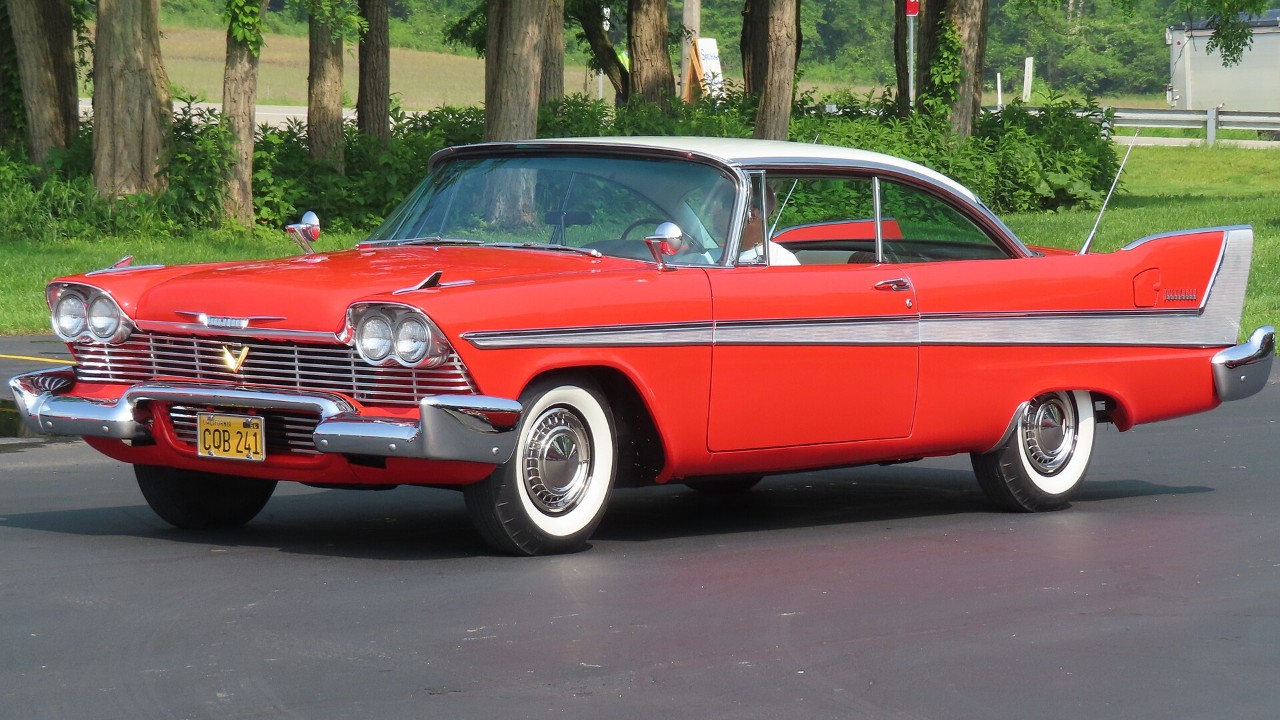
The red car in John Carpenter’s 1983 film Christine wears Plymouth Fury badges. Yet most of the cars that played her were not Furys at all. The production team bought cheaper 1957 and 1958 Belvederes and Savoys and dressed them as the star. That is how the Christine Plymouth Fury became one of the best-known cars in horror films, even though Plymouth never sold a Fury in that color.
The reason was simple supply. Plymouth built only a few thousand Furys for 1958, so gathering two dozen of them in the early 1980s would likely have been slow and costly. Its lesser siblings, on the other hand, shared the same body and sold in far bigger numbers.
So the screen car is really a composite. Here is what the genuine 1958 Fury was, why the stand-ins worked, and where the surviving film cars ended up.
What the real 1958 Plymouth Fury was
The Fury began life as a dressed-up member of the Belvedere family. Plymouth introduced it for 1956 as a sub-series of the Belvedere. It stayed that way until 1959, according to the Petersen Automotive Museum. For 1958, Plymouth offered it only as a two-door hardtop.
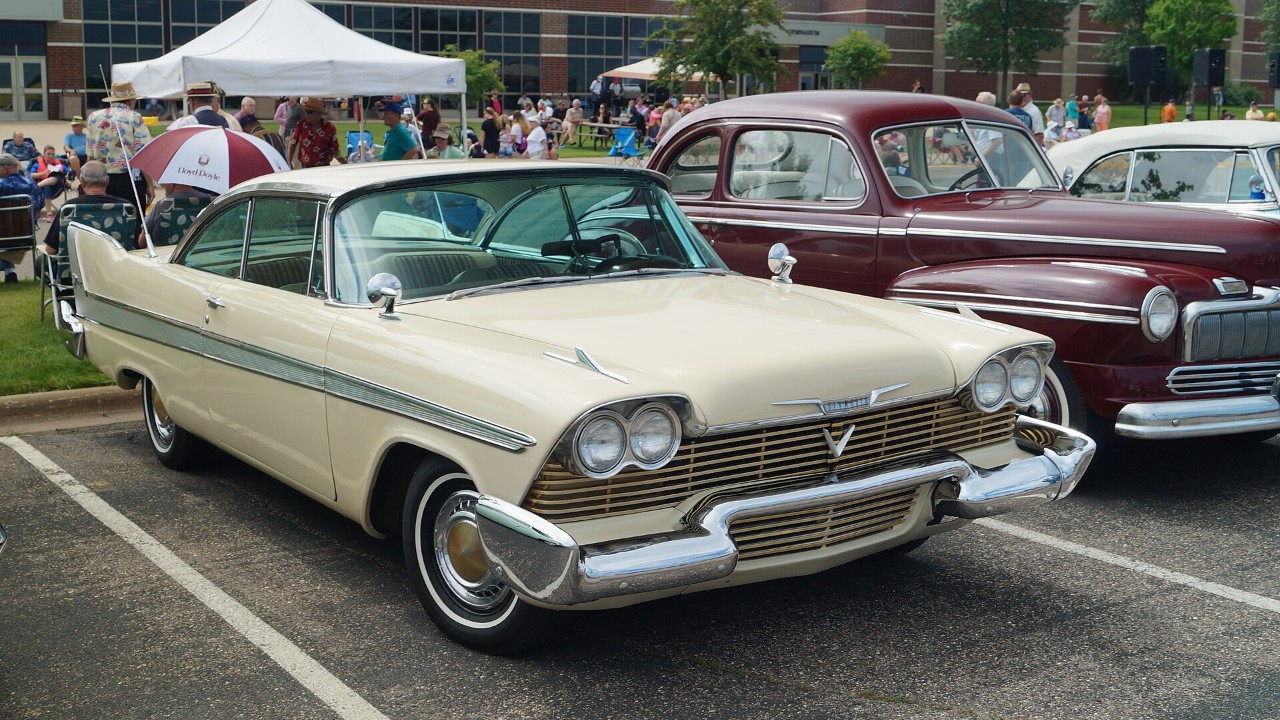
It also came in just one color scheme. Conceptcarz notes that the 1958 Fury was available only in Buckskin Beige with gold anodized aluminum trim, along with a special interior. Its production history lists 5,303 cars for 1958, down from 7,438 the year before. At a base price of $3,032 before options, it was the most expensive Plymouth of the year.
Power matched the price. The standard engine was the 318-cubic-inch “V-800 Dual Fury” V8 with two four-barrel carburetors, rated at 290 horsepower. Buyers could also order the 350-cubic-inch Golden Commando V8 at 305 horsepower, as Over-Drive’s 1958 Plymouth fact sheet lists. A fuel-injected 315-horsepower version also appeared, but Plymouth recalled it and swapped in the dual four-barrel setup instead.
Why Christine needed Belvederes and Savoys to play the Plymouth Fury
Stephen King picked the Fury on purpose. In fact, he said he wanted a “forgotten car” rather than one with its own legend, “like the ’50s Thunderbird,” Hagerty reports. His novel also painted Christine a fictional “Autumn Red,” a color no factory Fury ever wore, Jalopnik notes.
That choice created a casting problem. Columbia Pictures went looking for Furys, Belvederes and Savoys, according to Hagerty’s look back at the film. Most of the cars it found appeared on screen, while the rest became parts cars. Barrett-Jackson later put it more bluntly: the production used about 20 1958 Plymouths, mostly cheaper Belvederes and Savoys passed off as Furys.
The swap worked because the bodies matched. In 1958 the Savoy was Plymouth’s mid-priced line and the Belvedere its top full-line series, and both offered a two-door Sport Coupe hardtop. Over-Drive’s figures show 19,500 Savoy hardtops and 36,043 Belvedere hardtops that year. By comparison, that gave the filmmakers roughly ten times as many donor cars as genuine Furys.
How the film cars came together
Nobody agrees on the exact head count. Hagerty says more than 20 cars took part, with sources ranging from 23 to 28. The Petersen puts the total at 24 acquired for production. Meanwhile, Old Cars Weekly counted about 25, with 17 destroyed, six used for parts and two said to remain.
Some details show how much of the car was illusion. The famous self-repair scenes used hydraulic pumps inside a body double with plastic panels, and the crew ran the film in reverse. The engine growl did not come from a Plymouth either. Instead, Hagerty and Jalopnik both report that it came from a 1970 Mustang with a 428 Super Cobra Jet.
Even the story changed on the way to the screen. Screenwriter Bill Phillips added the opening scene on a Detroit assembly line, which is not in the book. In addition, the movie went into production before King’s novel reached stores, Hagerty notes.
Where the surviving Christines went
A handful of cars outlived the shoot. One of only two stunt cars in running condition was due for the crusher after the film came out. Martin Sanchez saved it and rebuilt it with parts from the other Christines. Today the Petersen lists it with a 5.2-liter, 290-horsepower V8.
Another car took a stranger route. After the film, USA Network’s “Night Flight” raffled a hero car on New Year’s Eve, and roughly 40,000 people entered, Old Cars Weekly reported. Scott Edminster of New London, Wisconsin, won it. Later the car joined Ron Pratte’s collection and crossed the block as Lot 2006 at Barrett-Jackson’s 2015 Scottsdale sale. Hagerty says a movie car sold there for $198,000.
That same car returned to auction at Mecum’s Kissimmee sale on January 10, 2020, with a pre-sale estimate of $400,000 to $500,000. Its restoration includes a small-block Wedge V8 on dual four-barrels and a push-button TorqueFlite. However, SlashGear reports that the car did not sell that day.
For buyers who just want the real thing, the regular Fury is a more reachable goal. Hagerty’s valuation tool gave an average of $47,700 for a 1958 Fury in excellent condition when its article ran. If you want more of the Fury’s own backstory, start with our look at how the 1958 Fury carried attitude long before Hollywood. Our story on the eggshell-white 1956 Fury covers the car that started the line.
The stunt car Sanchez saved from the crusher now carries the credit line “Collection of Martin C. Sanchez” on the Petersen’s own records.
More from Fast Lane Only