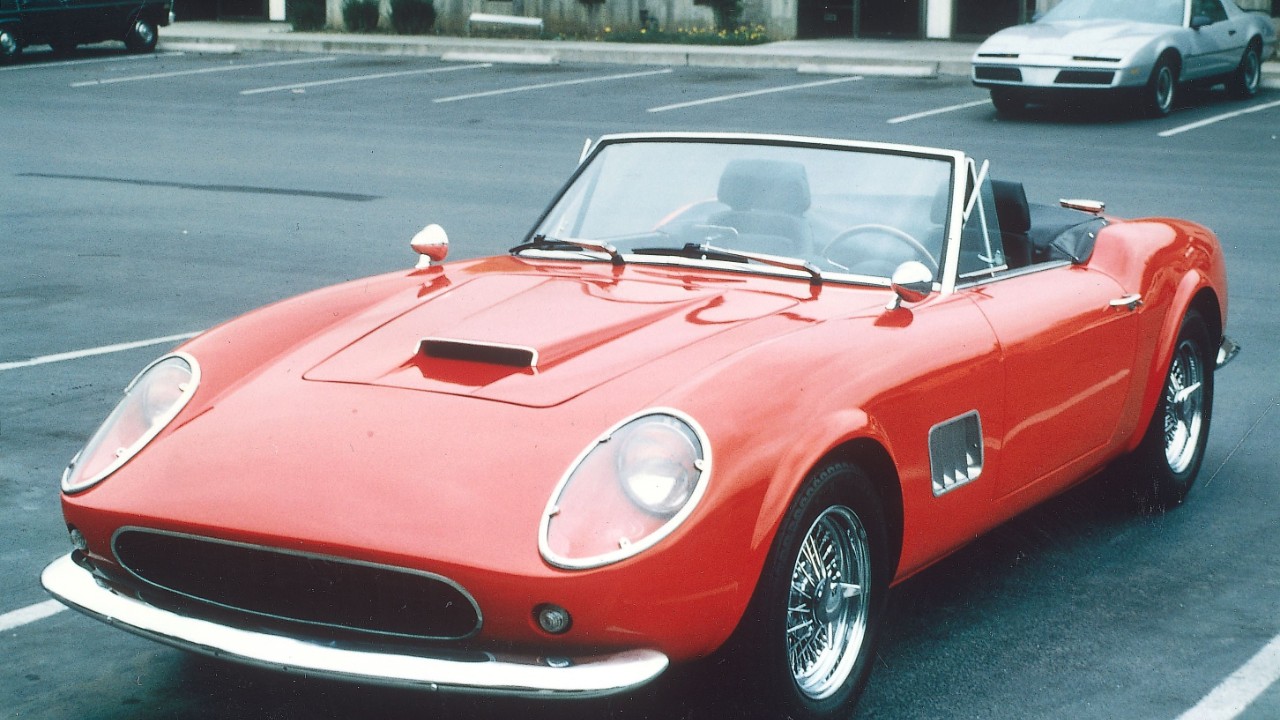
The Ferris Bueller Ferrari that flies out of Cameron’s garage was never a Ferrari at all. John Hughes cast a 1961 Ferrari 250 GT California Spyder as the car Cameron’s father loves more than anything. Then he filled most of the shoot with fiberglass copies built in a small California shop.
In fact, the real thing showed up only when the camera got close. That split between real and replica is why a kit car from 1985 now has its own place in American automotive history.
The story starts with money. A genuine California Spyder cost far more than a comedy could risk on a stunt. So Hughes went looking for something that only had to look the part.
Why Hughes needed a fake Ferris Bueller Ferrari
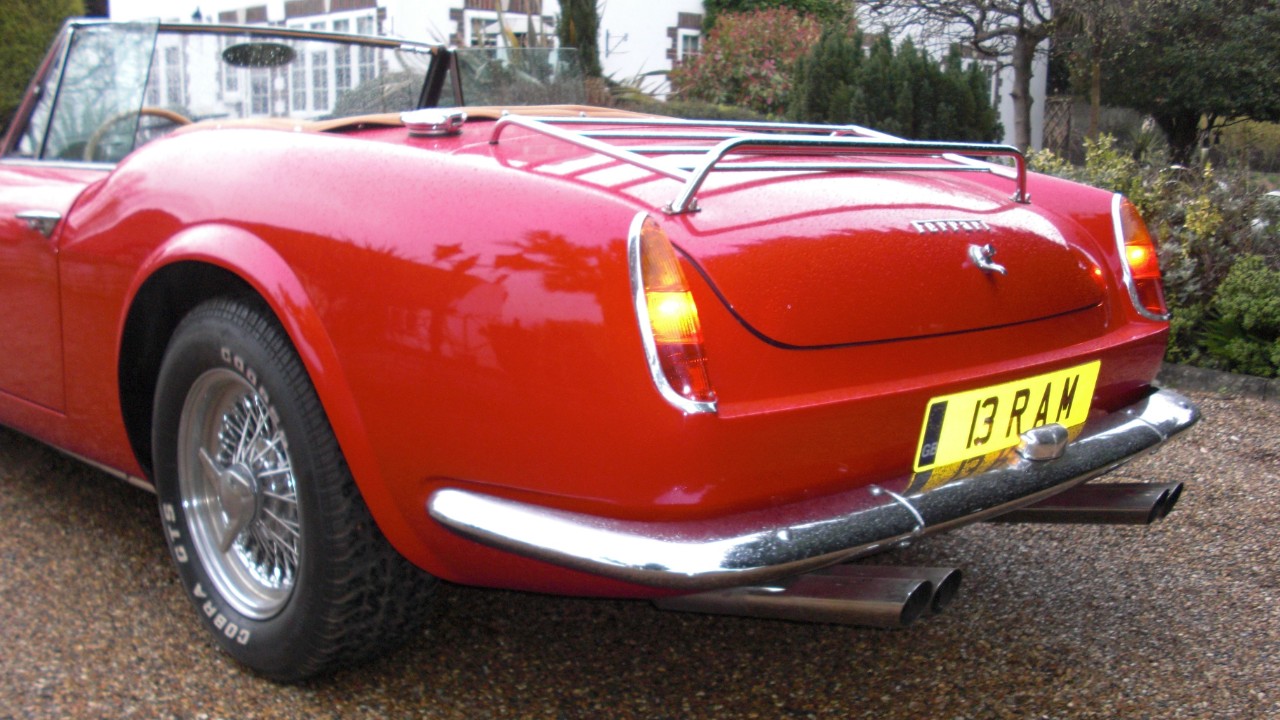
According to Hagerty’s history of the film car, the script first gave the role to a Mercedes. Hughes swapped it for a Ferrari because a Mercedes “just wasn’t priceless enough.” However, a real Cal Spider was out of reach on a film budget Hagerty puts at $5.8 million.
Hughes then read a magazine write-up about a replica and called the builder. Hagerty reports that Neil Glassmoyer hung up on him twice, sure the call was a prank. Eventually the director got through, and the deal was on.
The builder was Modena Design & Development of El Cajon, California. According to The Henry Ford museum, Glassmoyer and Mark Goyette founded the firm in the early 1980s.
What was under the fiberglass
The Henry Ford says Hughes commissioned three replicas. Two ran and drove for most scenes. The third was a non-runner, built for the moment the car flies out the back of Mr. Frye’s suburban Chicago garage.
Paramount leased one car and bought the other two, the museum says. Hagerty adds that the studio ordered two of the $35,000 cars, plus a third that the crew assembled during filming.
Underneath, the cars had nothing in common with Maranello. A steel-tube frame carried a fiberglass body. Hagerty credits the frame design to Bob Webb, who had done the same job on Penske Racing’s Zerex Specials. Power came from a 302-cubic-inch Ford V8 out of a 1974 Ford Torino. The Henry Ford says that engine was rated at 135 horsepower from the factory, and it drove through a Ford three-speed automatic.
The parts bin was just as mixed. Hagerty lists Fiat 124 windshields and inside door handles, Volkswagen Type 3 taillights, an MGB front bumper and trunk lid, a Karmann Ghia rear bumper, Chrysler front suspension and VW rear suspension. Still, Car and Driver tested one in March 1986 and weighed it at 2,580 pounds. The magazine called it “a good chassis and a competent suspension,” Hagerty reports.
The real 250 GT California behind the close-ups
Hagerty says a real Cal Spider was used for detail shots. A later report on the Barrett-Jackson sale of one replica also says a real 250 GT handled the film’s close-ups. Even so, the replica’s cockpit gave the game away to sharp-eyed fans. Hagerty notes that the gauge close-ups show Smiths instruments rather than the Veglia gauges a real car wore.
The genuine article was a very different machine. RM Sotheby’s catalog for a 1961 example lists a 2,953 cc Colombo V12 rated at 226 bhp and a 2,400 mm wheelbase. The same catalog says Ferrari built a grand total of 56 short-wheelbase California Spiders.
Prices explain why Hughes wanted a stand-in. Hagerty says real Cal Spiders climbed from under $50,000 to $250,000 in the early 1980s. Later, values passed $2.5 million, and Hagerty gives the current auction record as $18 million.
A lawsuit, a long life and a museum-grade record
Ferrari objected to the copies. The Henry Ford says the company sued after the film came out, and the case settled out of court when Modena agreed to minor changes.
Meanwhile, the surviving replicas kept working. According to the museum, the leased car went back to El Cajon after the shoot. There, Modena repaired it from a stunt scene and sold it to the first of several private owners. By 2003 it had moved to the United Kingdom.
Hagerty says that hero car served as a couple’s daily driver for years and logged 250,000 miles on its Torino V8. In 2010, Bonhams sold it for $108,251, and Hagerty names the buyer as Bob Winegard. He brought it home and restored it to its on-screen look.
The other running car took its own route. Hagerty reports that Glassmoyer restored the stunt car, upgraded its engine and sold it at Mecum Monterey in 2013 for $230,000. Later still, one of the Modena cars crossed the block at Barrett-Jackson’s Scottsdale sale in January 2020 and brought $396,000, according to a report on that auction. For more on the genuine article, see our look at Ferrari’s California Spyder.
Where the Ferris Bueller car lives in history
The Ferris Bueller car also earned a place few real Ferraris have. The Hagerty Drivers Foundation lists a 1985 Modena Spyder from the film on its National Historic Vehicle Register. Hagerty says that car was later shown on the National Mall in a glass box. As a result, a fiberglass copy with a Torino V8 now sits on the same register as cars that changed American history.
That is a fitting end for a fake. The real 1961 Ferrari 250 GT California Spyder made the close-ups, but Modena replicas did the driving. That leased Ferris Bueller Ferrari went on to cover 250,000 miles before Bonhams sold it for $108,251 in 2010.
More from Fast Lane Only