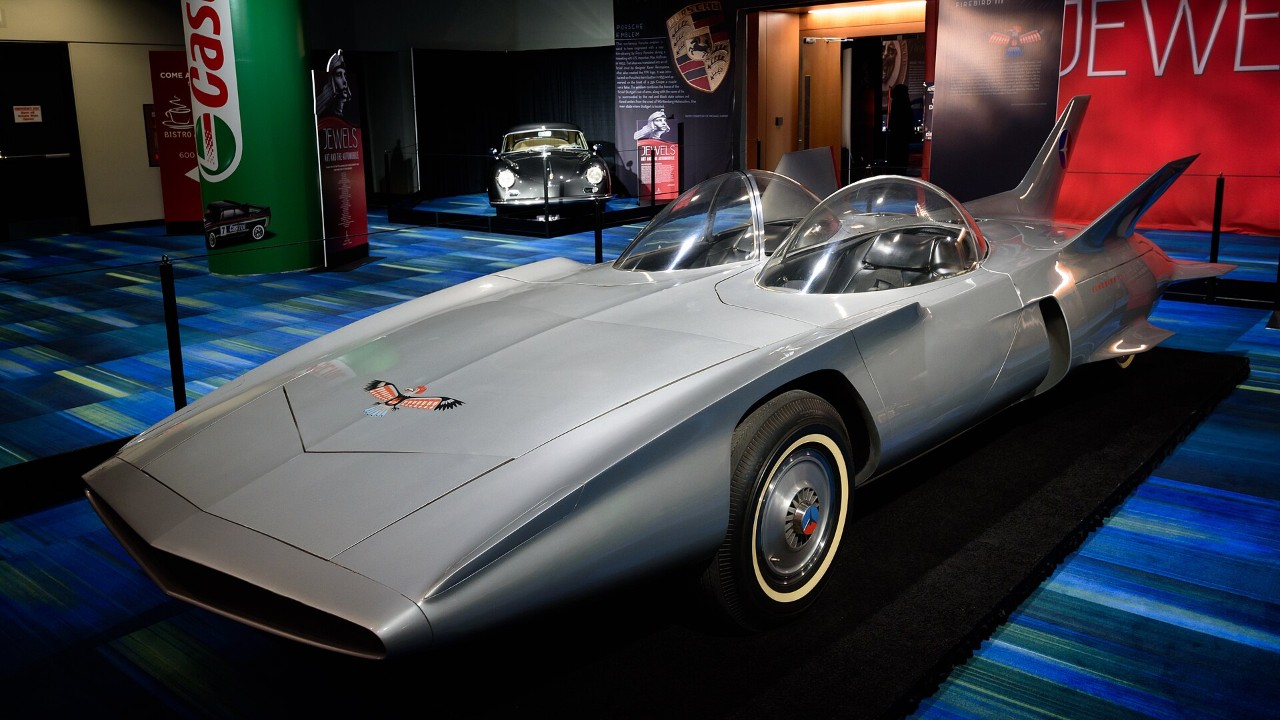
In January 1953, more than 45,000 people turned up on opening day of GM’s Motorama at New York’s Waldorf Astoria. They came to see dream cars, and over the next few years GM gave them jet fins, bubble tops and a titanium General Motors Firebird. Chrysler and Ford answered with show cars of their own, many of them hand-built in Italy.
None of these machines went on sale in the form shown on this list. Most were one-offs or tiny runs, built to test ideas and pull crowds. Yet several of those ideas, from wraparound glass to disc brakes and cruise control, ended up in the cars people actually bought.
These are our picks, 11 chrome-era show cars and concepts we think looked like the future. The judgment is ours. The engines, dimensions, build counts and sale results behind each one, however, come from museum records, auction catalogs and design histories.
1. 1954 Buick Wildcat II
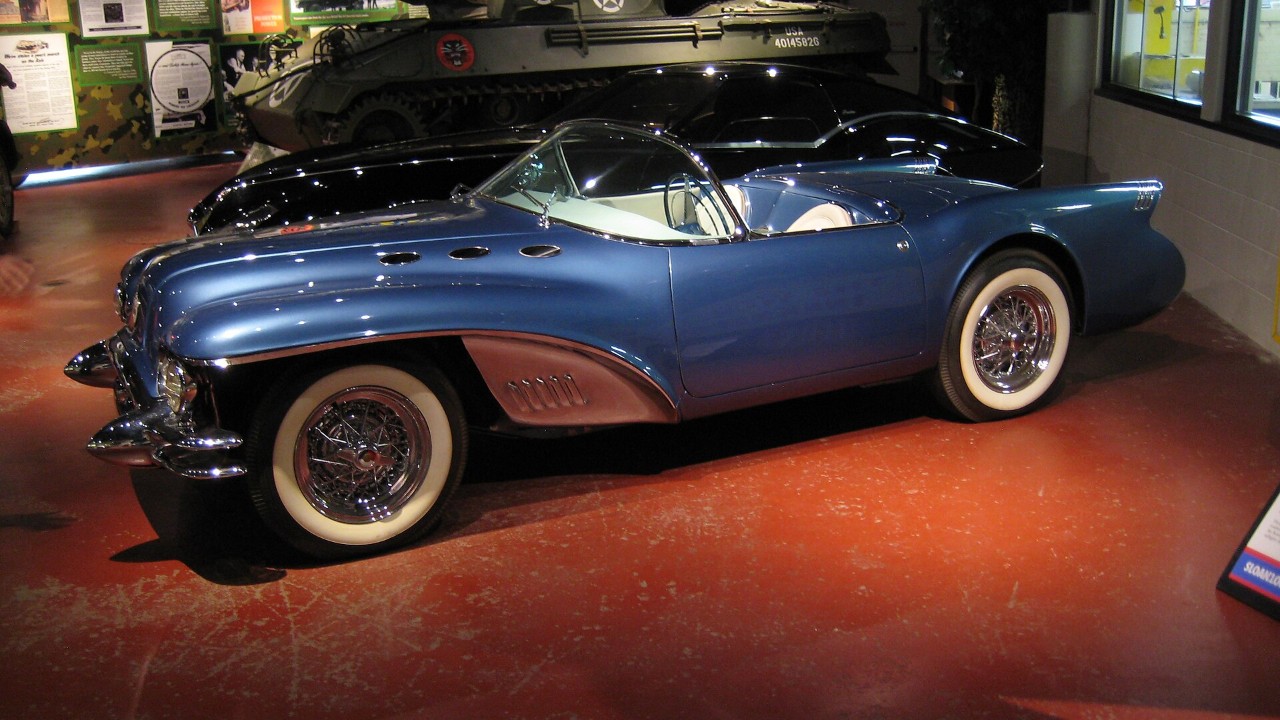
Buick stylist Ned Nickels shaped the Wildcat II under Harley Earl for the 1954 Motorama. It was a two-seat roadster with a fiberglass body on a 100-inch chassis, and it had no provision for a top. The front fenders were deeply scalloped, and the whole upper nose hinged forward like a clamshell for engine access.
Power came from a 322-cubic-inch V8 rated at 220 hp, 20 more than the production engine. According to Mac’s Motor City Garage, it breathed through four Carter sidedraft carburetors on a log manifold and drove through a Dynaflow automatic. The original front wheel covers didn’t spin, either. They stayed still and doubled as brake scoops.
The headlights first sat on the cowl beside the windshield, although Buick later added conventional lamps in the fenders. After its show career, the car retired to the Sloan Museum in Flint, Michigan.
In our view, the Wildcat II is the most aggressive Buick of its decade. It looks like a sports racer, even though it came from a brand known for comfortable sedans. That contrast is exactly why it still turns heads in photos today.
2. 1959 Cadillac Cyclone
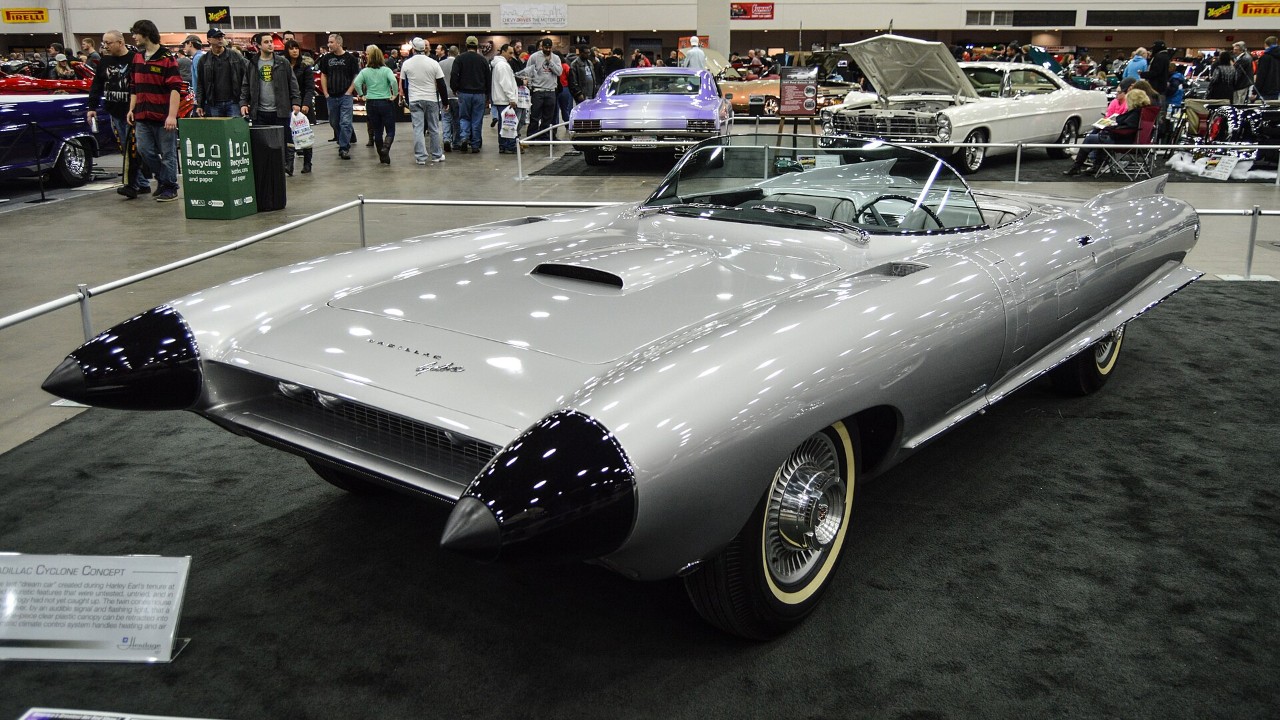
The Cyclone was one of the last cars Harley Earl designed before he retired. Cadillac built it in 1959, and it never reached production. Its biggest idea sat in the two black cones on the nose, which housed a radar system meant to warn the driver of objects ahead.
The rest of the car was just as bold. A silver-coated bubble canopy opened automatically with the doors, and it could fold away into the rear compartment. The doors themselves slid open electrically. Underneath, a front-mounted 390-cubic-inch V8 drove a rear-mounted automatic transaxle.
Radar collision warning took decades to become a showroom feature, so the Cyclone was very early. Meanwhile, the car itself survived and remains part of GM’s Heritage Collection. We told the full story in how the Cyclone carried radar in its twin nose cones.
Our take: the Cyclone is the clearest example of a 1950s designer guessing right. The rocket styling dates it, yet the safety idea underneath looks modern. Few concepts aged so unevenly, and that makes it fascinating to study.
3. 1954 Dodge Firearrow IV
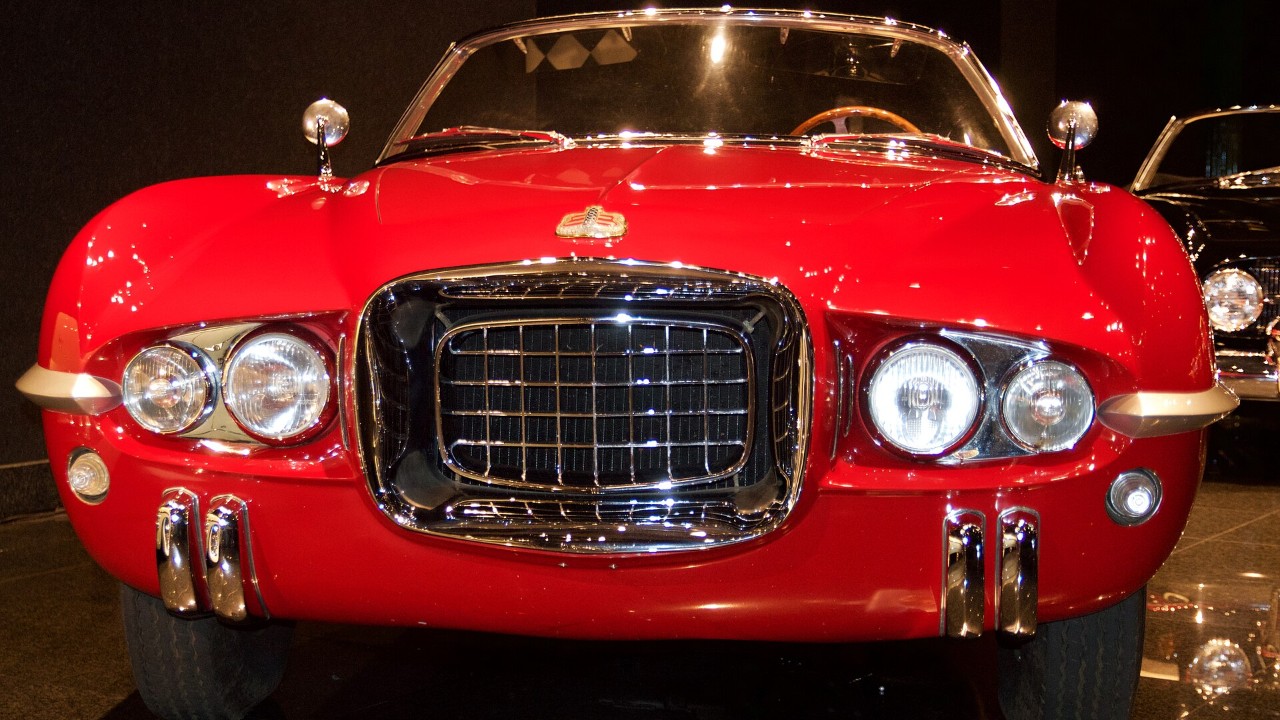
Virgil Exner designed the Firearrow series, and Ghia hand-built the cars in Turin, Italy. There were four. The first was a full-scale mockup, the second a running car, and the third a sport coupe. Then the Firearrow IV went further, as a usable convertible with a folding top and roll-up windows.
According to the Blackhawk Collection, it sat on a stock 119-inch Dodge chassis. Power came from a 241-cubic-inch Red Ram Hemi rated at 150 hp at 4,400 rpm, paired with Dodge’s Gyro-Torque four-speed semi-automatic. The collection describes it as fully designed and engineered for production.
Dodge showed the car at many major U.S. auto shows during 1954. In the end, however, Chrysler decided not to build it. Later, two Firearrow convertibles sold at no reserve at Barrett-Jackson in January 2007, according to Supercars.net.
In our opinion, the Firearrow IV is the most realistic car on this list. It wasn’t a fantasy with a fake engine. It was a running Hemi convertible with an Italian body, and Dodge could have sold it. That near miss gives it a special pull for Mopar fans.
4. 1956 General Motors Firebird II
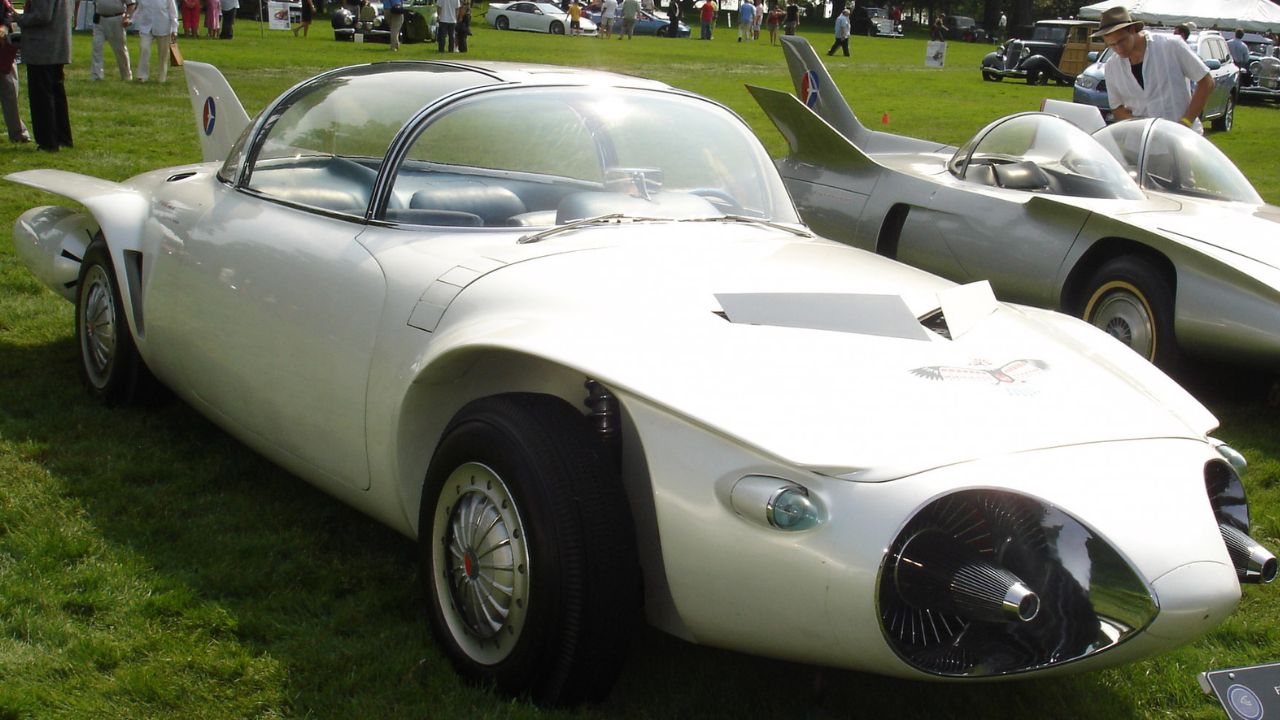
GM’s first Firebird appeared at the 1953 Motorama. For 1956, Harley Earl’s team turned the idea into a four-seat family car. Its body was made entirely of titanium, with two big air intakes up front, a tall bubble canopy and a vertical tail fin.
Under the skin, the Firebird II used a GT-304 gas turbine rated at 200 hp. It was GM’s first turbine with a regenerator, a device that recycled exhaust heat to cut fuel use. The car was also GM’s first with disc brakes at all four wheels and fully independent suspension. On top of that, it carried a guidance system meant for an automated highway of the future, although it never worked.
GM showed the car at the 1956 Motorama. Afterward, the company preserved it, and it now belongs to the GM Heritage Center in Sterling Heights, Michigan. Models of the Firebirds also sit in the permanent collection of the Henry Ford Museum in Dearborn.
Our take: the Firebird II is the General Motors Firebird that feels most like a real proposal. It had room for a family, and several of its parts, from disc brakes to independent suspension, became normal later. The turbine never did, but the rest of the car was a strong glimpse ahead.
5. 1958 General Motors Firebird III

GM built the Firebird III around a new Whirlfire GT-305 turbine in 1958, and it debuted at the 1959 Motorama. The engine made 225 hp. A separate two-cylinder gasoline engine of about 10 hp ran the accessories, so the turbine didn’t have to.
Its fiberglass body wore seven short wings and tail fins, plus a double-bubble canopy for its two seats. Instead of a steering wheel, the driver used a joystick between the seats. The feature list also included cruise control, anti-lock brakes, air conditioning and air drag brakes, along with another automated guidance system.
Several of those items are ordinary equipment today. However, in 1959, they read like science fiction. GM kept this car as well, and it sits with the Firebird II at the GM Heritage Center.
In our view, the Firebird III is the wildest-looking car Harley Earl’s studio ever finished. Still, the gadgets matter more than the fins. Cruise control and anti-lock brakes on a 1950s show car make it one of the best predictions of its era.
6. 1955 Ghia Streamline X Gilda
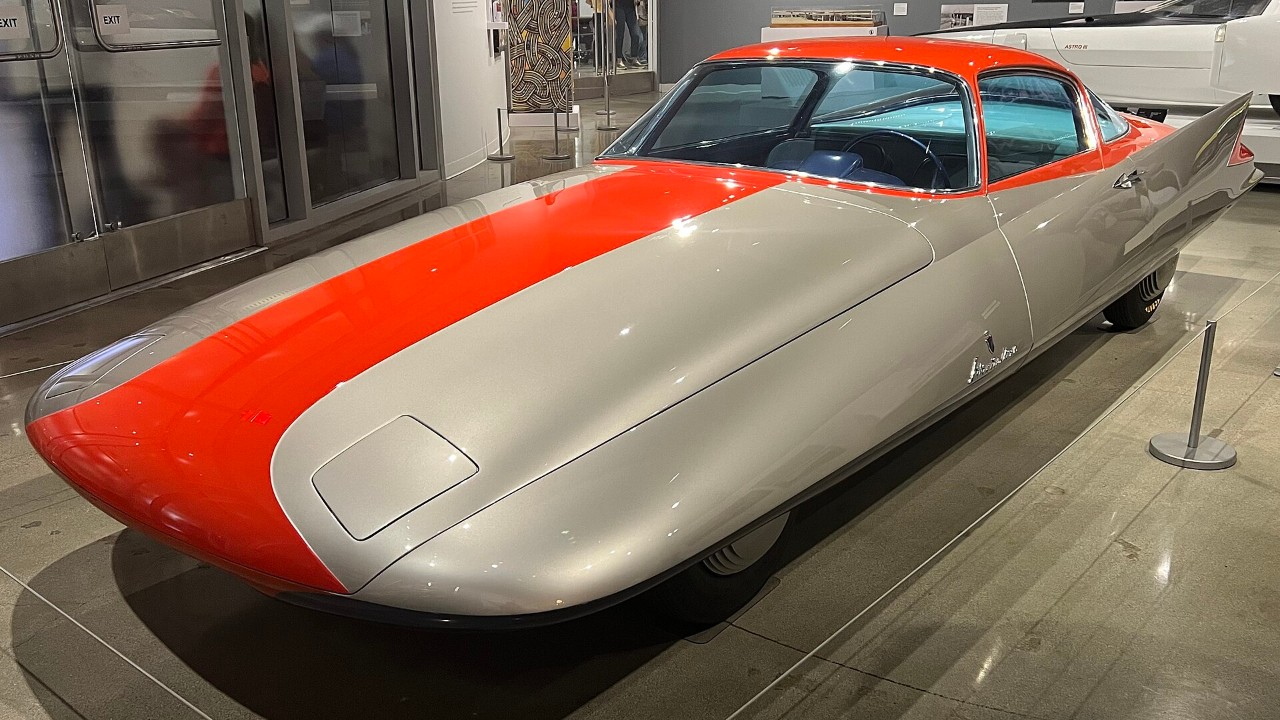
Ghia’s chief designer, Giovanni Savonuzzi, drew the Streamline X after Chrysler’s Virgil Exner asked for a wedge-shaped coupe. Ghia built it as a one-off, fully trimmed show car for the 1955 Turin Auto Show. Its nickname came from the 1946 film noir Gilda. Despite its show-only role, Ghia finished it with a complete interior, so it could stand up to close inspection on the stand.
Oddly, the Gilda had no engine when it was new. Instead, it was built to take a gas turbine. According to the Petersen Automotive Museum, a turbine has since been installed, with an estimated 70 hp and an estimated top speed of 160 mph. The museum also credits the car’s aerodynamic shape with influencing Chrysler’s Forward Look styling.
Today, the Gilda sits in a private collection, and the Petersen has shown it in its “Eyes on the Road” exhibit.
Our take: the Gilda looks less like a car than a wind-tunnel model, and that’s the point. Its fins and long tail made the case that airflow could shape a body. Then Chrysler’s late-1950s cars carried a softer version of that idea onto American roads.
7. 1960 Plymouth XNR
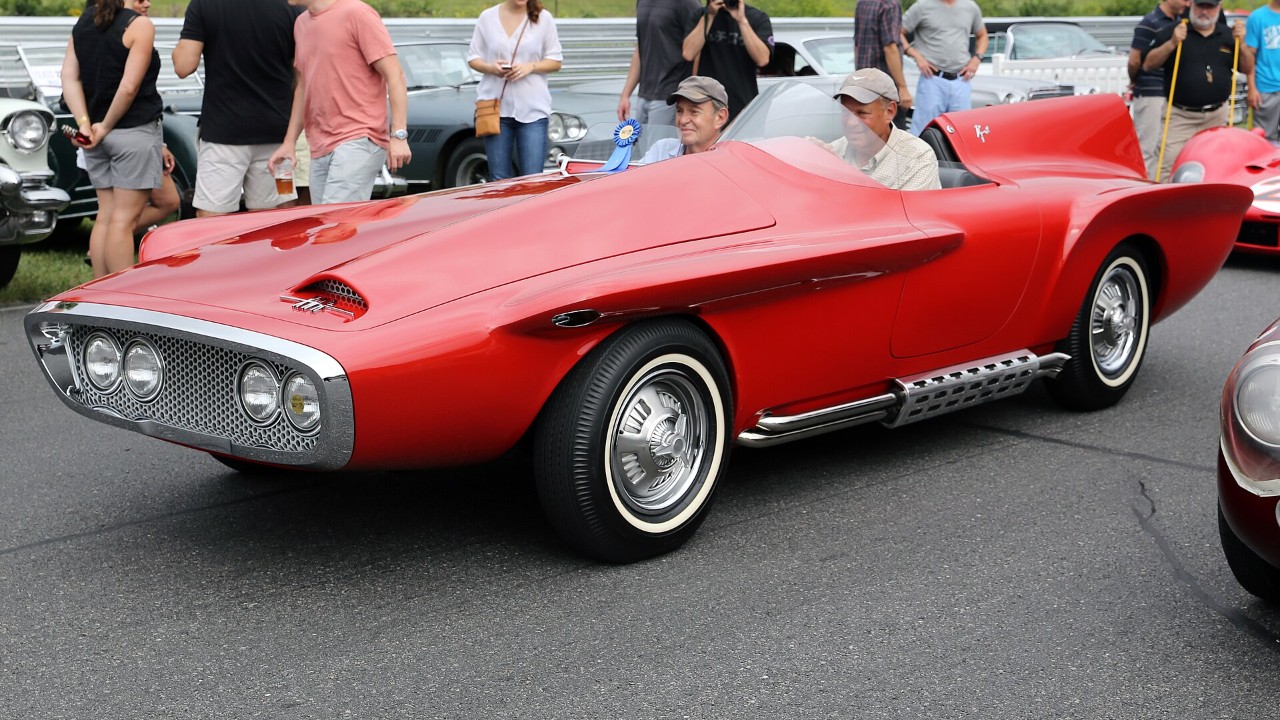
Virgil Exner put his own name in the title: XNR. Ghia built the open roadster, and it first appeared at the 1960 New York Auto Show. Its body was deliberately lopsided. An offset hood scoop ran along the driver’s side, then rose behind the driver into a tall fin, while the passenger sat four inches lower.
Power came from a 170-cubic-inch Slant Six with the Hyper Pak package, and its often-quoted output is 250 hp. As built, the XNR reportedly reached 146 mph. Afterward, its life got strange. It passed to a Swiss buyer, then to the Shah of Iran, then to a car dealer in Kuwait, and later to Lebanon, where it was hidden during the civil war.
RM Restorations finished a full restoration in 2011, and the car won the Gran Turismo Trophy at Pebble Beach that August. Then, in 2012, RM Sotheby’s sold it for $935,000 at Monterey.
In our opinion, the XNR shows how far Exner would push a show car. Asymmetry still looks radical today, more than 60 years later. Add its globe-trotting history, and it might be the best story on this list.
8. 1953 Cadillac Le Mans concept
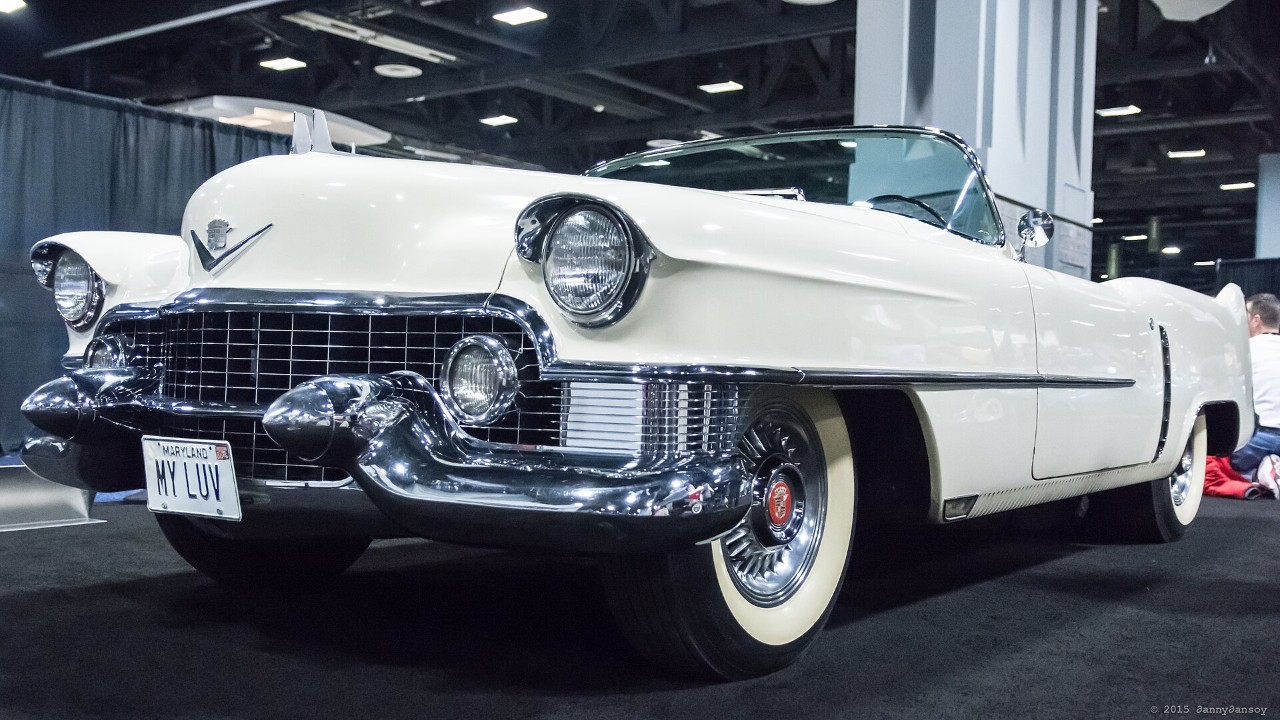
Cadillac unveiled the Le Mans at the January 1953 Motorama, and it built four of them. Each wore a lightweight fiberglass body on a 1953 Cadillac chassis shortened from 126 to 115 inches. The car stood just 51 inches tall at the windshield pillar.
That windshield was the headline. According to Mac’s Motor City Garage, the wraparound glass was a new wrinkle in 1953. Power came from Cadillac’s 331-cubic-inch V8, tuned from 220 to 250 hp and paired with a four-speed Hydra-Matic.
The four cars scattered. One went to George Barris for gold-plated trim and was reportedly destroyed in a fire in 1985. Another apparently disappeared. Meanwhile, one returned to Cadillac around 1959, received a 390 Eldorado engine, and now lives in GM’s Heritage Collection.
Our take: the Le Mans was a luxury sports car before America had a word for it. Its wraparound windshield previewed an idea that Detroit soon embraced, so this concept had real influence. That’s a better record than most dream cars can claim.
9. 1954 Mercury XM-800
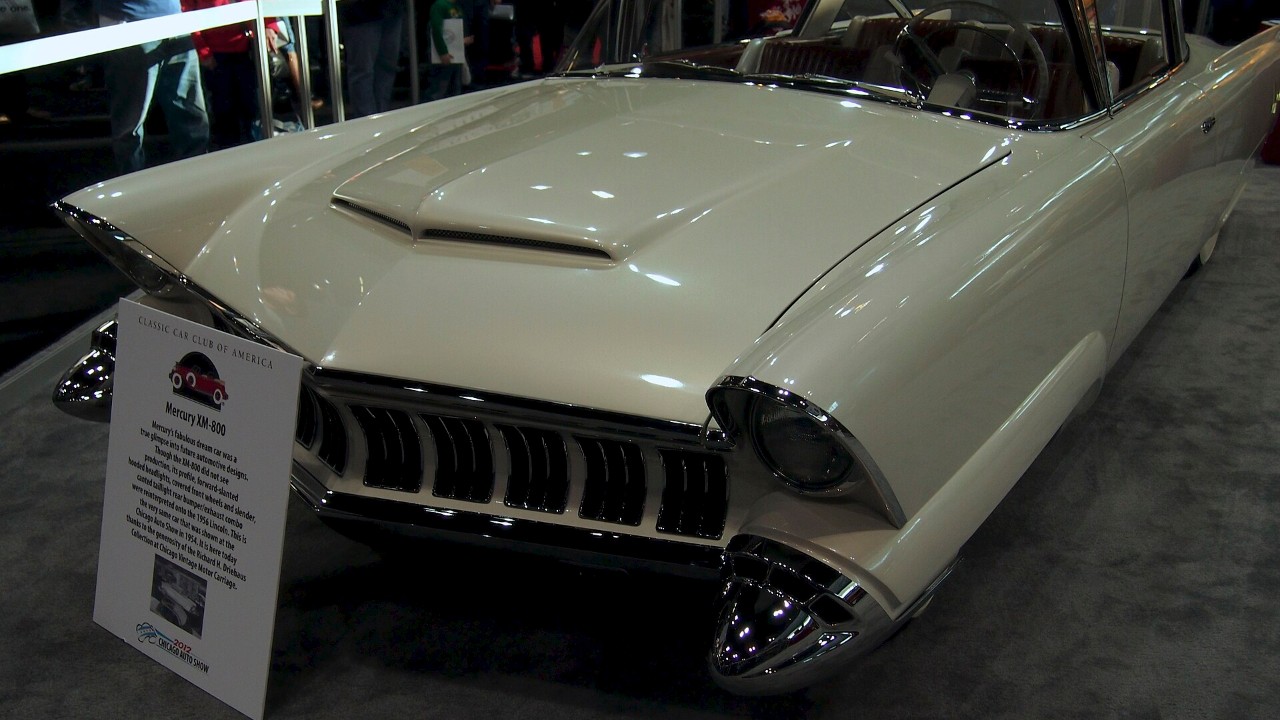
Ford promoted the XM-800 as an advanced design engineered for volume production. Designer John Najjar shaped it, and Creative Industries of Detroit built it on a modified Mercury frame. Its body was fiberglass, and even some of the trim was chrome-plated fiberglass.
The Henry Ford notes its low 55.6-inch height, hooded headlights and exhaust ports built into the rear bumper. Inside, it had four bucket seats. Although a 312-cubic-inch Mercury V8 sat under the hood, the car was only a push car at its 1954 debut. It didn’t drive under its own power until a restoration in 2009. The Henry Ford also confirms that the car never made it into production.
Its styling cues later showed up on the Lincoln Premiere and Capri, the Mercury Montclair and the Ford Crown Victoria. In 1957, Ford donated the car to the University of Michigan’s engineering lab. Much later, in 2010, it sold at auction for $429,000.
In our view, the XM-800 is the most practical-looking car here. It had four seats and a roof, and it looked ready for a dealer’s floor. That’s why so much of it reached the street on other cars.
10. 1954 Pontiac Bonneville Special
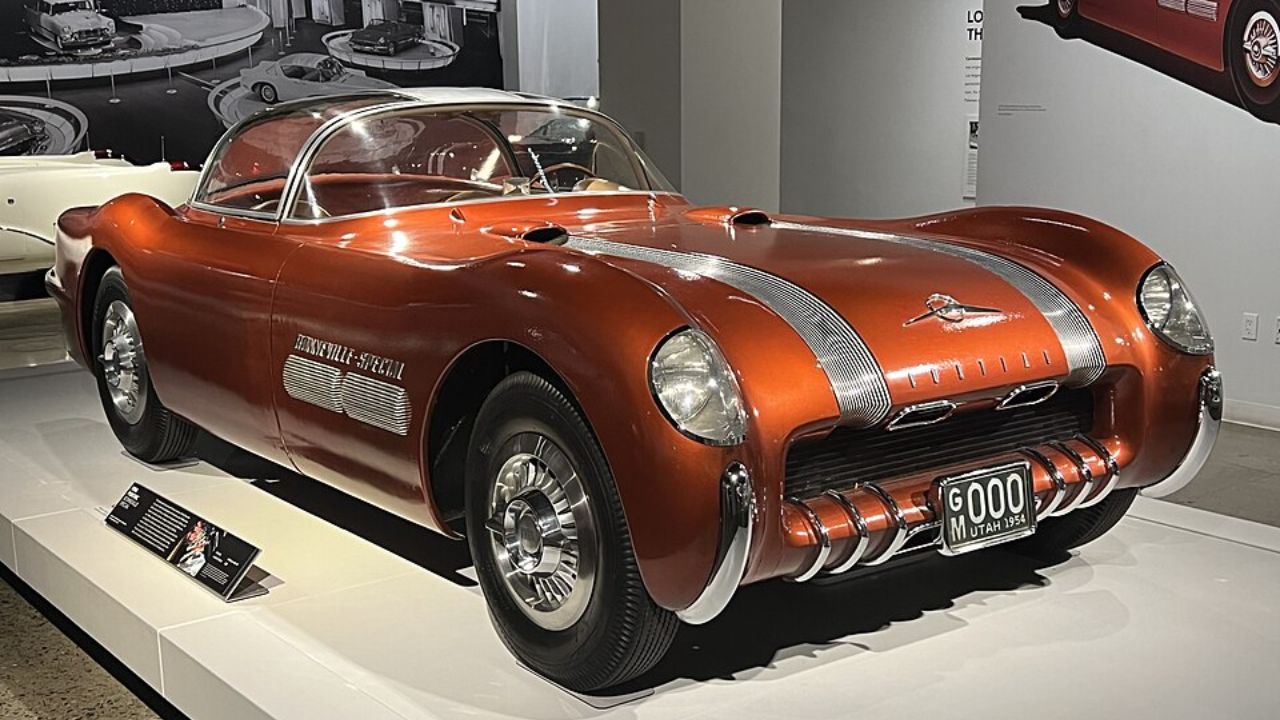
Pontiac built two Bonneville Specials for the 1954 Motorama, one in metallic bronze and one in emerald green. Harley Earl conceived them, and Homer LaGassey and Paul Gillan did the design work. Each had a fiberglass two-seat body under a Plexiglas bubble top with gull-wing side windows.
Pontiac had planned a V8, but the car used the brand’s straight-eight instead. According to Old Cars Weekly, four sidedraft carburetors, a long-duration cam and other changes lifted it from 122 hp to a claimed 230 hp. The bronze car measures 158.3 inches long and only 48.5 inches tall.
After the show circuit, the Detroit Historical Society held one car from 1958 to 1985. Collector Joe Bortz then bought it. It remains unrestored, showing 474.2 miles, and it has been displayed at the Petersen Automotive Museum.
Our take: the Bonneville Special put a bubble canopy on a Pontiac, and that alone makes it unforgettable. Because the bronze car was never restored, it also shows exactly how a 1954 show car was finished, down to its original paint.
11. 1952 Chrysler D’Elegance
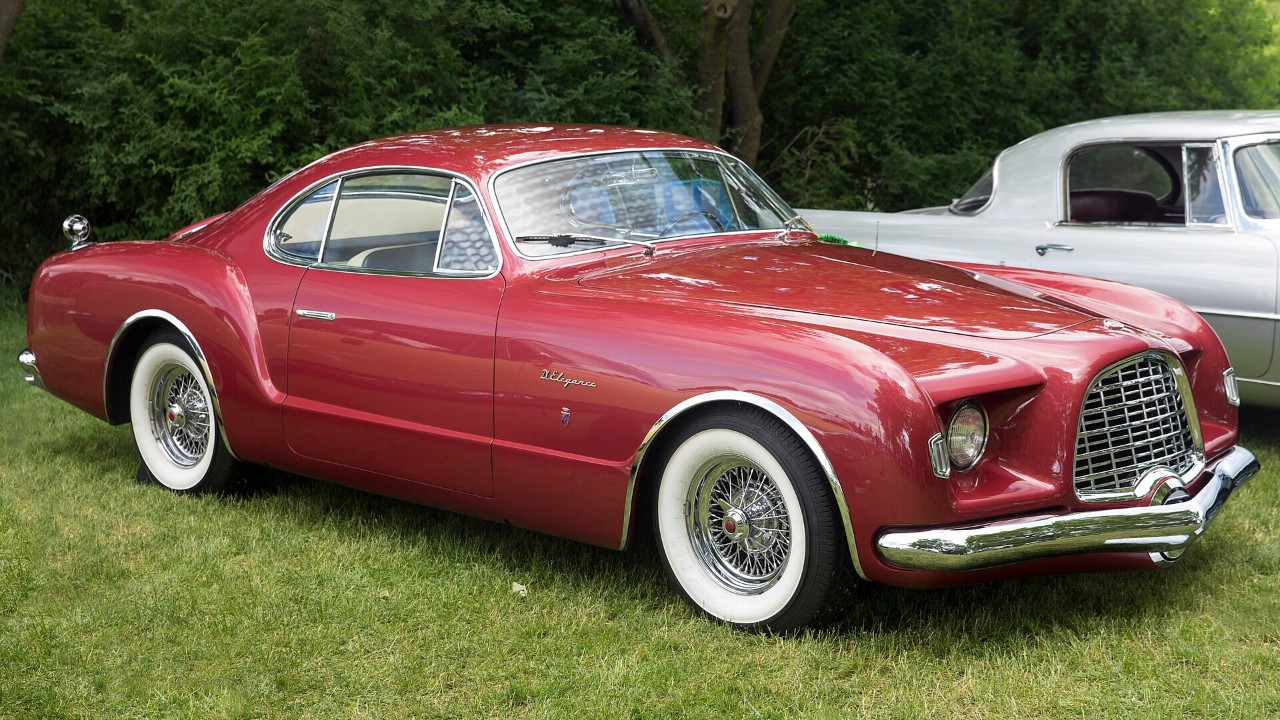
Exner and Ghia’s Luigi Segre developed the D’Elegance together as an update of the earlier K-310. It debuted at the Paris Motor Show in October 1952. The body was a fastback coupe with a long hood, gunsight taillights and a full-size spare tire on the rear deck. A hydraulic system lowered that spare to the ground.
Car Design News lists a 5.4-liter V8 with 180 hp. Meanwhile, RM Sotheby’s says the coupe sits on a New Yorker chassis shortened by 10 inches, to 115 inches. Its later history matters too. Ghia’s Savonuzzi downsized the shape for the 1955 Volkswagen Karmann Ghia, and Car Design News says almost half a million of those were built.
Exner confirmed the D’Elegance would stay a one-off. Even so, it passed through several collections, and RM Sotheby’s sold it for $885,000 in 2017. It also opened our look at American cars Ghia built in Turin.
In our opinion, no car here had a longer reach. The D’Elegance never sold, yet its shape lived on in one of the best-loved small cars ever built. That’s a remarkable legacy for a single show car.
More from Fast Lane Only