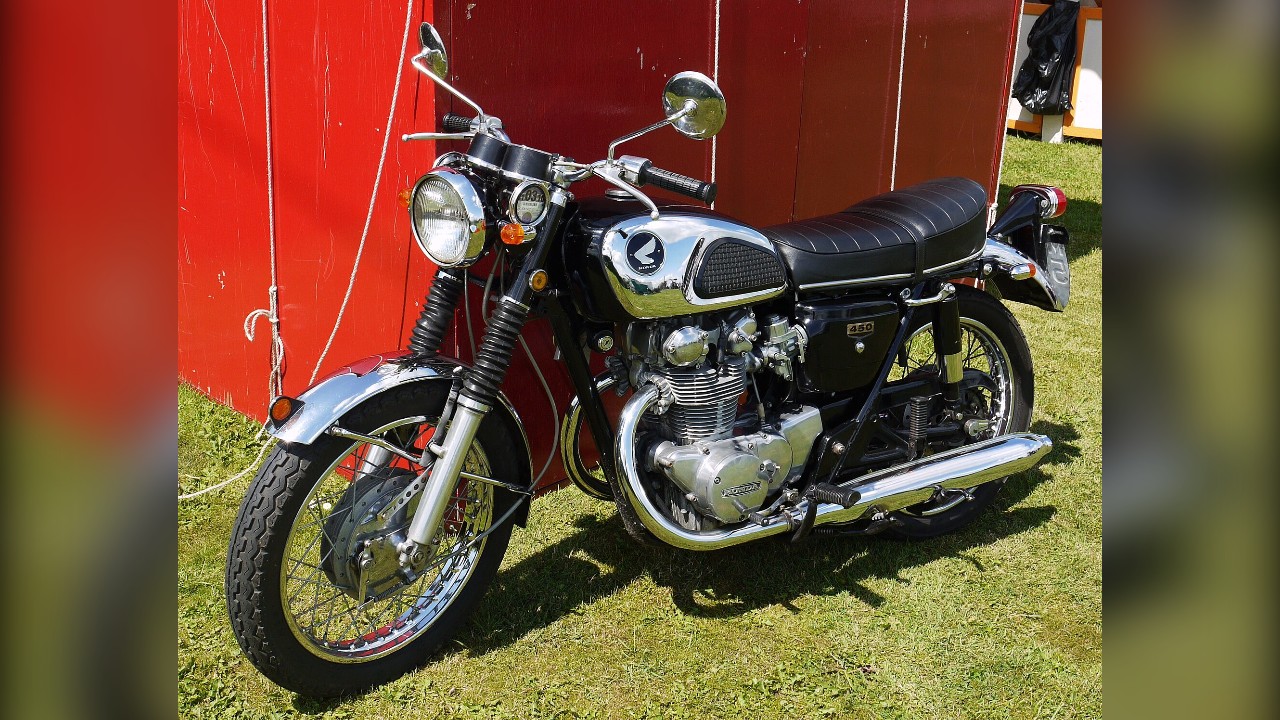
The 1965 Honda CB450 closed its valves without ordinary coil springs. Instead, its 444cc twin-cam engine used short torsion bars that twisted and sprang back. The bike’s all-black first-year paint earned it the nickname Black Bomber.
That valve gear was only part of the story. Honda built the CB450 to take on the big British twins sold in America. Yet it did it with less displacement, more revs and an engine layout borrowed from the race track.
The result was a motorcycle that period magazines praised and buyers mostly ignored. Today, though, the Black Bomber reads like an early sign of where the whole industry was heading.
What made the Honda CB450 different
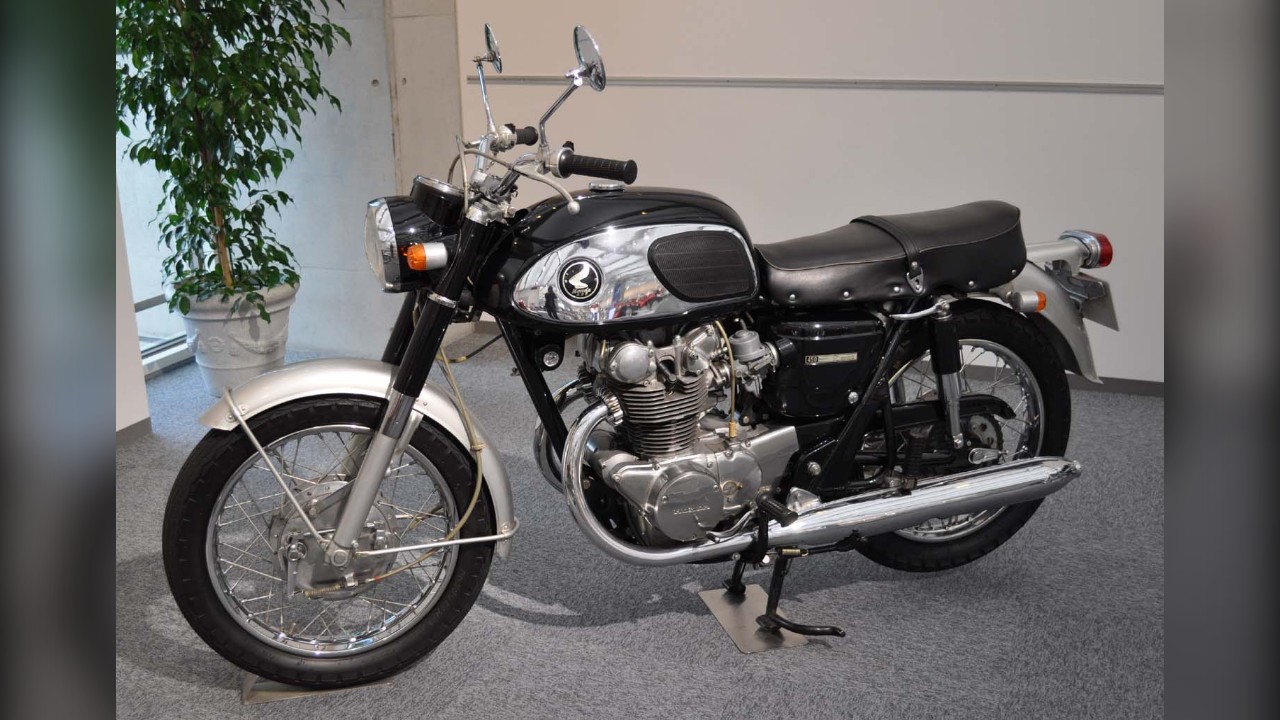
The Honda CB450 used an air-cooled parallel twin with double overhead camshafts. According to Motorcycle Classics, the engine displaced 444cc and Honda claimed 43 hp at 8,500 rpm. The magazine also calls it a short-stroke design.
The National Motorcycle Museum gives the bore and stroke as 70mm by 58mm, with a 9:1 compression ratio. It also points out that nearly every pure racing engine Honda built at the time used twin overhead cams. In short, Honda was into high-rpm designs, and the CB450 brought that thinking to the street.
British and American rivals worked differently. They relied on pushrod, side-valve and overhead-valve layouts. The museum says those engines made their power below about 7,500 rpm because of the mass of their valve-train parts.
How the torsion-bar valve springs worked
Here is the clever bit. Most four-stroke engines use a coil spring around each valve stem to snap the valve shut. Honda’s 450 did not. Motorcycle Classics describes the setup plainly: “The valves were seated by torsion bar valve springs — short lengths of steel splined into tubular guides.”
In other words, the steel bars did the spring’s job by twisting rather than compressing. The museum’s spec sheet sums it up as “torsion bar valve return, no valve springs per se.”
Why go to the trouble? Neither source spells out Honda’s reasoning. Still, the whole engine was built around high revs, and in our view the unusual valve gear fits that same goal.
Honda paired the engine with constant-velocity carburetors. Motorcycle Classics says the 450’s twin CV carbs were a first on a production motorcycle. At the time, Cycle magazine billed the bike as “featuring the world’s only production-line DOHC motorcycle engine.”
Built to take on the British twins
Honda had good reason to aim high. Motorcycle Classics reports that its U.S. sales reached 65,000 in 1962 and 150,000 in 1963. So the company saw room to move up from small commuter bikes into big-bike territory.
The Lane Motor Museum says the CB450 targeted the 650cc and 750cc British bikes. It was priced about the same and made up for its smaller engine with performance. Motorcycle Classics lists the original price at about $1,000.
On the road, meanwhile, the numbers were respectable. Cycle World recorded 102 mph in its August 1965 test, against Honda’s claim of 112 mph. However, the 450 was heavier than its targets. Motorcycle Classics gives a dry weight of 412 pounds, compared with about 365 pounds for a Triumph 650.
Why the Black Bomber sold slowly
For its part, the press liked the bike. In September 1965, Cycle World wrote that “the CB450 is blessed with one of the better seating positions in the world.” Even so, buyers stayed cautious.
The National Motorcycle Museum blames the styling. The bulbous tank and full-coverage fenders were unpopular, so sales were slow. Honda even sent U.S. dealers kits to give the bike a scrambler look. The museum also says the “Black Bomber” name was apparently coined by the British press.
Motorcycle Classics calls the CB450 “a slow seller” overall, though moderately successful. Still, Honda kept improving it. The K1 replaced the original K0 in February 1968 and brought a five-speed gearbox.
What the Black Bomber left behind
The 450 twin stayed in production through 1974, Motorcycle Classics reports. According to the museum, it carried on even after Honda launched the CB500 Four in 1972. Later versions got a sleeker tank and upswept pipes.
Today the early bikes have a following of their own. Collector Guy Webster summed up the appeal for Motorcycle Classics: “It has guts — I like the twin cam.” The magazine put values for the 1965–1968 Black Bomber at $3,500 to $6,000 when it profiled the bike in 2010.
The National Motorcycle Museum displays a restored early CB450 from the John and Jill Parham Collection. It is one place to see the torsion-bar twin that took on Britain’s big bikes in 1965.
More from Fast Lane Only