In 1941, a Chrysler Thunderbolt could fold its metal roof away at the push of a button. Most buyers that year drove cars with running boards and separate fenders. So the gap between the show floor and the street was huge, and the war only made it wider.
Then the late 1940s arrived, and the future suddenly showed up in real showrooms. Fenders melted into the body. Glass wrapped around corners. Small makers in France, Britain and California tried ideas that Detroit would not touch for years. Some of those cars sold by the tens of thousands, while others never got past a handful.
These are our picks for the 1940s cars that looked furthest ahead when they were new. They run from one-off show cars to family sedans. The facts come from maker records, museums and auction catalogs. The verdict on each one is our own opinion.
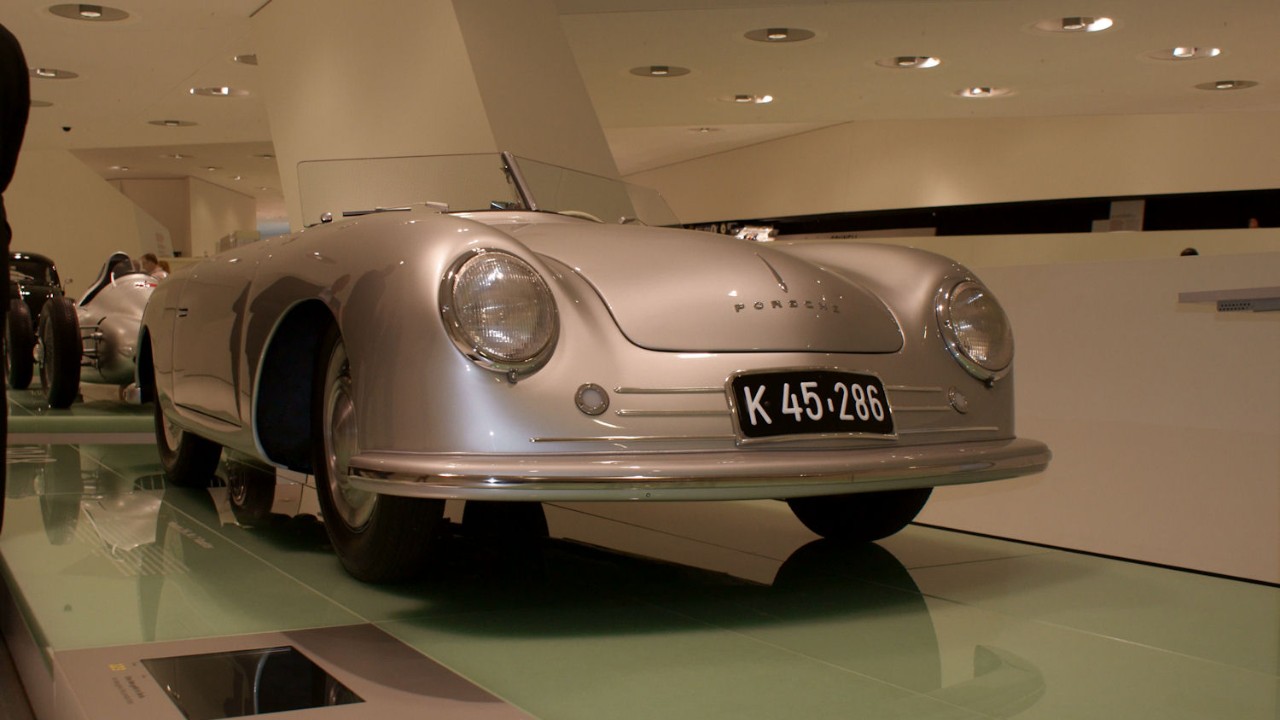
1. 1948 Porsche 356 No. 1 Roadster
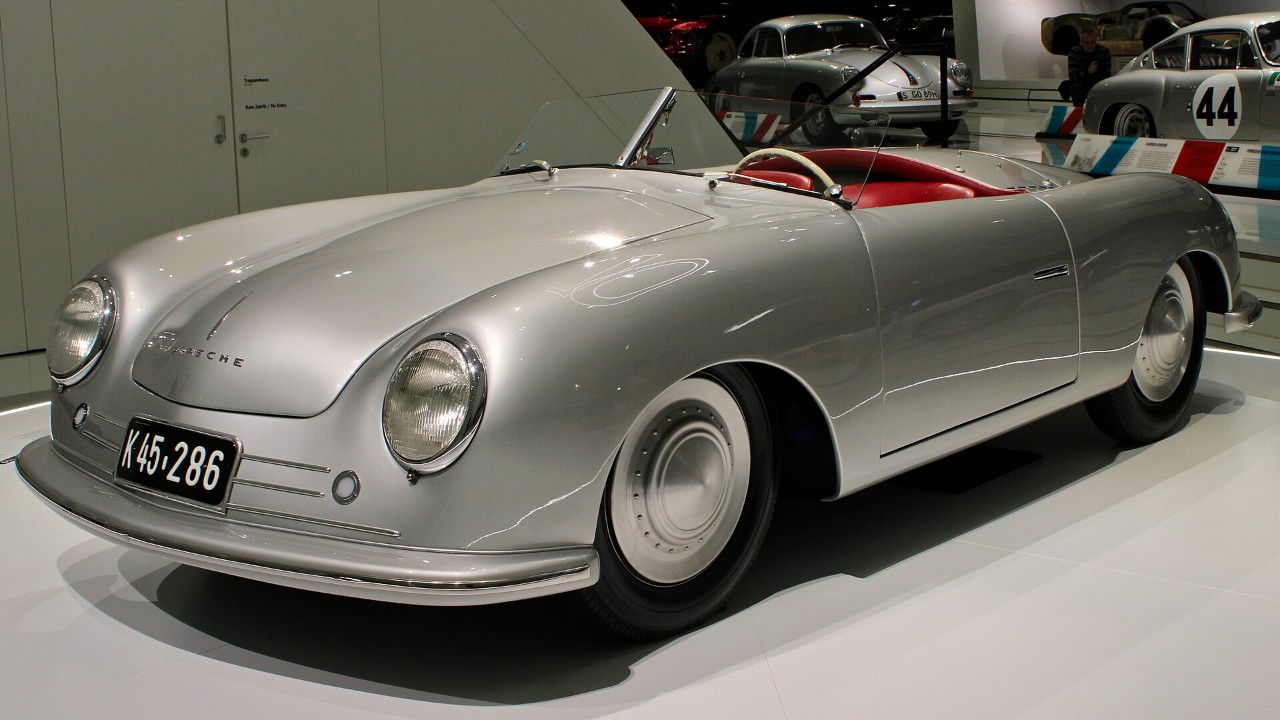
Before Porsche had a factory in Stuttgart, it had a workshop in Gmünd, Austria. That is where this little roadster took shape. According to the Porsche Museum’s own fact sheet, it received its general operating permit on June 8, 1948. Porsche treats that date as the birth of the brand.
The recipe was simple but clever. First, an aluminum body sat on a steel tube frame. Then a tuned Volkswagen flat-four went in front of the rear axle, not behind it. That engine displaced 1,131 cc and made 35 horsepower. Even so, the light car could reach 135 km/h, or about 84 mph.
Later 356 models moved the engine behind the axle and grew a roof. If you want that side of the story, read when the 1953 Porsche 356 proved lightweight speed mattered.
Our take: next to a 1948 American sedan, No. 1 looked like it came from another planet. It was low, bare and tiny. In fact, its mid-engine layout is the same basic idea that supercars use today.
2. 1949 Ferrari 166 MM Barchetta
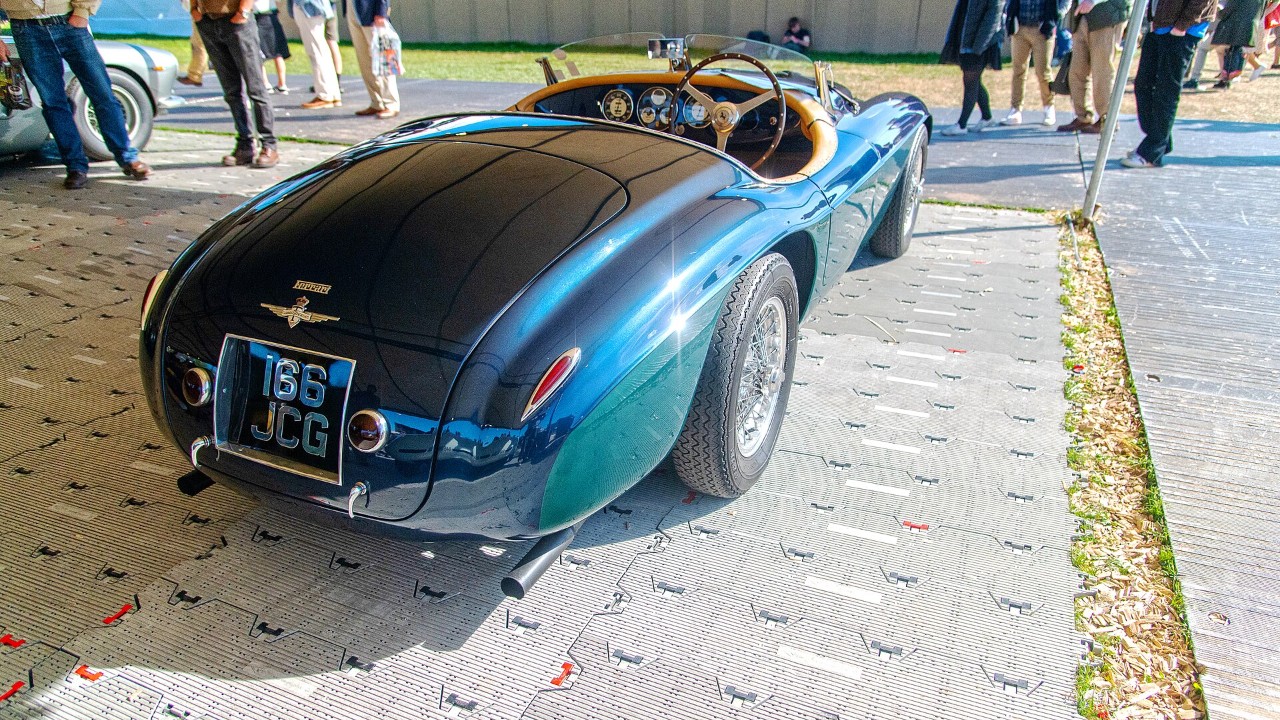
The word barchetta means “little boat” in Italian, and you can see why. Touring of Milan bodied most of the 166 MM cars as open two-seaters with a low, smooth hull. There were no separate fenders, no running boards and very little trim. As a result, the shape still reads as modern more than 75 years later.
Under the hood sat Gioachino Colombo’s 2.0-liter V12. Output eventually rose to 140 PS at 6,600 rpm, good for about 137 mph. That was serious speed for a small engine in the late 1940s.
The results backed up the looks. In 1949, 166 MM Barchettas finished first and second in the Mille Miglia. Later that year, Luigi Chinetti and Lord Selsdon won Le Mans in one. Ferrari built just 47 MM cars between 1948 and 1953.
We think this is the car that taught the world what a Ferrari should look like. You can see its slab-sided shape in plenty of later roadsters. However, few wore it with this much grace.
3. Panhard Dyna X
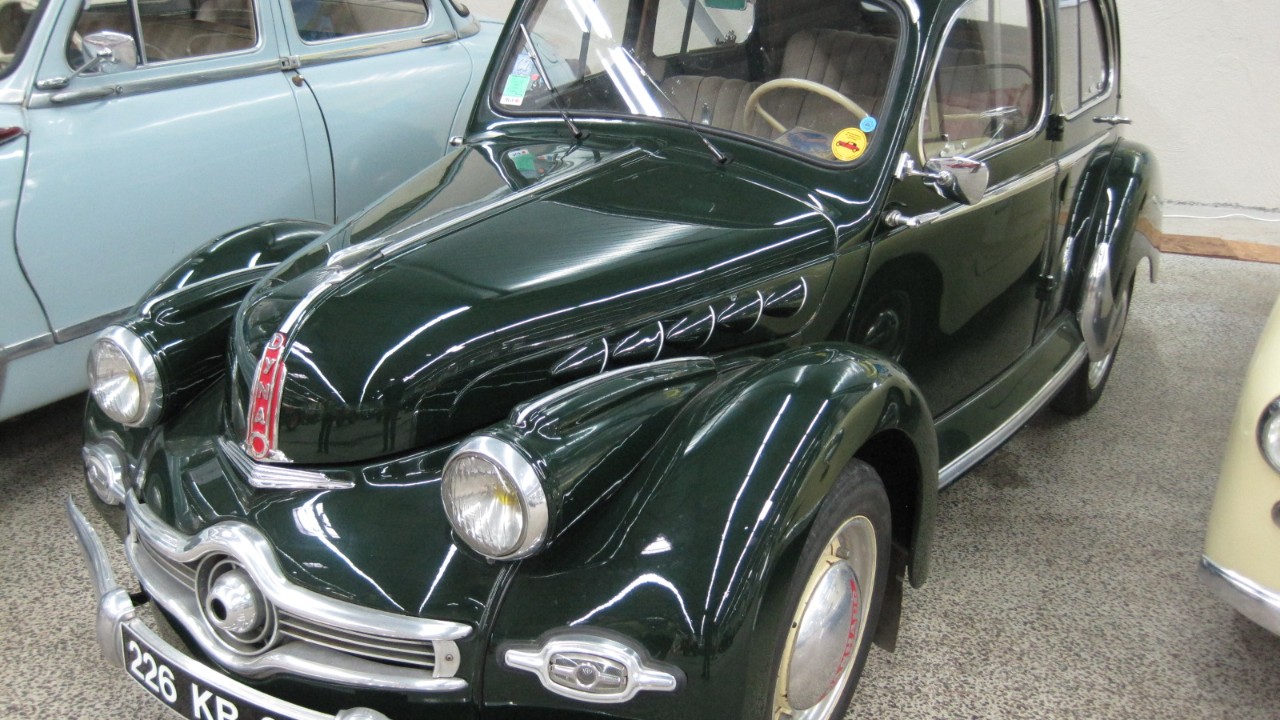
The Dyna X does not look fast, but it was thinking ahead in a different way. Engineer Jean Albert Grégoire designed it around one idea: save weight everywhere. Instead of a steel body, the car used a lightweight aluminum four-door shell on a tubular steel frame. It first appeared as the AFG Dyna at the Paris Motor Show in October 1946.
Power came from an air-cooled flat-twin. At launch it displaced just 610 cc, and later versions grew to 745 cc and then 851 cc. It also drove the front wheels. Curb weight was only 550 to 615 kg, or roughly 1,210 to 1,356 pounds.
That low weight made the little sedan a winner in late-1940s touring car racing. Later, in 1954, Bill Devin sold about a dozen Devin-Panhard sports cars built on its chassis and engines. About 47,049 Dyna X cars were built by 1954, by a conservative count.
Our take: front drive, an aluminum body and a tiny air-cooled engine sound like a 1970s economy car brief. Panhard had all three on sale in 1948.
4. 1949 Lincoln Cosmopolitan Convertible
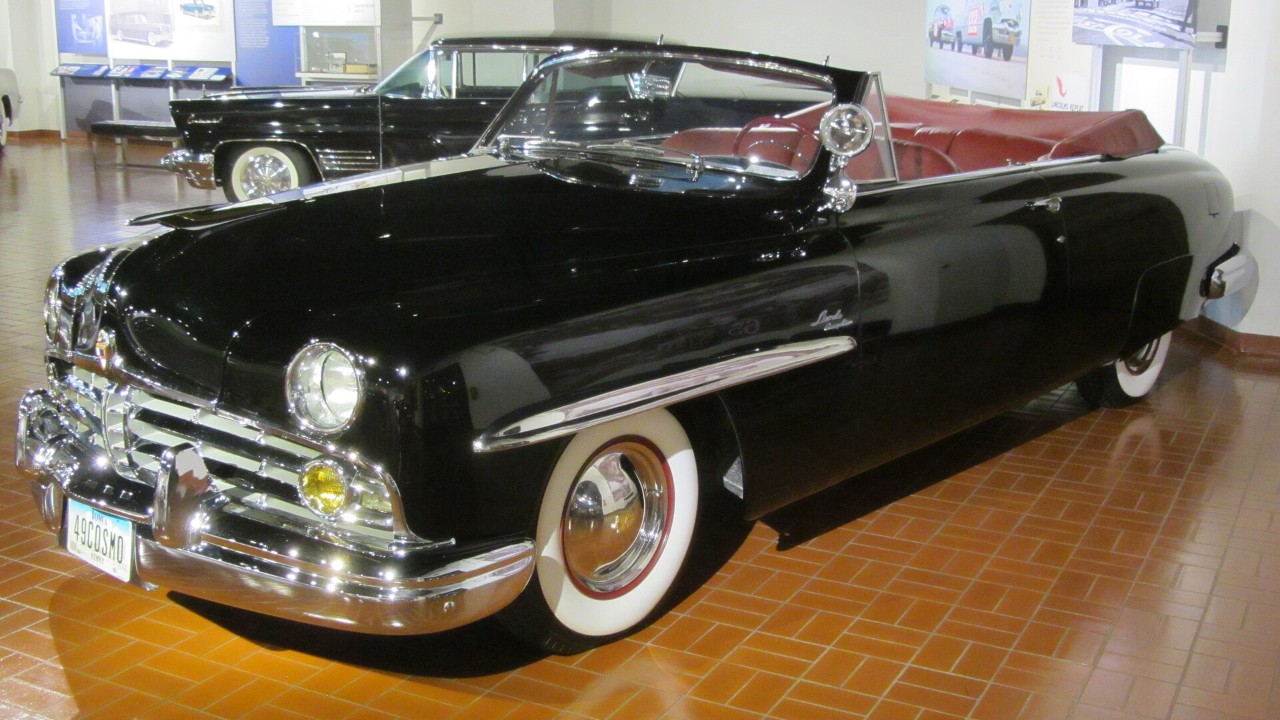
Lincoln’s first new postwar design dropped the old habits all at once. The running boards were gone. The fenders and doors ran together in one smooth slab, a style designers called “pontoon.” Meanwhile, the headlights and taillights sat recessed into the bodywork, a look customizers call “frenched.”
The Cosmopolitan sat at the top of the range, above the smaller Lincoln that shared parts with Mercury. Its engine was a 337-cubic-inch flathead V8, the same unit Ford used in its heavy trucks. That gave the big car plenty of pull. Buyers could choose a four-door sedan, a two-door, a fastback Town Sedan or this convertible.
The White House liked the look too. Under President Truman, it leased ten Cosmopolitans customized by Henney, and one of them was an armored convertible. Later, in 1954, Eisenhower’s Cosmopolitan convertible got a Plexiglas roof and became the “Bubble-top.” It stayed in presidential service until 1965.
In our view, a body that served a president for 16 years is proof enough. The 1949 Lincoln was not a passing fad. Instead, it set the shape of the big American car for the next decade.
5. 1949 Mercury Eight Coupe

For 1949, Mercury got its first truly postwar body, and buyers rushed in. The new shape removed the freestanding fenders and running boards. It also brought a wider, lower hood. Underneath, Ford finally dropped the old transverse leaf spring for independent front suspension.
Power came from a flathead V8, now at 255 cubic inches and 110 horsepower. An overdrive was optional. That package worked, because sales jumped by more than 250,000 units from 1948 to 1949. Mercury became the sixth-best-selling car brand in America.
Yet the real legacy came later, in garages. Sam Barris built the first “lead sled” from a 1949 Eight by chopping and smoothing it. Then, in 1953, Sam and George Barris built the Hirohata Merc, a car often called the most famous custom of all.
Our take: the factory shape looked like the future in 1949. However, customizers saw an even lower, sleeker future hiding inside it. That is why so many ’49 Mercs never stayed stock for long.
6. 1948 Davis Divan
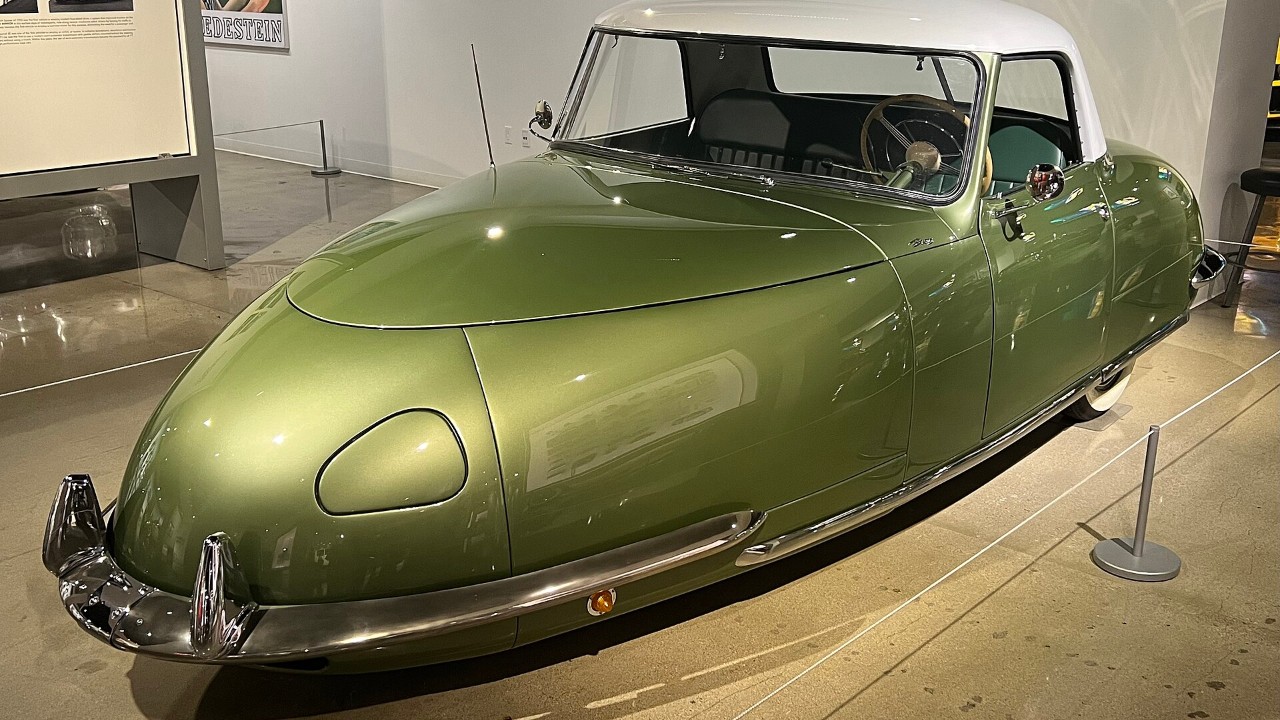
Gary Davis, a used-car salesman, wanted to sell America a three-wheeler. The Davis Divan put one wheel at the front and two at the rear. Its body was wide enough for four adults on one bench seat, which is how it got the name “Divan.” Davis assembled the cars in Van Nuys, California.
The car grew out of “The Californian,” a 1941 three-wheeled roadster that Frank Kurtis designed for Joel Thorne. Davis bought it in 1945 and used it as his starting point. Most Divans used a 63-horsepower Continental four-cylinder. The design also packed aircraft-style lines, hidden headlights, built-in jacks and a removable top.
For all that, the dream never reached mass production. Only 13 were built, counting two prototypes, and 12 survived as of 2005. The car pictured here belongs to the Petersen Automotive Museum in Los Angeles.
We’d call the Divan the most sci-fi car on this list that you could actually sit in. It is the kind of car a 1948 magazine would have drawn for the year 2000. Sadly, the business behind it could not keep up with the styling.
7. 1941 Chrysler LeBaron Thunderbolt
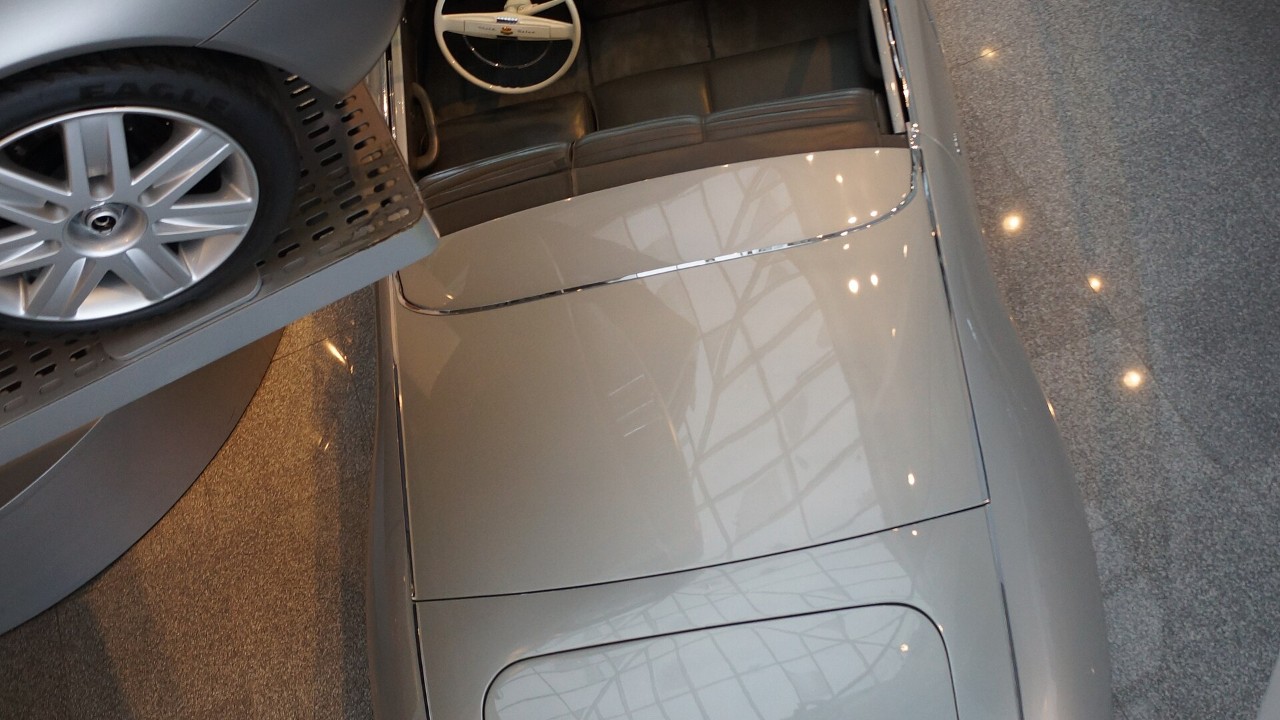
Alex Tremulis proposed the idea in 1939, and Ralph Roberts at the coachbuilder LeBaron turned it into metal. The result was the Chrysler Thunderbolt, a smooth convertible with enclosed wheels and hidden headlights. According to RM Sotheby’s catalog, its electrically operated hardtop retracted behind the seat in three synchronized moves. Roberts designed and patented that roof himself.
Each Chrysler Thunderbolt body used aluminum panels over a solid oak frame, with a steel hood and trunk lid. Power came from Chrysler’s Spitfire straight-eight. Chrysler sent the cars on a tour of dealers and the Indianapolis 500. One Sacramento dealer reported 8,500 visitors on the day a Thunderbolt sat in his showroom.
The Frist Art Museum notes that eight were planned at $8,250 each, but only five Chrysler Thunderbolt cars were built. Four survive today. In 2011, RM Sotheby’s sold one at Monterey for $935,000.
Our take: the Chrysler Thunderbolt is the purest “future car” here, because it was built to be exactly that. It was a show car, not a production model. Even so, it predicted the retractable hardtop decades before most buyers could order one.
8. 1949 Kaiser Virginian
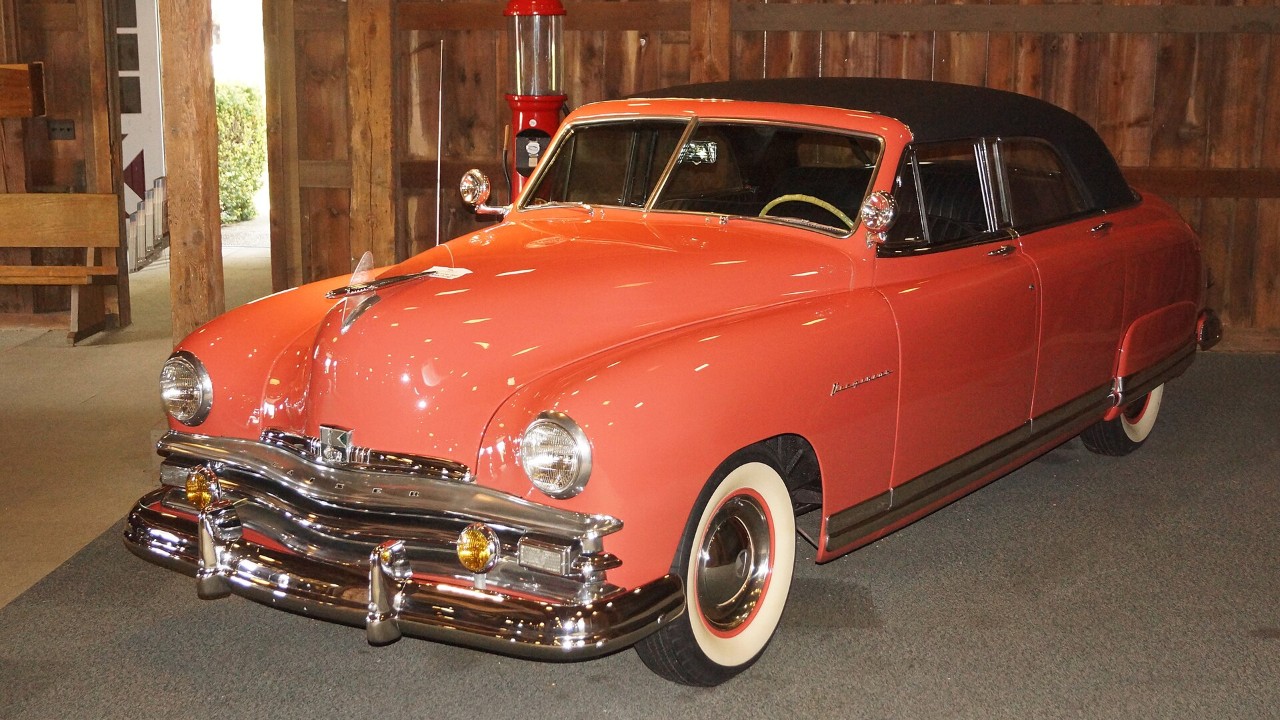
Kaiser-Frazer was a brand-new carmaker after the war, and it had to take chances. The Virginian was one of its boldest. Kaiser built it from its four-door convertible body but gave it a fixed steel roof. That roof wore a shiny nylon covering instead of a folding top.
The clever part was the side view. Where a normal sedan had a solid pillar between the doors, the Virginian had fixed window channels and glass. As Curbside Classic explains, that made it a four-door “hardtop” look in early 1949. For reference, Buick’s Riviera and Cadillac’s Coupe de Ville hardtops arrived later that same year.
Power came from a 226-cubic-inch L-head six. Kaiser also hand-built a very small run of Custom Virginians before Truman’s 1949 inauguration, and some carried VIPs in Washington. If you like Kaiser’s bolder side, see the story of the 1954 Kaiser Darrin and its sliding doors.
We think the Virginian deserves far more credit than it gets. Pillarless four-door hardtops became an American staple in the 1950s, and Kaiser was showing the look before the big brands.
9. 1948 Healey Elliott
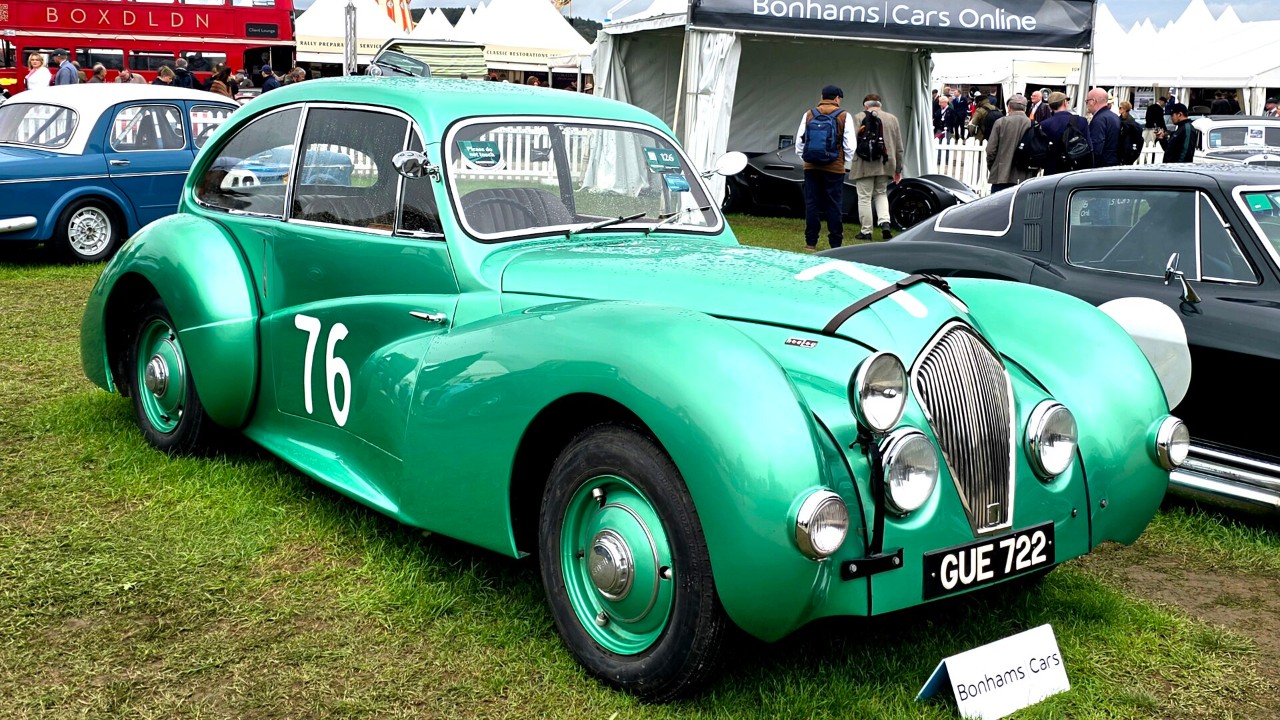
The Healey Elliott was a compact British sedan with big ambitions. Samuel Elliott & Sons built the body, which explains the Elliott name. Underneath sat a welded, X-braced chassis with Healey’s own trailing-arm independent front suspension. Power came from a 2.4-liter Riley engine.
The low, rounded body was more than style. In 1947, a Healey Elliott reached 110 mph at Jabbeke in Belgium, according to Bonhams. For a time, it was the world’s fastest closed four-seat production car. That was a remarkable claim for a modest-sized sedan.
Bonhams puts production at just 101 Elliott saloons. So you will rarely see one outside a museum or a historic rally. When one came up at the Goodwood Revival in September 2015, Bonhams sold it for £32,200.
Our take: in a country still on rationing, a four-seat sedan that could top 100 mph felt like a glimpse of better times. It also set Healey on the road to the sports cars that made his name famous.
10. 1947 Studebaker Starlight
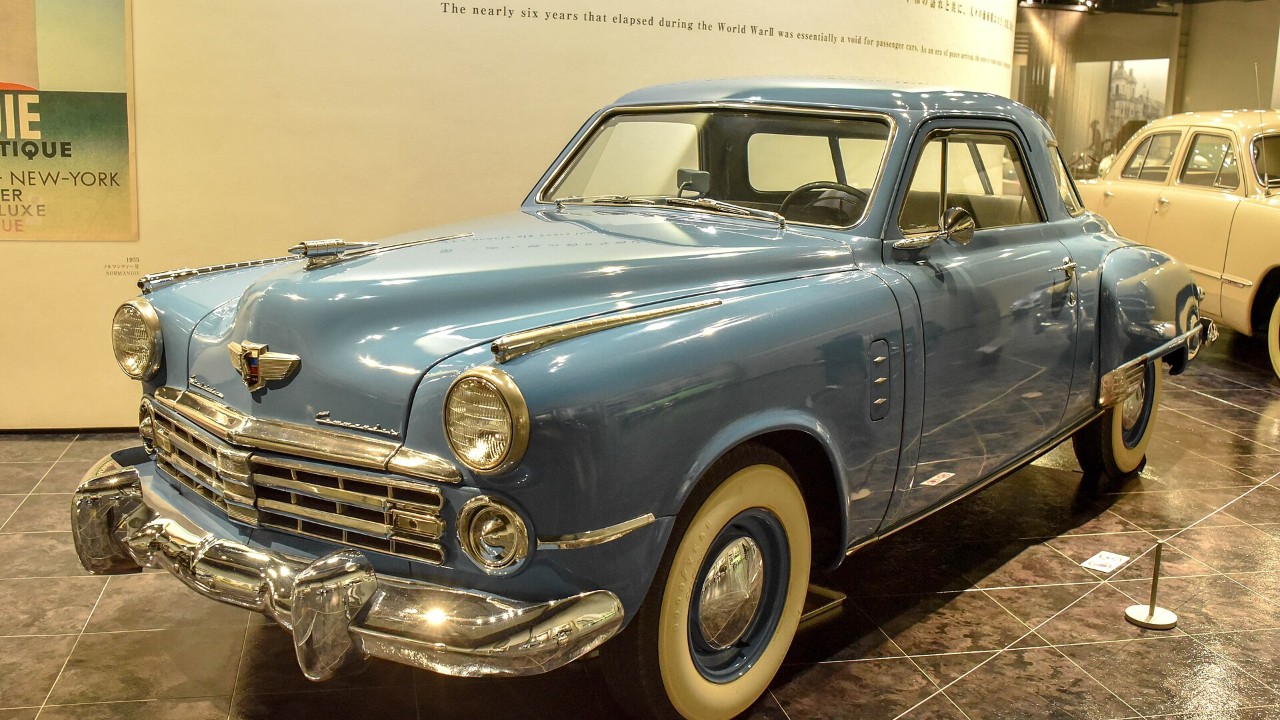
Studebaker went all in on a fresh postwar look, and the Starlight coupe was the boldest proof. Virgil Exner, formerly of Raymond Loewy’s design firm, shaped the car. Its roof ended in four fixed glass panels that curved around the back. The effect was a panoramic view, like a railroad observation car.
That rear end also confused people. Critics asked, “Which way is it going?” Comedian Fred Allen joked about it too. Even so, the shape sold, and rivals copied the general profile for their own 1949 models. In Champion form, the coupe used a 169.9-cubic-inch six making 80 horsepower.
The Starlight name stayed on the coupe into the early 1950s. Studebaker built the body style through 1952 before a new design arrived. For more on how this car aged, read why this 1947 Studebaker looks futuristic even now.
In our view, the Starlight is the car on this list most people picture when they think “1940s future.” It was not a show car or a racer. Instead, it was a family coupe that ordinary buyers could drive home.
11. 1949 Packard Custom Super Eight
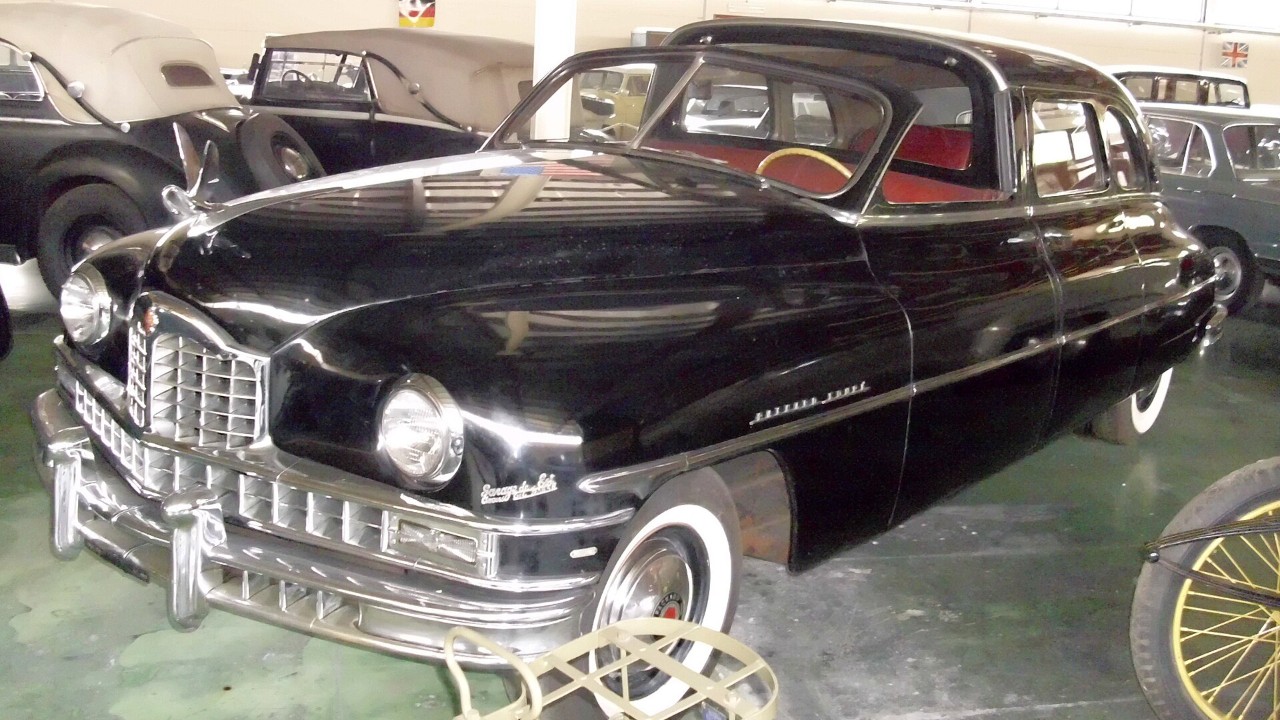
Packard went into the postwar years as America’s grand luxury name, and the Custom Super Eight showed how it planned to stay modern. The body used the smooth “ponton” shape, with the fenders blended in. Senior models carried an egg-crate grille below Packard’s traditional ox-yoke shape. A new “Winged Goddess” cormorant hood ornament sat on top.
Under the hood sat Packard’s 356-cubic-inch straight-eight. However, the bigger news for 1949 was Ultramatic, Packard’s own two-speed automatic transmission. That meant the luxury buyer no longer had to shift at all.
Coachbuilders kept a role too. The car shown here wears Derham coachwork on the 1949 chassis. Meanwhile, two stainless-steel trim strips along the lower body also set Custom Super trim apart from the plainer models.
Our take: the bulbous styling split opinion then and does now. But a smooth straight-eight with an in-house automatic pointed straight at the easy luxury car of the 1950s. The 2-speed Ultramatic made its debut in 1949, the year this car was built.
More from Fast Lane Only