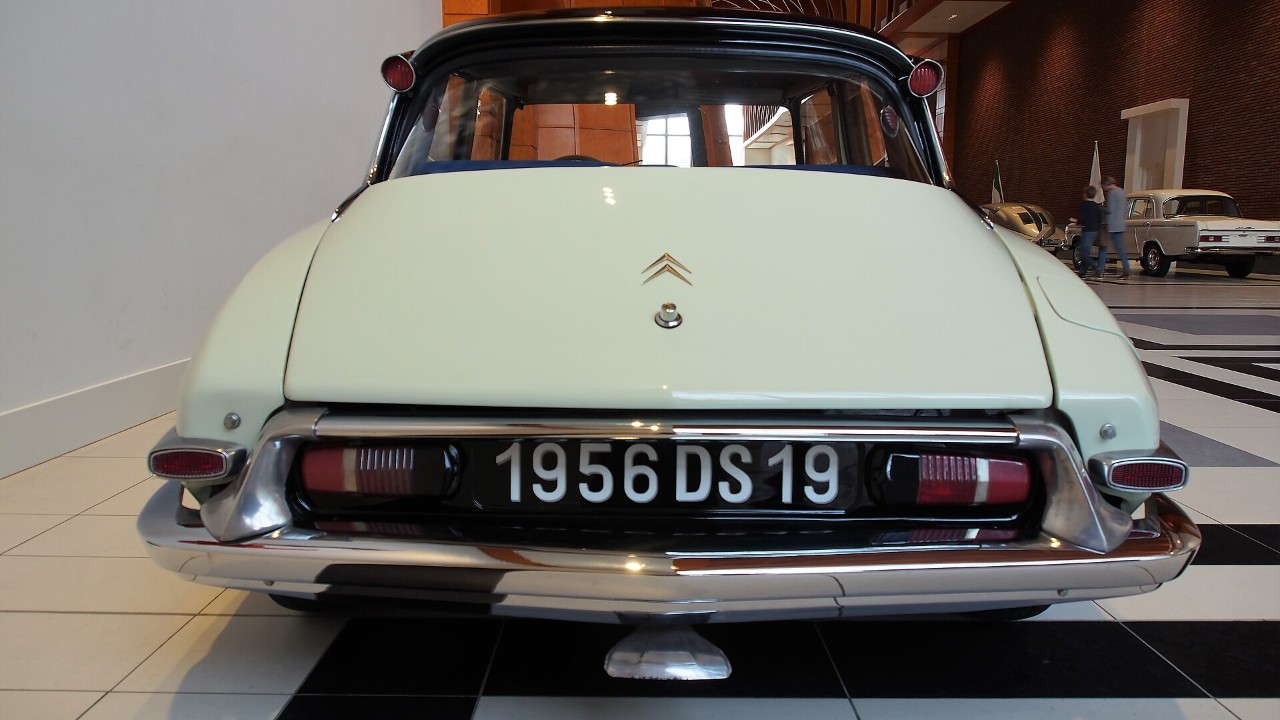
The Citroën DS hydropneumatic suspension let a big family sedan float over bad roads and level itself under load. Then Citroën added front disc brakes, at a time when such brakes were a rarity on road cars. No mass-production car had offered that pairing before the DS appeared at the Paris Motor Show in October 1955.
The DS ran for twenty years after that debut. Over that time, Citroën kept the same basic hydraulic layout while engines and trim changed around it.
The story behind those two features is really the story of three men and one remarkable hydraulic system. Here is how it worked, and how many were built.
Why the Citroën DS counts as a first
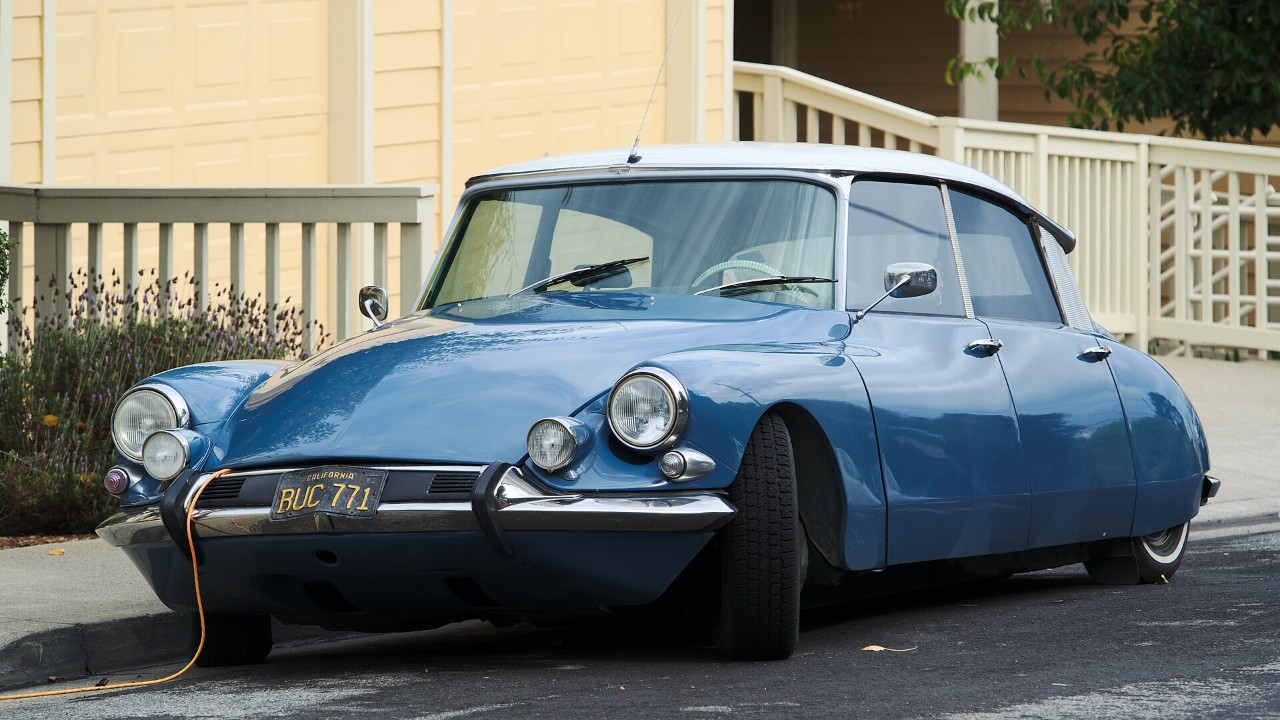
The disc brakes are what make the record. Octane describes the DS’s inboard front discs as making it the first mass-produced car to feature discs at all. Similarly, Ate Up With Motor’s model history calls the DS the first mass-production sedan in the world with disc brakes.
Because no mass-produced car had discs before it, no mass-produced car could have offered discs and hydropneumatic suspension together either. That is the combination the headline describes.
The suspension had a short prehistory, however. Octane says engineer Paul Magès first tried his system on the rear of the 15H, the final Traction Avant. Ate Up With Motor adds that Citroën offered a simplified version on Traction 15 models starting in 1954. Still, the DS was the first to pair it with disc brakes.
How the Citroën DS hydropneumatic suspension worked
Instead of steel springs, the DS used gas-filled spheres and pressurized fluid. According to Ate Up With Motor, the gas sphere set both the ride height and the effective spring rate, and both could change. As a result, the suspension stiffened automatically to keep the car flat and level.
Magès was self-taught, Wheels magazine notes. His system did more than hold the car up, too. The same hydraulics served the power steering and the gearbox, so one hydraulic system did several jobs at once.
In fact, the gearbox was a hydraulic-shifting four-speed manual, Wheels says. The driver selected gears, and the hydraulics handled the clutch work.
The brakes: inboard discs up front
Citroën mounted the front discs inboard, rather than out at the wheels. Ate Up With Motor says the discs measured 11.5 inches and sat there to reduce unsprung weight. The rear brakes stayed drums.
The whole brake system ran on high-pressure hydraulics as well. Wheels calls the fully hydraulic brake system a production-car first. Meanwhile, Motor1’s 70th-anniversary history describes the hydraulically assisted front discs as “a rarity at the time.”
Ate Up With Motor links the decision to Jaguar’s success at Le Mans, where disc brakes had proved themselves in racing. Citroën then put the idea into a family car.
The people behind the DS
Three names come up in every history. Motor1 credits aeronautical engineer André Lefèbvre with the front-wheel-drive, aerodynamic and lightweight thinking. Paul Magès developed the hydropneumatic suspension, plus the hydraulic steering, clutch and brakes. Finally, stylist Flaminio Bertoni and his team gave the car its shape.
The project itself began in 1938 under Pierre Boulanger, Motor1 says, and Pierre Bercot continued it from 1950. Octane adds that Bertoni trained as a sculptor in his native Italy. It also says Lefèbvre told him the car should be as sleek as the latest jet aircraft.
Under the futuristic body, the engine was conservative. Motor1 lists the 1955 DS 19 at 1,911 cc and 75 PS. Wheels points out that the pushrod four was already 21 years old by then.
Launch day and the long production run
The reveal caused a sensation. Motor1 says production began at the Quai de Javel plant the day after the show opened. It also repeats the legend of about 12,000 orders on the first day and roughly 80,000 by the end of the show.
Production started slowly, though. Octane says Citroën built just 69 cars in 1955. By contrast, 1970 was the best year, with 103,633 sold.
Later engines grew to 2,175 cc for the 1965 DS 21 and 2,347 cc for the 1972 DS 23, according to Motor1. Even so, the basic hydraulic recipe stayed in place for the whole run.
How the story ended
The one-millionth DS rolled out on October 7, 1969, Motor1 says. Production then ran on for more than five years after that milestone.
The last car, a DS 23 Pallas, was completed around 3 p.m. on April 24, 1975. By then, according to Motor1, exactly 1,456,115 had been built worldwide.
More from Fast Lane Only