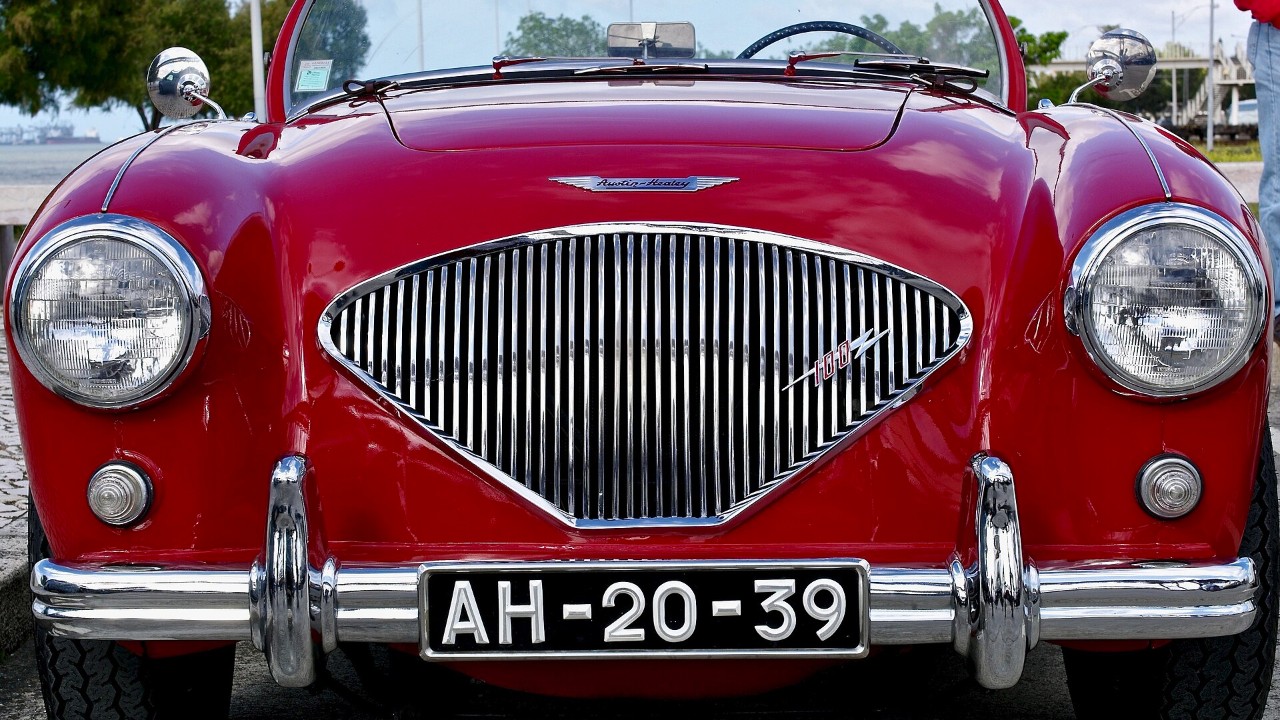
Only 50 production Austin-Healey 100S racers left the works, yet that small batch carries a name earned on the track. The “S” stands for Sebring, where a works car won its class in 1954. That habit of beating cars in its own size bracket ran through the whole Healey story, from the big six-cylinder rally cars to the tiny Sprite.
Most people picture one Austin-Healey: a red 3000 roadster at a summer car show. However, the badge also went on alloy racers, a handful of coachbuilt coupes and family-friendly 2+2s. Several of them were faster in their class than their reputations suggest, and some have slipped out of the conversation entirely.
These are our picks, eight Healeys we think outran the field around them. The “outran everything” verdict is our opinion. Every result, figure and production count below, though, comes from a period test, a club registry, an auction record or a marque history.
1. 1955 Austin-Healey 100S Sebring
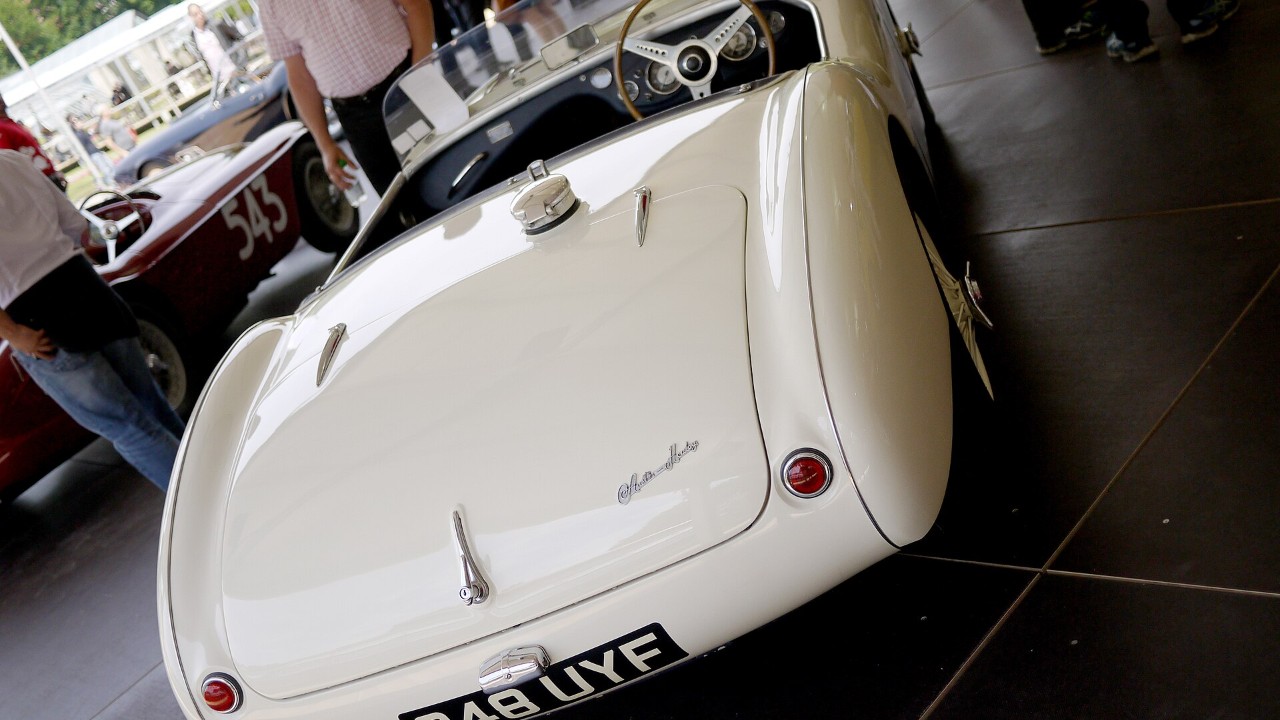
The Austin-Healey 100S was a stripped-down, all-alloy version of the 100 roadster. Its 2,660 cc pushrod four went from 90 bhp in the road car to 132 bhp. Meanwhile, Dunlop hydraulic disc brakes sat at all four corners, and the curb weight dropped to just 1,876 pounds.
That spec sheet came from a works car that won its class at Sebring in 1954. A year later, the 100S was back in Florida with a celebrity at the wheel. According to RM Sotheby’s history of the first production car, actor Jackie Cooper and co-driver Roy Jackson-Moore held 7th overall in the 1955 race. Then a wiring fault killed the battery, and Cooper pushed the car more than a mile. They were classified 42nd.
In our view, that is the Austin-Healey 100S in one story: fast enough to run with bigger machinery, fragile enough to remind you it was a hand-built racer. The market has noticed. RM Sotheby’s sold that first chassis at Amelia Island in 2015 for $1,012,000.
2. 1953 Austin-Healey 100 BN1 Le Mans
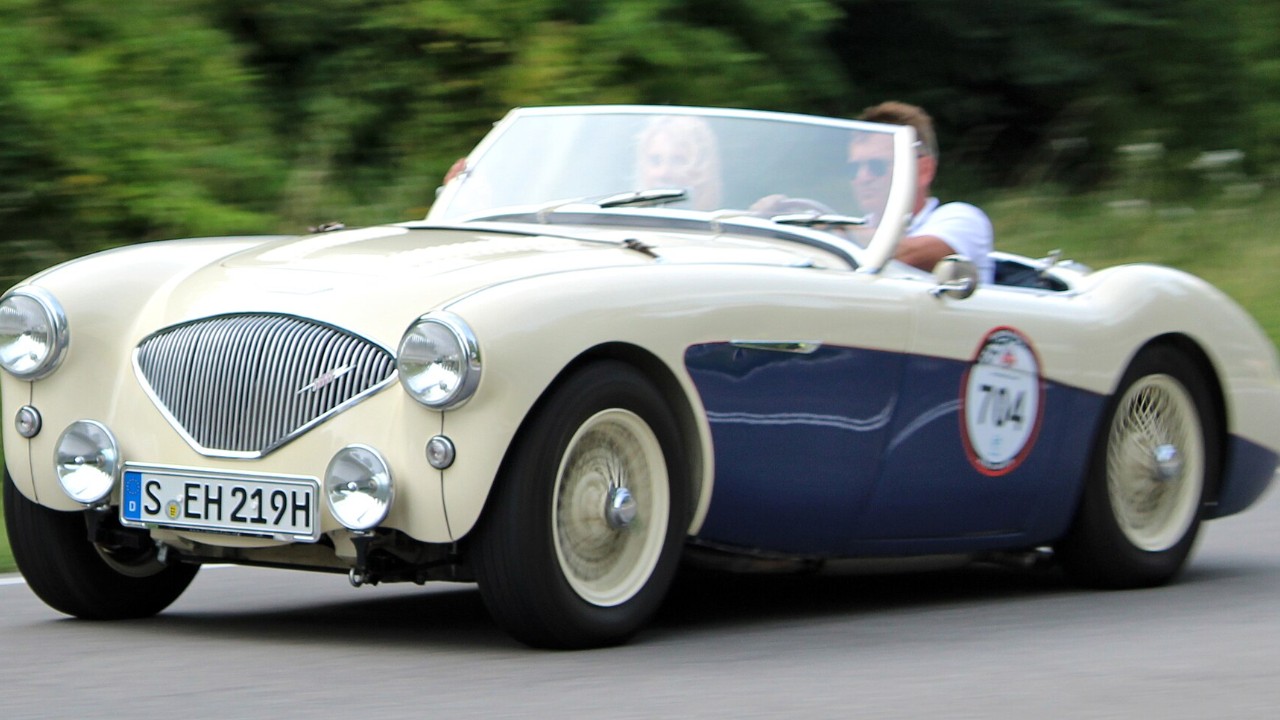
The BN1 was the first production Austin-Healey 100, and its racing name came early. Donald Healey and mechanic Roger Menadue prepared four BN1 “special test cars” for the 1953 Mille Miglia and the 24 Hours of Le Mans, according to the 100M registry’s history. Two of them, NOJ 392 and NOJ 393, finished 12th and 14th overall at Le Mans that year, as Classic & Sports Car reported.
That was a strong showing for a car built from a showroom design. The road car used a 2,660 cc four rated at 90 bhp. It also had an odd three-speed gearbox with overdrive on second and top, because first gear was blanked out. Even so, The Motor recorded 106 mph and 0–60 mph in 11.2 seconds in its 1953 road test.
Healey had already proved his point with the Nash-Healey, and the BN1 carried that thinking into a cheaper car. The BN1 run reached 10,030 cars between May 1953 and August 1955. Our take: like an Austin-Healey 100S, a BN1 with real Le Mans history is out of reach for most buyers, since Bonhams sold NOJ 393 in 2011 for a world-record £843,000.
3. 1956 Austin-Healey 100M
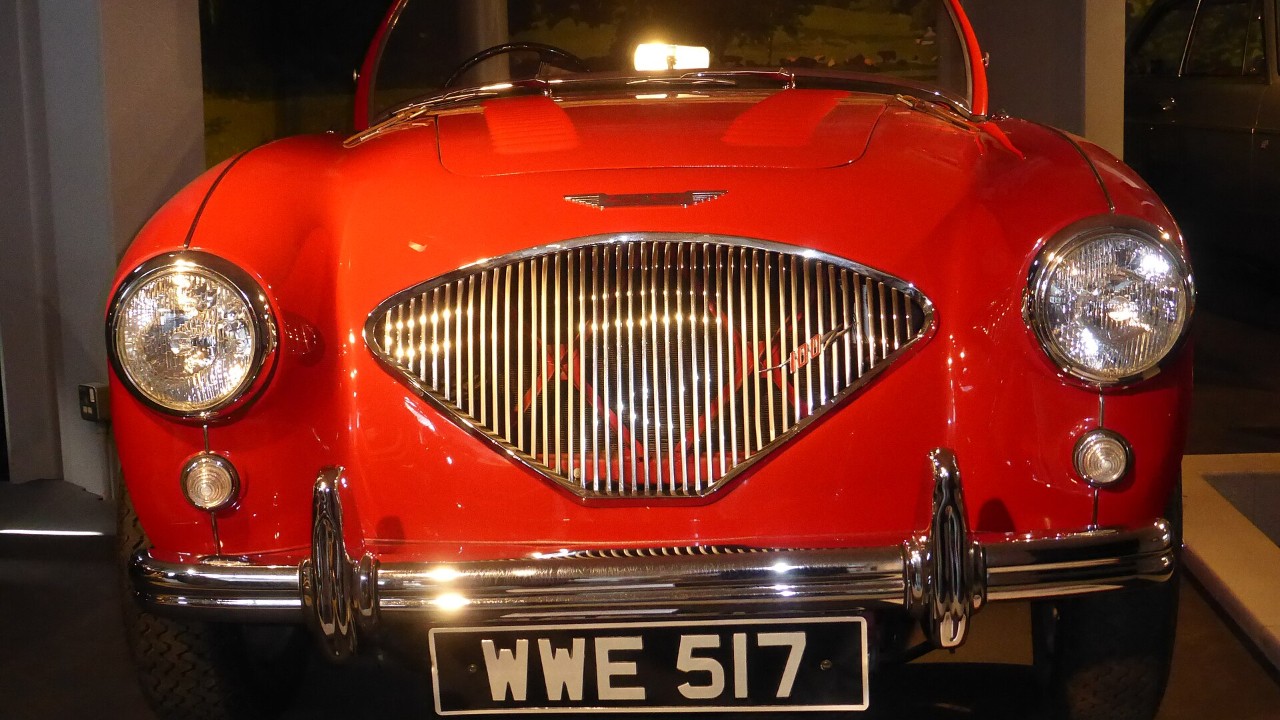
Here is a car whose true production count stayed hidden for decades. Factory records found in July 1985 showed that Austin-Healey built 640 factory 100Ms, according to the 100M registry. Production ran only from September 1955 to July 1956.
The 100M took its parts from the Le Mans Engine Modification Kit, which BMC first offered in 1954. That kit included high-compression pistons and gave roughly 100 bhp at 4,500 rpm. By comparison, the factory 100M made 110 bhp at the same engine speed. Its build cards also called for a louvered bonnet, the detail most people use to spot one today.
About 500 more Le Mans kits went to dealers and owners for converting standard cars. As a result, many “M-spec” Healeys exist, but only 640 began life as factory 100Ms. In our opinion, that makes the genuine article one of the most rewarding four-cylinder Healeys to own. It made 20 bhp more than the standard 90 bhp car, and it looked almost stock. If you shop for one, the factory records are the first thing to check.
4. 1960 Austin-Healey 3000 works rally car (Pat Moss)
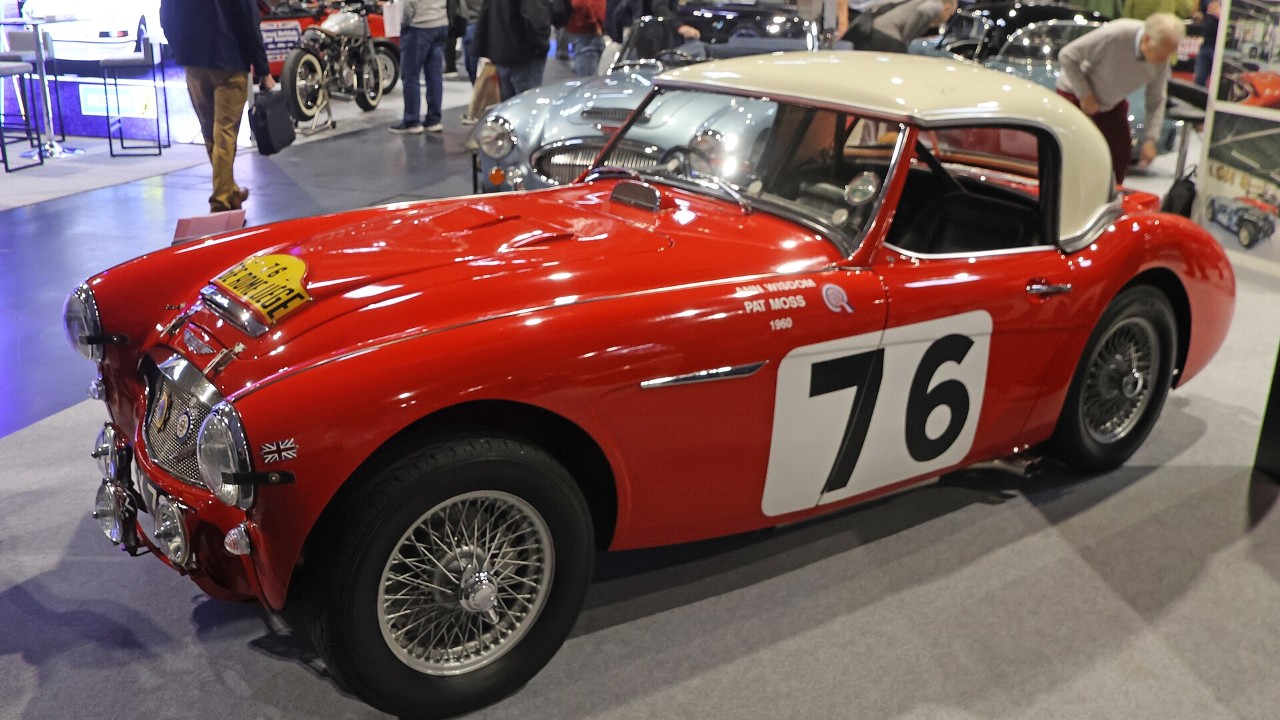
BMC announced the 3000 on July 1, 1959, with a 2,912 cc C-Series six. Within a year, the company’s rally team had turned the big roadster into a giant-killer on rough roads. The most famous example wore the registration URX 727.
Pat Moss and Ann Wisdom drove that car in 1960. According to Hagerty UK, they became the first all-woman crew to win the Liège-Rome-Liège Rally. The same season brought class wins on the Alpine and Tulip rallies, plus the Ladies’ Prize at both Monte Carlo and Geneva. The pair also shared a Driver of the Year award in 1960.
Moss went on to finish second overall on the 1961 RAC Rally. In total, she won the European Ladies’ Rally Champion title five times. She also bought URX 727 in 1961 for £500.
We think this is the purest example of a Healey beating the odds. A heavy, low-slung sports car should not win a road marathon, yet this one did. For scale, Hagerty’s valuation guide lists a concours 1960 3000 road car at £78,000, and URX 727 later went to Bonhams with an estimate several times higher.
5. Austin-Healey Sebring Sprite coupe
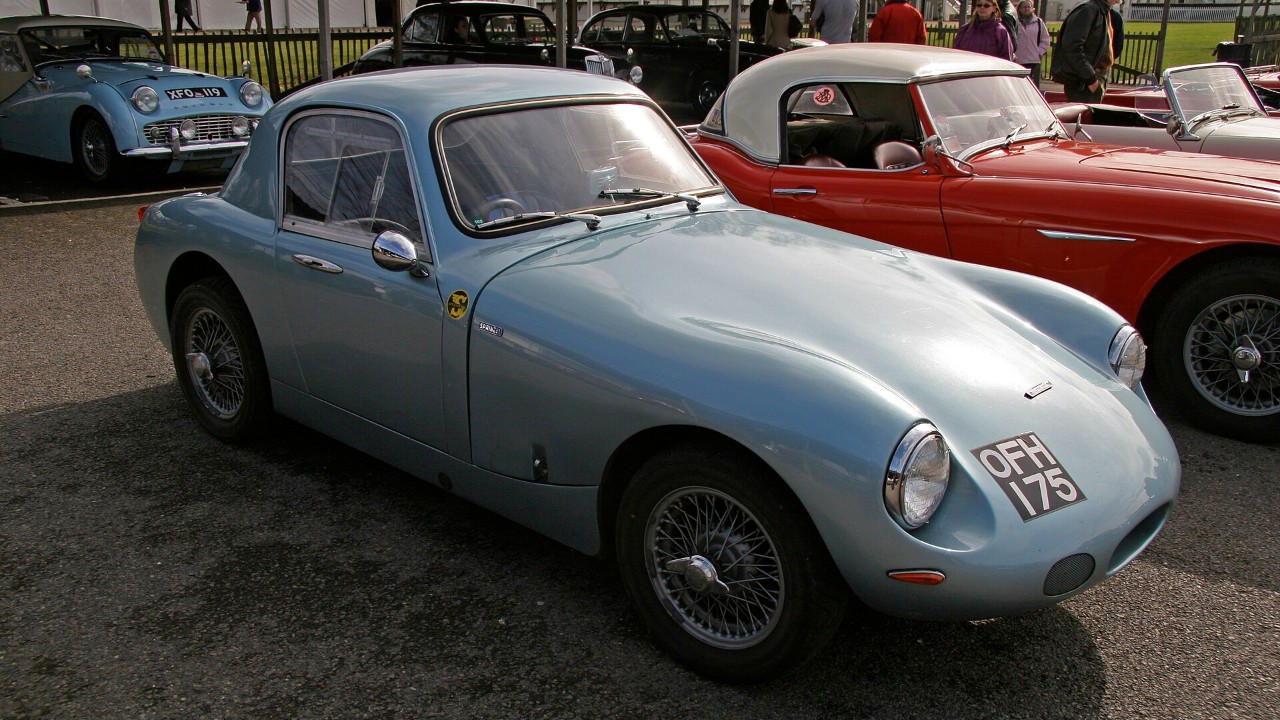
The Sprite had already proved itself before this coupe arrived. John Sprinzel and Willy Cave won their class on the 1958 Alpine Rally, and a Sprite took its class at the 1959 Sebring 12 Hours. Sprinzel then pushed for a faster, sleeker version.
London coachbuilders Williams & Pritchard made the flowing body and curved windscreen at his urging. An alloy prototype ran the November 1960 RAC Rally, and the coupe made its debut at the London Racing Car Show in January 1961. According to the Sebring Sprite register, probably only six cars were built to this design. Each had an aluminium roof, rear shroud and wings, but all except one used a fibreglass bonnet.
The driver list is remarkable for such a small car. Stirling Moss drove PMO 200 at Sebring in 1961, while his sister Pat drove S221 in the same event. Today S221 is the only coupe listed as surviving intact, and Chris Clegg races it regularly.
Our take: this is the forgotten star of the list. It took the Sprite’s class-winning chassis and gave it the aerodynamics it always lacked.
6. 1962 Austin-Healey 3000 Mk II BN7
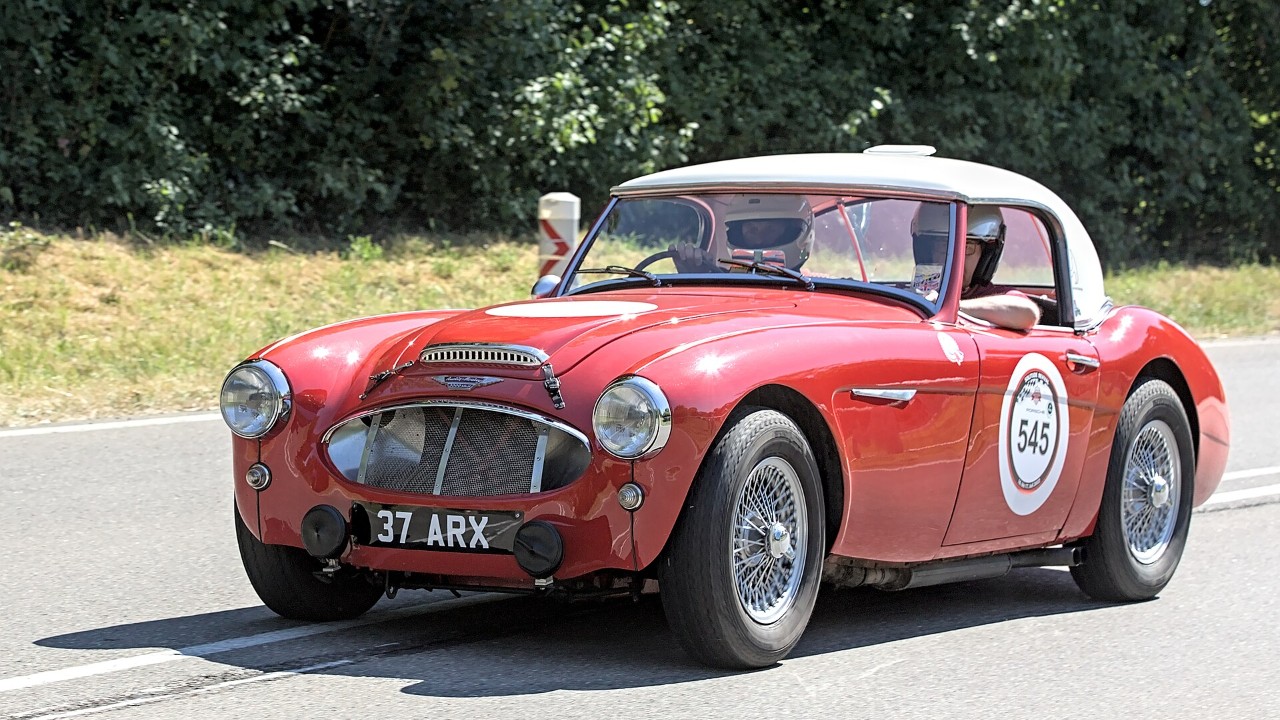
The Mk II 3000 arrived with the most memorable induction setup of any Big Healey. At the end of May 1961, BMC announced triple SU HS4 carburettors and an improved camshaft for the car. That trio of carburettors is the reason enthusiasts single out the early Mk II.
The two-seat BN7 version was also the rarest of the bunch. The Mk II run totalled 11,564 cars, but only 355 were BN7 two-seaters. Most buyers chose the BT7 2+2 instead, which accounted for 5,096 cars. Then, from the end of August 1962, the new BJ7 sports convertible switched to twin SU HS6 carburettors, and the triple-carb era ended.
In our view, the BN7 Mk II is the Big Healey to want if you value sharpness over comfort. It skips the occasional rear seats and has the busiest-looking engine bay of the line. It also belongs to the years when the works team still rallied 3000s. That program wound down by 1965, largely because the Mini Cooper S had become the faster bet. Just 355 BN7 Mk IIs were ever built, so a correct one is hard to find.
7. Austin-Healey 100-Six BN4
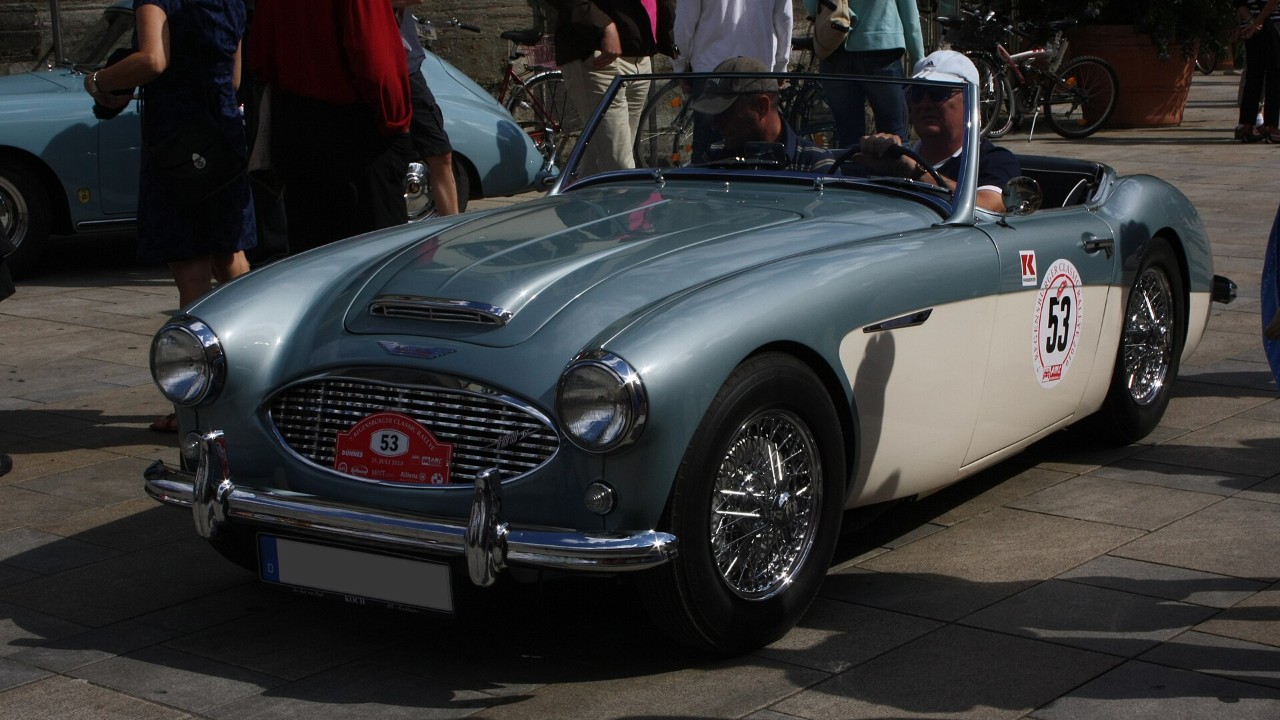
The 100-Six is the Healey that collectors tend to skip on their way to a 3000. That is a mistake, in our opinion. The 2+2 BN4 arrived in 1956 with two occasional rear seats, which later became optional, and a wheelbase stretched by 2 inches to 92 inches.
Its 2,639 cc C-Series six first made 102 bhp. Then, in 1957, a revised manifold and cylinder head raised that to 117 bhp. Late that year, production also moved from Longbridge to the MG plant at Abingdon. When The Motor tested the 117 bhp two-seat BN6 in 1959, it recorded a top speed of 103.9 mph and 0–60 mph in 10.7 seconds.
Those numbers put a family-friendly 2+2 within reach of the earlier four-cylinder roadsters. In total, Austin-Healey built 14,436 100-Sixes across both body styles. Our take: if you want a six-cylinder Healey with room for a child in the back, the later 117 bhp BN4 is the smart buy.
8. 1965 Austin-Healey Sprite Mk III
The Mk III Sprite made the little Healey a proper all-weather car. BMC announced it in March 1964 with wind-up side windows, hinged quarterlights and a slightly curved windscreen. For the first time, it also had exterior door handles with separate locks.
Under the skin, the changes mattered even more. The 1,098 cc engine kept its size but gained a stronger block and 2-inch crankshaft main bearings. At the rear, semi-elliptic leaf springs replaced the earlier quarter-elliptic setup, and the upper links disappeared. As a result, the car rode better without losing the go-kart feel that made Sprites so quick through corners.
We think the Mk III is the best-balanced small Healey for regular use. It also carries the bloodline of those class wins at Sebring and on the Alpine Rally. If you are torn between it and its MG twin, we compared them in our 1965 Sprite vs. 1965 Midget test. In the end, BMC built 25,905 Mk III Sprites.
More from Fast Lane Only