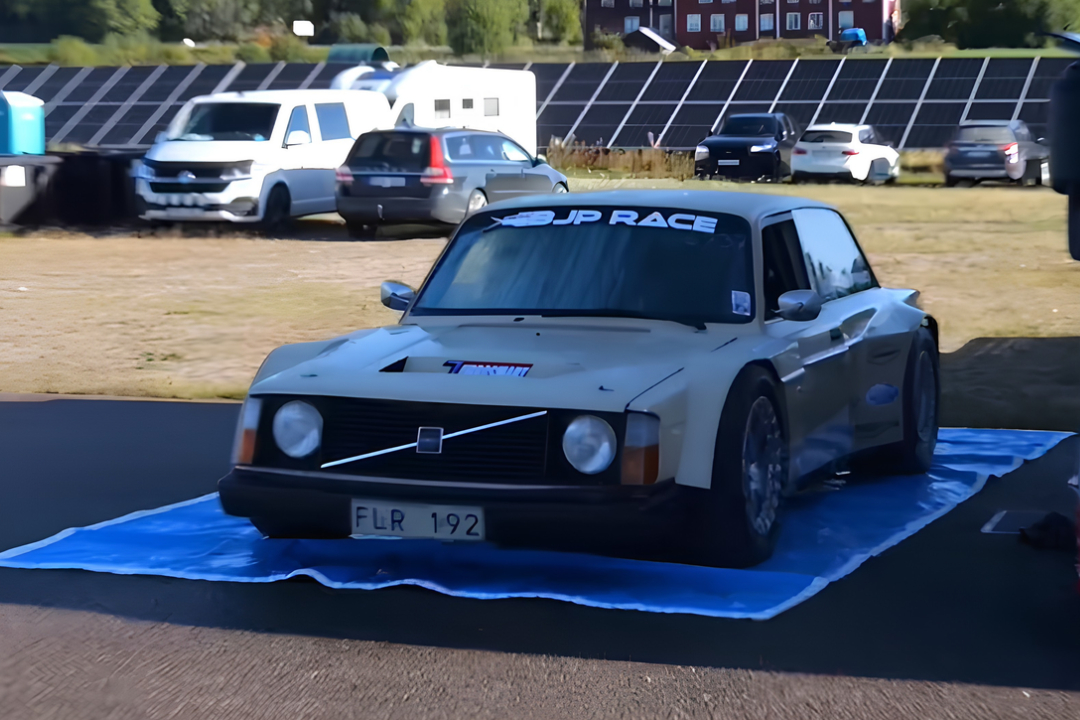
Most people would probably want to make sure a heavily modified Volvo was fully sorted before taking it to a drag strip. Peter Björck did something a little different with his AWD Volvo 240 wagon, which he calls Waffles.
After spending plenty of time in the garage rebuilding and tuning the car, Björck took the twin-turbo Lamborghini V10-powered Volvo to Hudik Raceway for its first proper test on a prepared drag strip. He had no idea what tire pressure would work best, no perfect launch setup and several things still to sort out.
The first pass came together despite the unknowns
Björck started cautiously, using the test-and-tune session to figure out how the car behaved on the prepared surface. The first pass produced a 1.38-second 60-foot time and a 218 km/h speed, with a 5.52-second eighth-mile time.
The launch was not perfect. Björck had set the launch RPM at 4,500, but the engine dropped to around 3,800 rpm when the car actually launched. He planned to increase the launch boost and torque for the next attempt.
Despite the numbers, Björck said the pass actually felt a little slow because the track was so good. He noted that the same power would have felt much faster on a normal street. Still, the car completed the run without a major problem, giving him a useful starting point for the next passes.
More power quickly exposed the setup problems
The second pass was aborted after the engine started cutting power. Björck traced the issue to the pitch-control system, which was reacting to the car’s movement and cutting the engine.
He also noticed the launch was losing RPM and believed the 400-unit launch torque target was too low. After making adjustments, the third pass improved to a 1.29-second 60-foot time, a 5.34-second eighth-mile time and 221 km/h.
The car was still not behaving perfectly. During another pass, the front wheels lifted off the ground enough to trigger the pitch control again. Björck said the system was too aggressive and needed more adjustment.
The Volvo started trying to do wheelies
The front-end lift became one of the biggest problems of the session. Björck said there was no issue with tire spin on the prepared surface. Instead, the Volvo was trying to lift its front wheels, something he clearly did not want to deal with.
He considered adding a parachute in the future and discussed changes to the suspension and tire setup, including potentially moving to radial tires. He also wanted to work on the car’s anti-squat characteristics rather than simply adding wheelie bars.
There were other tuning issues too. The car’s MoTeC system was cutting torque in third gear during the second day of testing, and Björck spent time looking through the logs to work out why the torque model was limiting the engine.
534 was enough for a first outing
By the end of the weekend, Björck had made eight passes, and the car was still in one piece. He did not have to repair the Volvo during the entire weekend, although the torque-cutting problem remained unresolved.
The best pass was the third one, which produced the 5.34-second eighth-mile run at 221 km/h. Björck said the car was running around 1.1 bar of boost, roughly 16 to 17 psi, although the boost was oscillating between about 1.1 and 1.2 bar.
He believed the twin turbos could support substantially more boost, but he was not yet sure how much the engine itself could handle. For now, the first test had already given him plenty to work on. The strangest part was how little the car seemed to care about the extra power. On a prepared track, Björck said it had no real traction problem. It wanted to lift the front end instead.
After years of garage work, the twin-turbo V10 Volvo 240 had finally made it onto a drag strip. It was not finished, but it had survived eight passes and left Björck with a 5.34-second starting point for whatever comes next.
More from Fast Lane Only
- Unboxing the WWII Jeep in a Crate
- 15 rare Chevys collectors are quietly buying
- 10 underrated V8s still worth hunting down
- Police notice this before you even roll window down
*Research for this article included AI assistance, with all final content reviewed by human editors.