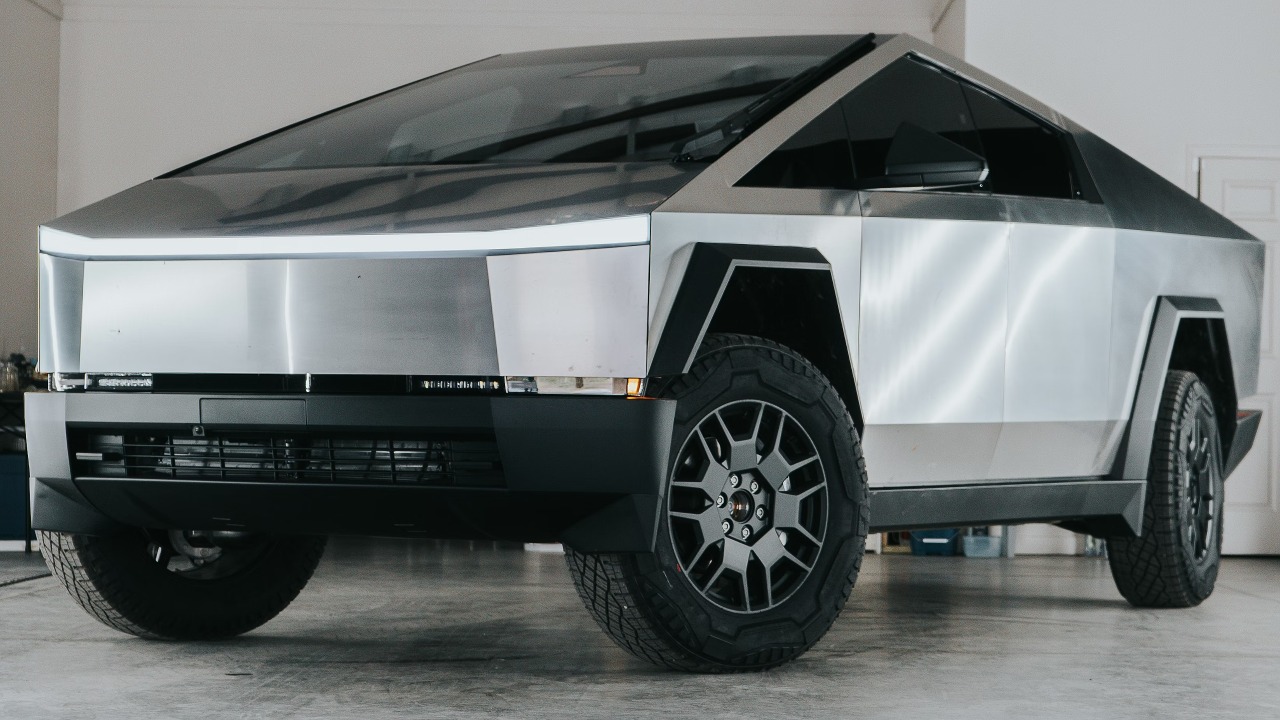
Tesla is steering its most polarizing vehicle into new territory just as enthusiasm at home appears to be fading. With Cybertruck sales in the United States sliding sharply from their launch peak, the company is now delivering the stainless steel pickup in the Middle East and testing whether a different kind of truck culture can revive a faltering experiment. The shift underscores how quickly the narrative around the Cybertruck has flipped from backlog to oversupply, and how urgently Tesla needs fresh demand to justify its bold bet on the model.
The move into the United Arab Emirates and neighboring markets is more than a routine geographic expansion. It is an early test of whether the Cybertruck’s radical design, premium pricing, and complex manufacturing can be sustained once the initial wave of early adopters in North America has been satisfied. If the Middle East cannot absorb meaningful volume, the vehicle risks becoming a niche halo product rather than the growth engine Elon Musk once promised.
From launch darling to demand problem
Cybertruck deliveries in the United States surged out of the gate, but the momentum has not held. Data from Cox Automotive shows that Tesla sold 20,237 Cybertrucks in the US last year, a figure that looks modest against the company’s earlier rhetoric about mass-market disruption. Another analysis put the annual tally at 20,237 units as well, and described a year-over-year decline of 48.1 percent, underscoring how quickly interest cooled once the initial backlog was cleared. For a vehicle that was framed as a cornerstone of Tesla’s next phase of growth, those numbers signal a serious demand gap rather than a temporary pause.
The broader trend is equally stark. Cox Automotive has reported that Tesla sold 38,965 Cybertrucks in 2024, but that total fell by nearly half in 2025, marking a 48 percent decrease in sales. That kind of drop is unusual for a relatively new model that should still be climbing its adoption curve, and it suggests that the Cybertruck’s appeal is narrower than Tesla anticipated. Instead of expanding into the mainstream pickup segment, the vehicle appears to be settling into a smaller pool of enthusiasts who are willing to tolerate its compromises in exchange for its distinctive look and performance.
Resale market sends an early warning
Softening demand in the primary market is being echoed in the used market, where resale values are slipping faster than Tesla would like. Reports on the secondary market describe a pattern in which Cybertruck Resale Market Weakens As demand for new vehicles softens, with some listings undercutting original purchase prices despite the model’s relative youth. For a brand that has often benefited from strong residual values, especially on high-profile models, that is a notable reversal. It indicates that buyers are not confident the truck will hold its value, a perception that can further chill new orders.
The weakening resale environment also reflects the Cybertruck’s awkward positioning. The vehicle was introduced as a premium, almost exotic pickup, yet it competes in a segment where buyers typically prize practicality, towing capability, and serviceability over avant-garde styling. As the novelty wears off, the combination of high price, unconventional design, and lingering questions about real-world usability appears to be weighing on both new and used demand. That backdrop helps explain why Tesla is now looking abroad for customers who might see the truck less as a work tool and more as a luxury statement.
Cybertruck goes to the Middle East
Against that domestic backdrop, Tesla has begun shipping the Cybertruck to the Middle East, positioning the region as the model’s first major market outside North America. Cybertruck Goes To The Middle East after the company opened orders for Cybertruck for the Middle East in September, and the first deliveries have now reached customers. The rollout started in the United Arab Emirates, with the UAE becoming the first territory outside North America to receive the all-electric pickup. From there, Tesla has extended availability to the wider Middle East, including the United Arab Emirates, Qatar, and Saudi Arabia, where local configurators are now live.
Early volumes, however, are modest. One report on Cybertruck Delivers noted that Tesla’s Cybertruck Delivers 63 Units in Middle East as North American Demand Plummets, a figure that underscores how nascent this expansion still is. The 63 Units delivered so far are a symbolic foothold rather than a meaningful offset to the tens of thousands of trucks that Tesla had once hoped to sell annually in its home market. Even if deliveries ramp steadily, the gap between current Middle Eastern volumes and the shortfall in North America is wide, and it will take sustained growth for the region to become more than a marginal contributor.
Premium pricing and regional positioning
Tesla is not discounting its ambitions in the Middle East, at least not on price. According to the region’s online configurator, The Cost of Going Global is steep, with pricing that starts at around AED 404,900 for the dual-motor configuration. That figure places the Cybertruck firmly in luxury territory, especially when compared with conventional pickups and SUVs available in the same markets. For the more powerful Cyberbeast variant, pricing climbs even higher, putting it in the same aspirational bracket as high-end performance cars rather than work-focused trucks.
This pricing strategy suggests Tesla is targeting affluent buyers who see the Cybertruck as a status symbol suited to the region’s highways and desert landscapes, rather than as a fleet or commercial vehicle. The company has highlighted the Middle East’s vast deserts and mountainous regions as a natural stage for the truck’s off-road capabilities, and early marketing has leaned into that imagery. At the same time, the high entry price narrows the potential customer base and raises the stakes: if the wealthy clientele Tesla is courting does not embrace the Cybertruck in sufficient numbers, there is little room to pivot to a more value-oriented pitch without undermining the model’s premium positioning.
Global growth hopes meet hard math
For Tesla, the Middle Eastern launch is being framed internally as a proof point for its broader international strategy. Company commentary on Implications for Tesla, Global Growth The suggests that successful delivery of Cybertrucks in the Middle East is meant to demonstrate that the model can be adapted to diverse regulatory environments and customer expectations. If that thesis holds, the region could serve as a template for future expansions into other markets that prize luxury vehicles and off-road capability. The Middle East, with its mix of high-income buyers and challenging terrain, is a logical test bed for that approach.
The numbers, however, remain unforgiving. With Cybertruck sales down by nearly half in 2025 and US volumes stuck around 20,237 units, even a robust Middle Eastern ramp would need to scale far beyond the current 63 Units to materially change the trajectory. Cybertruck for the Middle East is therefore less a guaranteed lifeline than a calculated gamble that a different cultural and economic context can succeed where North American demand has stalled. If the bet pays off, Tesla will have shown that the Cybertruck can be more than a curiosity confined to US freeways. If it does not, the model risks becoming a costly reminder that not every bold design can be willed into mass-market success, even by a company as influential as Tesla.
More from Fast Lane Only