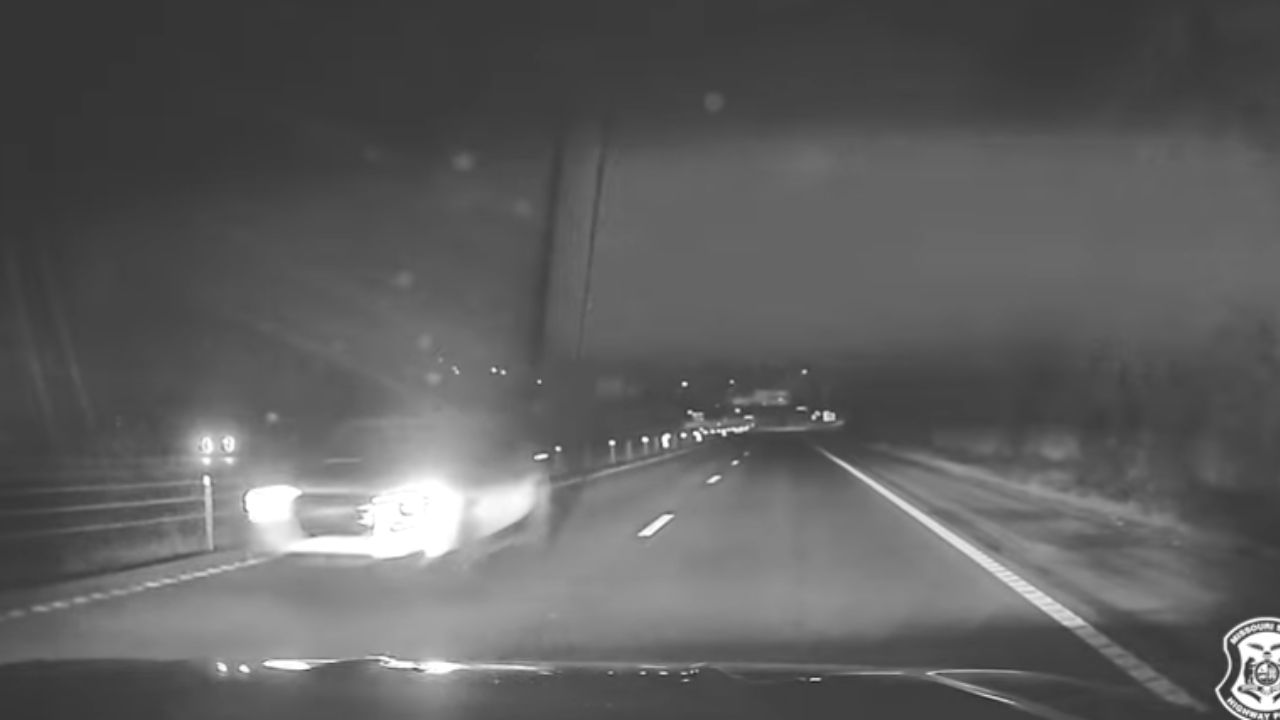
On a Missouri highway, a state trooper used his own cruiser as a barrier between a wrong-way driver and unsuspecting motorists, a split-second decision that turned a potential mass casualty crash into a controlled collision. You can see the stakes in the dash cam footage, where headlights appear in the wrong lane and the trooper accelerates toward danger instead of away from it. For anyone who drives that stretch of road, the video is a reminder that your safety sometimes depends on what an officer decides in the span of a few heartbeats.
As you watch the clip, you are not just seeing a dramatic near miss, you are watching how training, instinct, and technology intersect on a dark highway. The Missouri State Highway Patrol captured the entire encounter on camera, and the images have since circulated widely, sparking debate about how far troopers should go to stop impaired drivers before they turn a mistake into a fatal crash.
The moment a routine patrol turned critical
You start in the passenger seat of the patrol car, looking through the windshield as traffic flows normally along the divided highway. Then, in the distance, a pair of headlights appears where they should not be, drifting toward you in the wrong lanes. In the Dashcam clip shared from the Missouri State Highway Patrol, the trooper does not hesitate, he swings across the median and accelerates directly toward the oncoming vehicle, choosing to intercept it before it can reach a line of unsuspecting drivers.
By the time the wrong-way car fills the frame, you can see there is no room left for negotiation. The trooper positions his cruiser as a moving shield, absorbing the impact so that the other driver, and the people you imagine just beyond the camera’s view, are spared a head-on collision at full highway speed. Officials later arrested the motorist, who they say was driving while impaired, turning what could have been a deadly crash into a controlled stop that you can replay second by second in the Dashcam video.
Inside the trooper’s split-second decision
From your vantage point on the couch, it is easy to pause, rewind, and analyze every frame, but inside that cruiser the trooper had only a few seconds to weigh his options. You can see him make a rapid U-turn, then commit to a head-on intercept, a tactic that carries obvious risk to his own safety. In the New footage released by the Missouri State Highway Patrol, you watch the cruiser surge forward as the wrong-way headlights grow larger, a visual that underlines how little time there was to call for backup or set up a roadblock.
For you as a driver, that decision matters because it shows how troopers sometimes choose between imperfect options, sacrificing their own vehicle, and potentially their own well-being, to keep an impaired motorist from reaching a crowded stretch of highway. The agency’s training prepares officers to recognize the unique danger of a wrong-way driver, where every passing second means another quarter mile of risk, and the video makes clear that waiting for a safer opportunity was not realistic once the car was already barreling toward oncoming traffic.
What the video reveals about impaired driving risks
When you watch the wrong-way car drift into view, you are seeing more than a navigation mistake, you are seeing the real-world consequence of impaired driving. Officials say the driver in this case was under the influence, a detail that explains the slow reaction to sirens and the failure to correct course even as the patrol car approached. The Missouri State Highway has emphasized that impairment can turn a familiar route into a maze, where off-ramps look like on-ramps and lane markings blur into a confusing pattern.
For you, that means the most dangerous driver on the road might not be the one weaving in and out of traffic at high speed, but the person who is so compromised that they do not realize they are traveling against the flow at all. The wrong-way angle captured in the patrol car’s video is a stark illustration of how quickly an impaired driver can put dozens of people at risk, including families in minivans, truckers hauling freight, and commuters heading home in compact sedans like a Toyota Corolla or a Honda Civic with no warning that disaster is coming toward them.
How technology and training shape what you see
The clarity of the footage is not an accident, it is the result of years of investment in in-car cameras and digital evidence systems that now ride along in nearly every patrol vehicle. When you see the trooper’s perspective in the Dashcam clip, you are looking through a wide-angle lens mounted on the cruiser’s windshield, tied into a system that records audio, speed, and location data that can later be reviewed by supervisors, prosecutors, and, as in this case, the public.
For you as a viewer, that technology turns an abstract police report into a concrete narrative, one where you can judge for yourself how quickly the trooper reacted and how close the wrong-way driver came to colliding with other vehicles. The Missouri State Highway Patrol uses these recordings not only as evidence in impaired driving cases, but also as training material, replaying moments like the rapid U-turn captured in the New video so that other troopers can study what worked and what nearly went wrong.
What you can do when a wrong-way driver is on the road
Watching the trooper’s collision on video, you might wonder what you should do if you ever encounter a similar threat from behind the wheel. The first step is to recognize the signs early: headlights facing you in your lane, brake lights from cars ahead suddenly flaring, or traffic on a normally busy side of the highway thinning out in an odd way. If you suspect a wrong-way driver is nearby, you should slow down, move as far right as safely possible, and, if you can, exit the highway at the next opportunity rather than trying to outrun the danger in the left lane.
Once you are in a safe spot, you can call 911 and give dispatchers as much detail as you can about the vehicle, including its color, make, and direction of travel, information that can help troopers like the one in the Dashcam video locate and intercept the threat. You should never attempt to block or chase a wrong-way driver yourself, because the same impairment that led them into the wrong lanes can also make their reactions unpredictable, and the safest place for you is behind a guardrail or off the roadway entirely while trained officers move in.
More from Fast Lane Only