The De Tomaso name is returning to the road with a car that looks like it slipped through a wormhole from the 1960s, yet is engineered for the present. The P72, a low-volume supercar that has inched from concept to production intent over several years, is now close enough to reality that early customers are preparing for deliveries. For a brand that once faded into obscurity, the P72 represents both a resurrection and a statement of intent about what an analogue-focused supercar can still be.
Rather than chasing the latest hybrid systems or all-electric powertrains, De Tomaso has chosen a different path, pairing a hand-assembled V8 with a carbon chassis and a cabin that prioritizes tactility over touchscreens. The result is a machine that aims to feel as special to operate as it looks to behold, and that is before considering the extreme rarity and price that frame it as a collector’s piece from day one.
From long-gestating concept to production reality
The P72’s journey from design study to road-ready supercar has been unusually drawn out, even by boutique standards, which has only heightened anticipation. After years of development, De Tomaso revealed the first prototype that reflected the production-intent design in the middle of 2025, using that car as a rolling laboratory to validate aerodynamics, cooling, and real-world usability before customer builds begin. That prototype has served as the reference point for final adjustments, with the company indicating that the first examples are scheduled to be delivered later in 2026 once testing and homologation are complete.
Behind the scenes, the brand has treated the P72 as a relaunch platform, using the extended gestation to refine both engineering and customer support. The prototype phase has allowed De Tomaso to demonstrate that the car is not a static showpiece but a fully functioning machine, while also giving engineers time to align the production car with modern safety and performance expectations. The company’s own communication describes the P72 as ready for the road, signaling that the long wait is finally giving way to a tangible production run.
Design language rooted in the 1960s, executed with modern tools
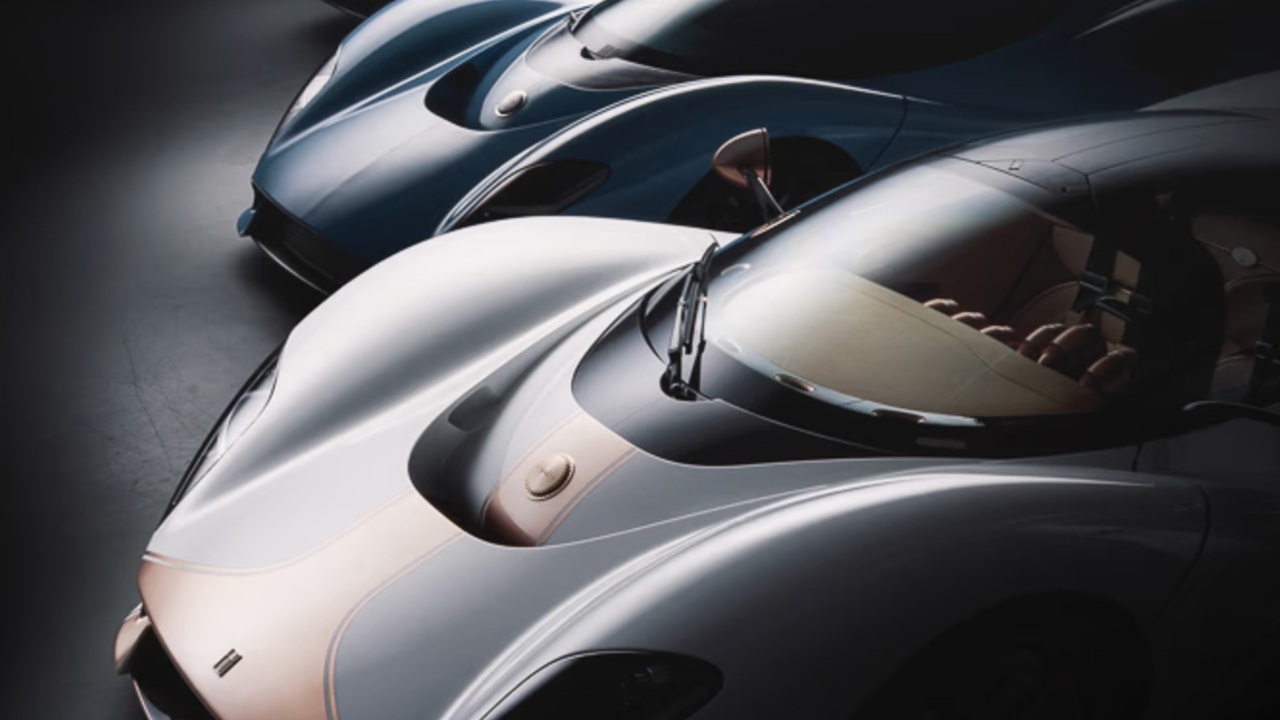
Visually, the P72 is a deliberate throwback to the era of curvaceous Le Mans racers, yet it is built with contemporary materials and techniques. The exterior is a flowing teardrop, with long, arcing fenders, a low nose, and a canopy-style cockpit that clearly nods to the 1965 P70 and other 1960s Le Mans machines. De Tomaso has framed the car as a modern tribute to that period, with the bodywork emphasizing organic surfacing rather than the sharp creases and aggressive aero addenda that dominate many current supercars.
Beneath that retro-inspired skin sits a thoroughly modern structure. The P72 rides on a carbon chassis that is related to the architecture used by the Apollo IE and is designed to meet FIA safety standards, which gives the car the rigidity and crash performance expected of a contemporary high-performance model. This combination of classic proportions and advanced underpinnings is central to the P72’s appeal, presenting a car that looks like a museum piece but is engineered to withstand the demands of modern track and road use.
A hand-assembled V8 at the heart of the experience
While many rivals move toward electrification, De Tomaso has anchored the P72 around a traditional internal combustion heart that is meant to define the driving experience. At the heart of the car is a hand-assembled 5.0 liter supercharged V8, developed specifically for the P platform and tuned to deliver both high output and a broad torque curve. The production specification lists 700 horsepower and 605 lb ft of torque from a supercharged 5.0 liter Ford Coyote based engine, with development work by Roush to tailor the power delivery and durability for this application.
The decision to use a supercharged layout rather than turbocharging aligns with the car’s analogue ethos, prioritizing linear response and immediate throttle reaction. De Tomaso has emphasized that the engine is built with bespoke forged internals and calibrated to provide a rich, mechanical character rather than a muted, filtered soundtrack. The result is a powertrain that aims to feel old-school in its engagement while still delivering performance figures that place the P72 firmly in modern supercar territory.
Performance targets and driving philosophy
On paper, the P72’s performance targets are as serious as its styling is romantic. The company has cited a top speed of approximately 221 mph (355 km/h), a figure that places the car among the fastest combustion-powered road machines currently in development. That headline number is supported by the combination of the 700 horsepower output, the lightweight carbon structure, and aerodynamics that are designed to provide stability at very high speeds without resorting to extreme wings or splitters that would compromise the car’s classic lines.
Yet De Tomaso has been equally vocal about the driving philosophy behind those numbers. The P72 is positioned as a celebration of analogue driving, with an emphasis on mechanical purity and driver involvement rather than outright lap times. Company statements around the launch of the production-spec car stress a commitment to vehicles that stir the soul and highlight analogue driving and mechanical purity, a stance that sets the P72 apart from the increasingly digital, software-driven character of many contemporary hypercars. In practice, that means the performance is intended to be accessible and rewarding, not just impressive on a spec sheet.
Exclusivity, pricing, and the business of a boutique revival
The P72 is not only a technical and design statement, it is also a carefully calibrated business proposition aimed at collectors and enthusiasts willing to pay for rarity. Production is capped at 72 units, a figure that De Tomaso has tied directly to the goal of ensuring exclusivity. All 72 production slots were sold out years ago, with reports of a lengthy waiting list for any potential cancellations, underscoring the level of demand for a car that blends heritage styling with modern engineering in such a limited run.
That scarcity is matched by a price tag that firmly places the P72 in hypercar territory. Prices are believed to start around €1.6 million, roughly $1.87 million, with other reporting citing a figure of €1.6 m and $1.87 m for the car in its base configuration, and some references noting a similar €1.6 million (~$1.8 million) level depending on specification. Each example is commissioned to the owner’s preferences, which can push the final cost higher, and De Tomaso has arranged aftersales support for North American buyers through Miller, a move intended to reassure clients that the brand’s revival is backed by practical service infrastructure as well as romantic storytelling.
More from Fast Lane Only