Ferrari’s naturally aspirated V12 is living on borrowed time, yet the company is quietly engineering its most radical evolution in the shadows. While the 12Cilindri road car keeps the lineage alive in public, a more secretive project, hinted at by patents and camouflaged prototypes, suggests that Maranello is preparing a hypercar whose engine technology will be heard long before it is ever seen.
That tension between visibility and secrecy, between heritage and experimentation, now defines Ferrari’s approach to twelve cylinders. The familiar scream of a high revving V12 is being reimagined with unconventional hardware and wrapped in bodywork so disguised that even dedicated spotters around Maranello, Italy struggle to decode what is coming next.
The last great road‑going V12, hiding in plain sight
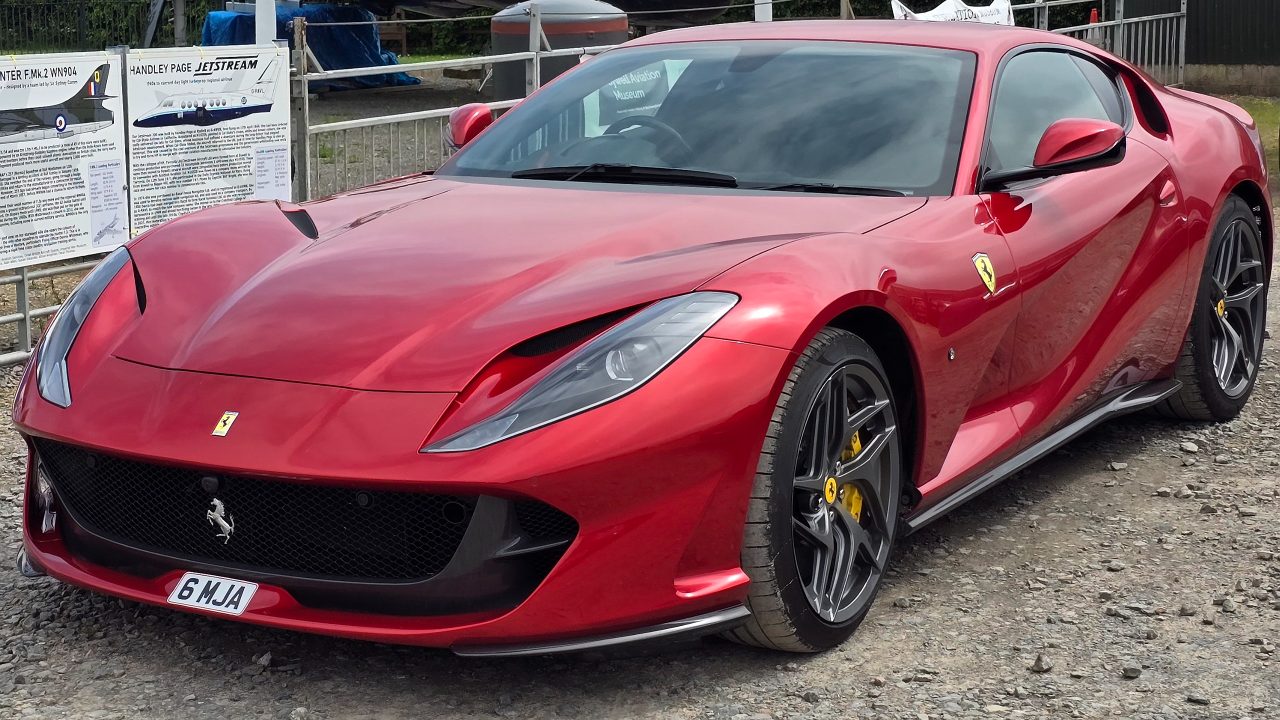
Ferrari has already framed the 12Cilindri as a kind of rolling manifesto for the V12’s future, even as regulations and electrification close in. Official material on the car’s Technical Specifications confirms that its heart is a Naturally Aspirated F140HD 6.5 litre unit, a capacity that anchors it firmly in the brand’s long line of big displacement twelve cylinders. The same data lists the engine under the simple label ENGINE, a reminder that in this car, everything else is built around that mechanical centrepiece rather than the other way round.
Performance figures underline how far Ferrari has pushed a configuration many rivals have already abandoned. The Ferrari 12Cilindri is credited with a Power output of 830 PS, equivalent to 610 kW or 819 hp, numbers that place it squarely in hypercar territory despite its front engined grand tourer layout. A separate breakdown of Specs and Performance describes the car as a new Ferrari supercar and highlights the 12Cilindri Engine Highlights, reinforcing that the naturally aspirated character is not a nostalgic afterthought but the core selling point.
Design as camouflage, and a name that refuses to whisper
Ferrari’s design leadership has treated the 12Cilindri as both a tribute and a test bed. In detailed Technical Details and Design notes, the company explains that With the Ferrari 12Cilindri, Flavio Manzoni and the team at Ferrari Centro Stile set out to radically reinterpret the classic front engined V12 silhouette. References to a long bonnet and sculpted rear are joined by more experimental elements, such as the so called Delta Wing roof lines that flow into a double bulge clamshell tail. One analysis of the car’s shape notes that this treatment does away with the earlier Delta Wing roof lines and turns the rear into a double bulge clamshell instead, a choice that visually lowers the car and makes its proportions harder to read at a glance.
Even the name is a statement of intent. A detailed explanation of how the 12Cilindri and its open top sibling were christened describes the badge as a Name That Says It All. Unlike some earlier models that relied on coded designations or historical references, Ferrari chose to spell out the car’s legendary 12 cylinder engine directly in Italian. That blunt honesty about what sits under the bonnet contrasts with the visual complexity of the bodywork, which seems designed to make it harder for casual observers to distinguish a standard 12Cilindri from any more exotic prototypes that might share its basic proportions.
Tradition, innovation and the secret oval piston V12
Ferrari’s own language around the 12Cilindri makes clear that the car is not just a swansong but a bridge. In an official reflection on its new V12 icons, the company writes that Tradition informs Innovation and that Innovation shocks Tradition, summing up the internal debate over how far to push a format that has defined the brand for decades. The same piece describes how the 12Cilindri and its Spider counterpart are engineered for the seamless flow of power, a phrase that hints at both mechanical refinement and the need to reconcile old school combustion with modern expectations of drivability and efficiency.
That balancing act becomes even more striking when set against Ferrari’s recent patent activity. A report on a new filing explains that Ferrari has patented a secretive V12 engine that uses pistons in the shape of ovals, described as “stadium shaped” in the documentation. The patent text notes that these unusual pistons are detailed in a report filed by Ferrari, suggesting a serious research programme rather than a speculative sketch. While the filing does not explicitly tie the design to a specific model, the combination of a traditional cylinder count with such unconventional internal geometry points directly at the kind of hypercar powertrain that would need to stand apart from the already extreme F140HD 6.5 litre unit.
Clues from Maranello’s test routes and the Dodici Cilindri interior
Evidence that Ferrari is already testing something beyond the 12Cilindri has surfaced around its home town. An account of a Mysterious V12 Ferrari spotted near Maranello, Italy describes a heavily camouflaged prototype circulating on local roads. The observer notes that One of the great things about being around Maranello, Italy is the chance to see development cars in the wild, and adds that enthusiasts would never say no to Ferrari using their V12 engine in another car. The description of the test mule is deliberately vague, but the emphasis on a clearly audible twelve cylinder soundtrack suggests that the company is not confining its V12 experiments to the 12Cilindri’s front engined format.
Inside the cabin, Ferrari has already shown how a future hypercar might feel. Coverage of the Dodici Cilindri, a close relative of the 12Cilindri, notes that Inside, Ferrari has removed physical buttons and moved to a fully digital interface that wraps around the driver. This approach aligns with broader comments about a futuristic cockpit that contrasts sharply with the analogue drama of the V12 itself. When combined with the external camouflage of test cars and the radical oval piston patent, the interior philosophy suggests that any upcoming hypercar will pair a very traditional engine layout with a cabin that looks and operates more like a high end device than a classic grand tourer.
The V12 experience, from open‑air Spider to unseen hypercar
For those who want to hear the V12 without a roof in the way, Ferrari has already delivered a Spider version of its latest engine platform. A detailed walk through of the 12Cilindri Spider describes it as Ferrari’s latest and greatest front engined grand tourer, explicitly named after its naturally aspirated V12 engine. The same material notes that the Spider effectively replaces the 812 Superfast in the brand’s line up, confirming that the 12Cilindri architecture is now the primary carrier of Ferrari’s twelve cylinder identity on the road. With the Spider, the company has demonstrated that it can still package an 819 hp V12 in a car that is usable, luxurious and compliant with current regulations.
Yet even this open air flagship may not represent the ultimate expression of the engine. A detailed review by Andrew Frankel recounts how, about 20 miles into a drive, There came a moment when the author stopped trying to persuade Google Maps to cooperate and instead focused entirely on the way the V12 delivered its power and sound. That anecdote, modest on the surface, captures why Ferrari is investing in secretive hardware like the oval piston design and why it continues to run disguised V12 prototypes around Maranello, Italy. The company understands that the emotional impact of a screaming twelve cylinder, whether in a grand tourer or a hypercar that most people will never see, is still central to its identity, and it is working quietly to ensure that impact survives in a world that is increasingly hostile to engines of this kind.
More from Fast Lane Only