On most streets, the 1969 Polski Fiat 125p slips past without a second glance, its boxy profile dismissed as just another tired Eastern European saloon. Yet this unassuming sedan carried families across a continent, earned hard currency abroad, and even rewrote endurance records that many better known marques never touched. Few people recognize it today, but the reach of the 125p went far beyond what its modest shape suggests.
Born from a licensing deal and engineered for survival in difficult conditions, the Polski Fiat 125p combined Italian style with Polish pragmatism. It became a workhorse of everyday life, a surprisingly capable competition car, and a quiet export success that stretched from the Eastern Bloc to Cuba and Thailand.
From Italian blueprint to Polish workhorse
The story of the 1969 Polski Fiat 125p starts with a partnership. The Polski Fiat 125p was a licence-built version of an Italian Fiat sedan, produced in Poland by FSO. The arrangement gave Polish industry access to contemporary Western design at a time when domestic car development lagged behind, while Fiat gained a foothold in a vast socialist market without building factories there itself.
Mechanically, the Polski Fiat 125p was engineered for durability rather than glamour. The car retained relatively simple running gear and a straightforward drivetrain, which made it easier to service in workshops with limited tools and spare parts. According to production figures, the car stayed in continuous manufacture until late June 1991, and in total 1,445,689 examples were built. For a model from a centrally planned economy, that number alone illustrates how thoroughly it permeated Polish roads.
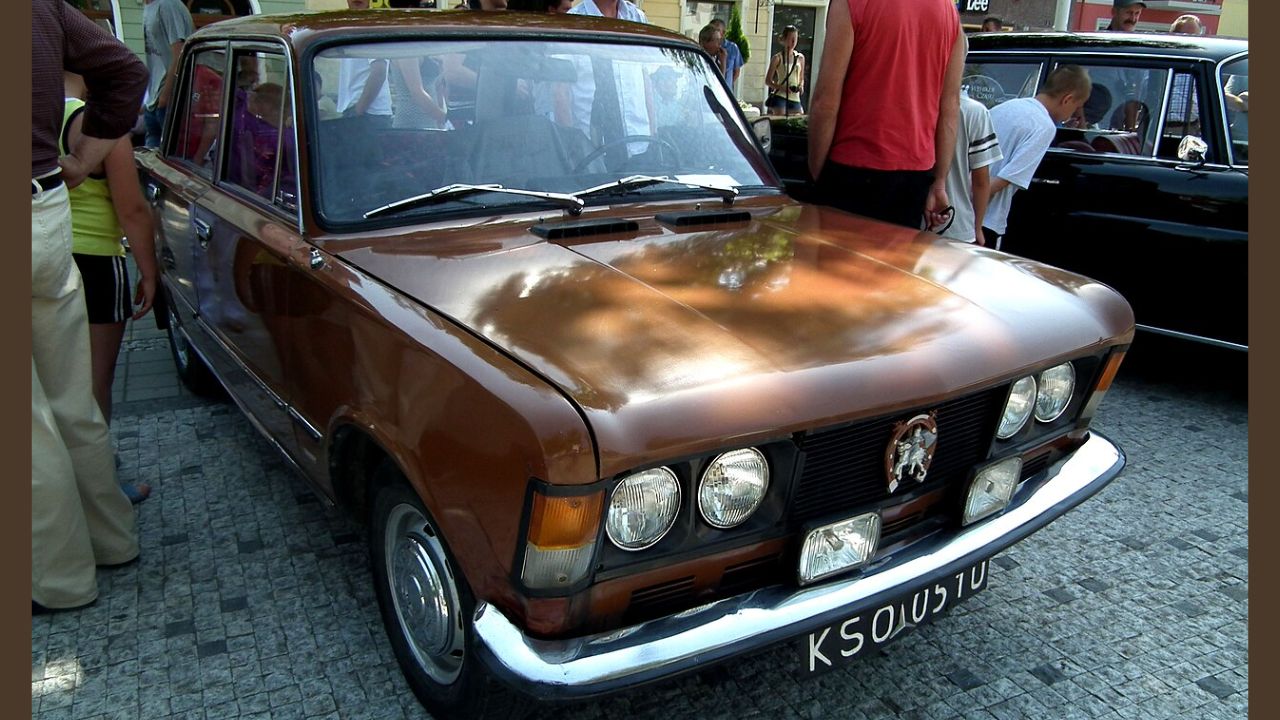
Stylistically, the 125p borrowed the crisp three-box form of its Italian inspiration, but the details were distinctly local. Polish cars differed from the original Italian version in several ways, including double round headlights in place of square units, simpler bumpers and a plainer front grille. These changes were not simply aesthetic; they reflected a drive to cut costs and simplify manufacturing, while also accommodating local regulations and supply chains.
Inside, the car was basic but functional. Reports describe durable leatherette seats and a spacious cabin that could handle a family and their luggage without complaint. The design language remained rooted in the 1960s long after Western manufacturers moved on, yet that conservatism made the 125p easier to keep in production and maintain.
Built for Polish conditions, and then for the world
From the outset, the Polski Fiat 125p was adapted for the roads and climate it would face. Compared to the original Italian 125, the Polish version had simplified trim, fewer luxury features and was tuned for durability and ease of maintenance under local conditions. As one period description notes, it was explicitly configured for Polish conditions, which meant rough surfaces, cold winters and limited access to high quality fuel.
That pragmatism paid off. The Polski Fiat 125p quickly became a fixture of state fleets, taxis and private ownership. Its relatively high ground clearance, simple suspension and robust components let it cope with potholes and unpaved stretches that would challenge more delicate Western saloons. Owners valued the car less for refinement and more for the fact that it started, hauled and survived.
The 125p did not stay confined to its home market. Poland used the model as a valuable export earner. The car was shipped across the Eastern Bloc and also to Western markets for hard currency. It went to the United Kingdom, West Germany and Finland, and then even further afield, with exports reaching Cuba and Thailand. One account describes how the 125p was exported to Eastern Bloc and Western countries for much-needed foreign exchange.
This global reach is part of what makes the 125p so surprising today. In period photographs from Finland or the United Kingdom, the Polish saloon appears alongside Volvos, Fords and Vauxhalls, often wearing different badges or trim but clearly recognizable to anyone who grew up in Warsaw. In Canada and other markets, it represented a cheap entry into European motoring, even if reviewers sometimes criticized its dated feel.
Despite this spread, the car never achieved the name recognition of Western icons from the same era. Some of that anonymity comes from branding. In certain export markets, the car lost the Polski Fiat name and was sold simply as a FSO 125 or under local designations. In others, it was overshadowed by better known Italian Fiat products that shared part of its styling but not its exact specification.
Endurance records that few remember
The 125p did more than carry families and officials. It also proved its stamina on the track. In 1973, a specially prepared Polski Fiat 125p took part in a world endurance record attempt that pushed the car far beyond normal use. A period photograph by Chris Niedenthal shows the Fiat 125p on track during this successful record run, a rare visual reminder that the boxy saloon once lived at sustained high speed.
The attempt was not a solo effort. In 1973 eight drivers, including Sobi and others, shared the wheel and beat three long distance touring car records in the 1100 to 1500 cubic centimeter class. They did it by keeping the car circulating at an average travel speed equal to 138 km/h, a figure that comes directly from period documentation. That Average travel speed made it possible to set distance marks at 25,000 kilometers, 50,000 kilometers and 25,000 miles over the course of several days.
The statistics are stark. Holding 138 km/h in a mass production sedan designed for rough roads is demanding even on a modern circuit. For a car associated in popular memory with slow traffic and smoky exhaust, the idea of a 125p pounding around a track at that pace, day and night, defies stereotype. The record run demonstrated that under the right preparation, the platform had reserves of strength that everyday use rarely revealed.
Those records also fed into domestic pride. In a socialist economy where consumer choice was limited, proving that a home built car could compete in international record books had symbolic value. It suggested that Polish engineering, even when constrained by licensing and political realities, could match or surpass foreign benchmarks in endurance.
Rally stages and the Monte Carlo spotlight
The endurance run was not the only time the Polski Fiat 125p stepped into the sporting spotlight. The car also contested international rally events, where its sturdy construction and predictable handling made it a natural candidate for long distance competition on mixed surfaces.
One of the most notable outings came at the 41st Monte Carlo Rally in 1972. In that event, a 125p driven by the duo of Mucha and Jaworowicz reached the finish among a small group of classified cars and won its class in the 1600 cubic centimeter category. Records describe how the Mucha Jaworowicz crew brought the car home as one of only 34 finishers, a testament to both driving skill and mechanical stamina.
Success in Monte Carlo mattered far beyond the rally community. The event was one of the most prestigious in the world, and simply appearing there placed the Polski Fiat 125p alongside factory backed entries from Western manufacturers. A class win, even in a lower displacement bracket, showed that the car could survive and perform in one of the harshest competitive environments, from icy mountain passes to narrow village streets.
These rally exploits also fed back into the car’s image at home. Owners could look at their own sedans and see a direct link to machines that had tackled the Col de Turini and other legendary stages. For a population that often waited years for delivery of a new car, that connection added a layer of aspiration to what was otherwise a practical purchase.
Mass production, corrosion and a fading presence
In raw numbers, the Polski Fiat 125p was anything but obscure. Over its production run, more than 1.4 m examples were built as a licence copy of an Italian saloon, a figure that aligns closely with the detailed tally of 1,445,689 cars produced. Some 1,445,689 units left the Warsaw factory, yet relatively few survive in good condition today. Contemporary accounts point out that the Warsaw built cars proved as corrosion prone as their Italian counterparts, and harsh winters with salted roads accelerated the decay.
That vulnerability to rust means many 125p bodies simply dissolved over time, especially in regions where cars were used year round without extensive rustproofing. In Poland, the car often served as a family workhorse until structural corrosion made repairs uneconomical, at which point it was scrapped rather than restored. In export markets, the car’s low purchase price and modest image meant few owners saw it as a future classic worth preserving.
As a result, the 125p is now far rarer on the road than its production figures suggest. Enthusiast communities in Poland and abroad have begun to rescue and restore surviving examples, but the starting pool is small. Those that remain in original condition attract growing attention at shows, where their period details and once familiar silhouette now seem exotic.
The car’s reputation has also evolved. Some commentators describe the Polski Fiat 125p as a flawed yet aspirational object. One video portrait of the model characterizes it as a Polish sedan that many people desired despite problems and early reliability issues. That tension between dream and reality mirrors broader memories of life in late socialist Poland, where access to a private car, even an imperfect one, represented freedom and status.
Why recognition lags behind achievement
Given its production volume, geographic reach and competition record, the 1969 Polski Fiat 125p might be expected to enjoy the same recognition as other mass market classics. Instead, it occupies a quieter corner of automotive history, often overshadowed by both Western icons and more radical Eastern Bloc designs.
Several factors help explain that gap. First, the car’s styling, while clean, lacked the distinctive flair that made contemporaries like the Citroën DS or BMW 2002 instantly recognizable. Second, the licensing arrangement blurred its identity. Some saw it as a lesser copy of an Italian original, others as a state issued appliance, and few as a standalone design.
Third, the political context shaped how the car was remembered. In Poland and other former socialist states, the 125p became associated with long waiting lists, bureaucratic allocation and the compromises of centrally planned consumer goods. After political change, many owners were eager to move on to newer Western models, and the old Polski Fiat was discarded rather than cherished.
Yet when the car’s story is traced in full, a different picture appears. The Polski Fiat 125p was a bridge between East and West, a product of cooperation between Fiat and FSO that brought Italian engineering into Polish factories. It was rugged enough to survive bad roads, adaptable enough to be exported from the Eastern Block to the West for hard currency, and strong enough to sustain a 125 m themed narrative in modern retrospectives that track how Poland sent the 125 models to Finland, the United Kingdom and Canada through Poland exports.
More from Fast Lane Only