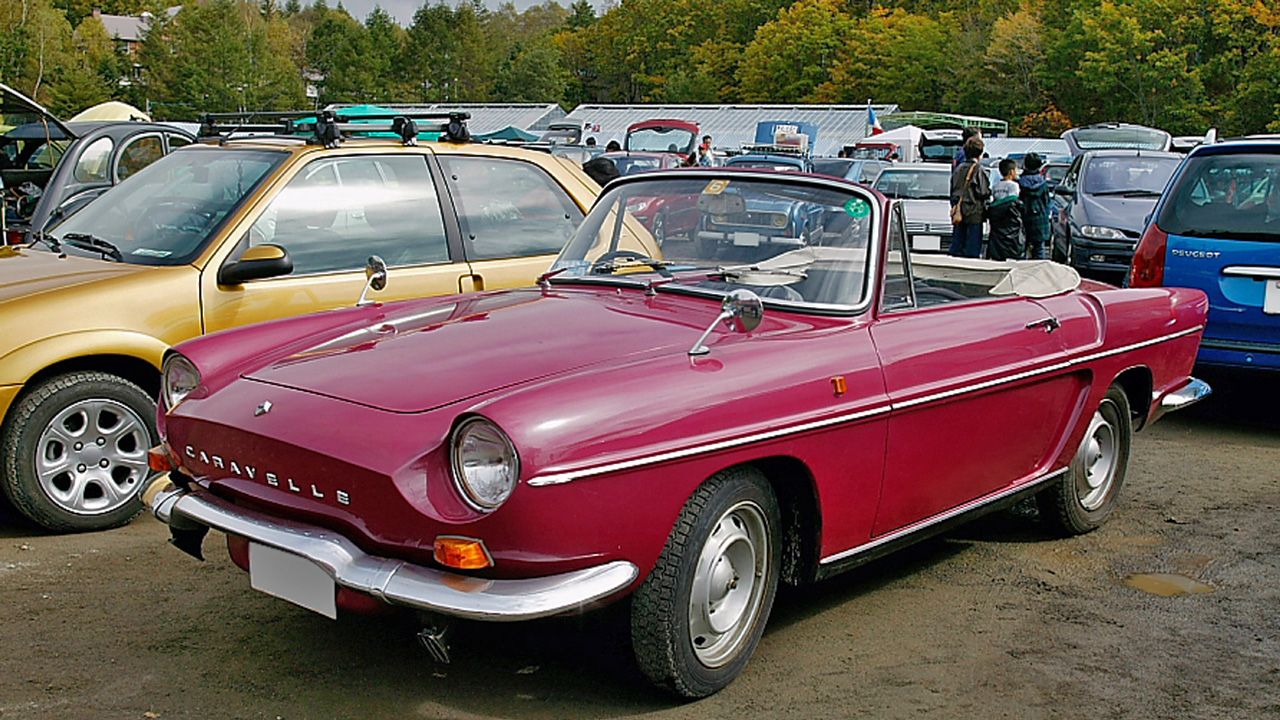
The Renault Caravelle arrived in the late 1950s as a compact French convertible that put style ahead of raw speed, a car built to be seen in rather than to dominate a timing sheet. It shared humble mechanical roots with Renault’s sensible saloons, yet its low body, delicate chrome and Riviera-ready cabin turned it into a fashion accessory on wheels. For enthusiasts who only know the era’s icons from Germany, Britain or Italy, this softly spoken French alternative tells a different story about what a “sports car” could be.
From Floride to Caravelle
When Renault developed its small open car, the company did not start with a blank sheet of paper. The project used the running gear and rear-engine layout of the company’s mainstream models, then wrapped those parts in a low, elegant body that looked nothing like the upright family cars in Renault showrooms. In European markets the car was introduced as the Renault Floride, a name chosen to evoke sun, sea and holiday roads rather than motorsport circuits.
Contemporary accounts describe how the Floride and Caravelle names were applied to the same basic car, with regional differences and later rationalisation. One detailed overview of the Renault Caravelle explains that the line covered both coupé and cabriolet versions over a production run that stretched across the 1960s. Early cars leaned heavily on the styling statement, while later updates focused on modest mechanical improvements and a more unified identity.
Even among dedicated owners, the dual identity still prompts debate. Enthusiast discussions highlight that these were effectively two badges for one model line, with the Floride name used on early European cars and Caravelle adopted elsewhere. A detailed feature on Floride and Caravelle notes that both names coexisted before Renault standardised on Caravelle in the 1960s, a shift that helped simplify marketing while keeping the core design intact.
The name game became even more delicate when Renault looked across the Atlantic. A period account shared in a dedicated Floride and Caravelle community records that the “Floride” name was considered unsuitable for 49 of the 50 states of the U.S., since it could have implied disrespect to the other states by singling out Florida. That discussion, preserved in a Floride owners group, helps explain why Renault leaned on the Caravelle badge in North America, where local sensitivities could easily turn a light-hearted name into a marketing headache.
Paris show glamour and Riviera dreams
Renault chose a suitably glamorous stage for its compact convertible. A detailed timeline shared among fans recalls that Renault Floride models were introduced at the Paris Motor Show in the late 1950s, where the public also encountered the Renault Caravelle name as part of the same stylish project. In one enthusiast summary, the phrase “At the 1958 Paris Motor Show, the public was introduced to the Renault Caravelle” is used to underline how the company framed the car from the beginning as a fashionable object rather than a workhorse, even if the mechanical base came from everyday saloons.
Marketing language from the period leaned into that image. A retrospective on the car’s image notes that in 1958 Renault called its new Caravelle “a dream car come true,” a phrase that captured how the company wanted buyers to see the model. That same piece, which follows the story of the Caravelle, describes how, growing up in the 1960s, Lee Richardson associated the car with sunny holidays and coastal roads rather than with racetracks or rally stages. The Caravelle was built to inhabit postcards and seaside promenades.
Period photographs and owner recollections reinforce that point. One history of a 1960 Renault Floride Cabriolet describes the Renault Floride, known as the Caravelle in some markets, as “a stylish compact coupe and convertible” that stood out for its clean lines and bright colors. That description, preserved in a Floride history post, matches the way the car appears in surviving images: slim pillars, a low beltline, and just enough chrome to catch the light without overwhelming the shape.
The Floride and Caravelle story is also kept alive in social media groups that treat the car as a shared secret. In one enthusiast community dedicated to the Renault Caravelle and Floride, owners swap restoration tips, track down rare trim pieces and share period brochures. A recent thread in a Caravelle owners group shows how that passion persists, with members comparing paint codes and interior fabrics to keep surviving cars faithful to their original Riviera-ready look.
Design that put style ahead of speed
Under the skin, the Caravelle never tried to compete with high performance sports cars. Its mechanical package was derived from Renault’s mainstream models, with modest power and a rear-engine layout that prioritised packaging and simplicity. What made the car distinctive was the way those ordinary parts were dressed up. Period road tests and later retrospectives agree that the Floride and Caravelle offered relaxed cruising rather than thrilling acceleration, but owners valued the car for how it looked and how it made them feel on a summer road.
Several detailed histories describe how the styling balanced French elegance with hints of Italian influence. The long rear deck, subtle tailfins and wraparound windscreen gave the car a light, airy presence. Inside, slim seats and simple instruments kept the cabin uncluttered, while bright colors and two-tone schemes helped the small Renault punch above its weight in visual drama. One retrospective on Renault Floride Caravelle models in 1960 highlights how the combination of compact dimensions and vivid paint made the car look more expensive than its mechanical specification would suggest.
The emphasis on appearance did not mean the Caravelle was fragile. Owners who use their cars regularly report that, when maintained, the mechanical components are straightforward and durable, thanks to their origins in high volume Renault saloons. The challenge is often cosmetic rather than mechanical, as trim pieces, badges and specific Floride or Caravelle details can be hard to source. That scarcity feeds into the car’s appeal among collectors who value originality and period-correct presentation.
Modern video features help show how that design plays to current tastes. In a recent walkaround of a 1960s French sports car nicknamed after a movie star, the presenter Jan invites Robin to talk through the car’s details. The clip, which can be found as a short YouTube segment, captures the reaction many people have when they see a Caravelle for the first time: surprise at how delicate and contemporary the lines still look, followed by curiosity about why the model is not better known.
Taking on the Karmann Ghia and the Beetle crowd
Context matters when judging the Caravelle’s impact. Renault did not build the car in a vacuum, but as a response to the success of other style-led coupes built on humble platforms. In particular, the company had an eye on Volkswagen’s strategy. A period analysis of the rivalry explains that the Karmann Ghia arrived in 1955 as a 1956 model. Being based on standard Volkswagen Beetle running gear, it combined beautiful styling with proven mechanicals and targeted buyers who wanted something more glamorous than a Beetle without paying for a full scale sports car. That same piece on how Renault’s Caravelle took on Volkswagen Beetle based frames the French car as a direct answer to that formula.
Like the Karmann Ghia, the Caravelle appealed to buyers who valued design and open air driving over lap times. Both cars traded on their ability to transform an everyday mechanical package into something aspirational. Where the Volkswagen based coupe leaned on its German build image and the familiarity of Beetle parts, the Renault alternative sold a different dream, one tied to the South of France, café terraces and coastal roads. The Caravelle’s marketing and color palette reinforced that positioning, with soft pastels and bright whites that looked at home against Mediterranean backdrops.
Sales volumes never matched those of the Beetle or even the Karmann Ghia, which benefited from Volkswagen’s global reach and production scale. Yet the Caravelle carved out a loyal following, particularly in markets where French cars already had a foothold. Owners appreciated the combination of manageable size, good visibility and a cabin that felt more refined than its price suggested. In later years, as performance expectations for sports cars rose, the Caravelle’s gentle pace became less of a selling point, but its design remained distinctive enough to sustain interest among collectors.
Life after the showroom
Today the Caravelle and Floride occupy an intriguing niche in classic car culture. They are rare enough to feel special at a show, yet not so scarce that they are unattainable. Enthusiast groups on social media help bridge the gap between scattered owners, sharing workshop tips and historical material. One such community, focused on Renault Floride owners, includes detailed timelines that describe how Renault Floride (1958-1968) models evolved and how the Renault Caravelle name was used in different markets, preserving knowledge that might otherwise fade.
Printed media also plays a role in keeping the story alive. Specialist classic car magazines continue to feature the Floride and Caravelle in their pages, sometimes as part of themed issues on 1960s coupes or French design. Readers can still find back issues and special editions through outlets such as classic car magazines or collections of classic sports car features from specialist retailers. Those publications often highlight the same qualities that drew buyers in period: elegance, usability and a sense of lighthearted fun.
Online, the car’s profile benefits from video platforms and the tools that support them. Enthusiasts use YouTube to share restoration diaries, driving impressions and event coverage, often guided by resources such as the YouTube developer tools that make it easier to publish and organise content. Clips featuring the Caravelle introduce the car to new audiences who may have never seen one on the road, especially in regions where Renault had a limited presence.
Language specific resources extend that reach further. Dedicated pages on German Wikipedia, Spanish Wikipedia and Persian Wikipedia mirror the core information about the Renault Caravelle and adapt it for different audiences, a reminder that the car was exported widely enough to leave traces in multiple markets. Those entries often draw on the same pool of period brochures, technical documents and owner recollections, but they also reflect local memories of how the car fitted into each country’s motoring scene.
Behind the scenes, even the infrastructure that keeps such reference material online has its own ecosystem, from the donation pages that support Wikipedia to the social sharing links that circulate classic car features on platforms like Facebook and Twitter. Each share, video view or forum post helps sustain the car’s quiet afterlife.
More from Fast Lane Only