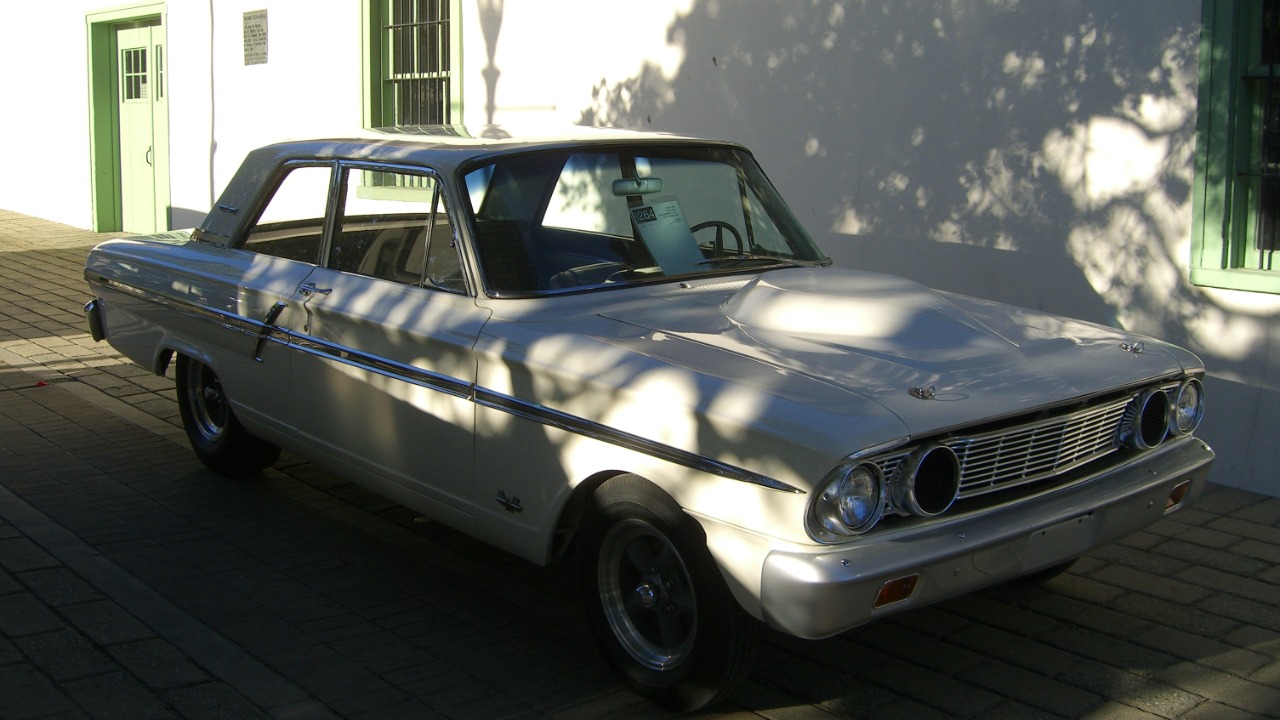
You can measure how wild 1960s drag racing really was by looking at the cars that forced officials to rewrite the rulebook. The 1964 Ford Fairlane Thunderbolt did exactly that, turning a mild-mannered midsize sedan into a factory-built weapon that pushed organized racing right up to its limits. When you follow its story, you see how one short‑run experiment reshaped what you expect from both muscle cars and modern sanctioning bodies.
Instead of being a collectible that slowly earned its legend, the Ford Fairlane Thunderbolt arrived fully loaded with controversy, speed, and compromise. You are looking at a car that was barely street legal, built in tiny numbers, and aimed squarely at domination rather than comfort or style. That single-minded focus is what pushed drag racing past the breaking point.
The moment Ford decided to break the class
If you trace the Thunderbolt back to its roots, you land in the Super Stock wars, where Ford had already tasted success with big full-size machines. Earlier in the 1960s, Ford was running heavy Galaxies in the NHRA (National Hot Rod Association) Super Stock class, and they knew weight was their enemy. The company’s engineers and racers understood that if you stuffed the same powertrain into a smaller shell, you could leapfrog rivals overnight. That is how the idea of turning a Fairlane into a purpose-built drag car took hold.
Instead of sticking with their big block powered Galaxies, Ford pivoted to an experimental Fairlane that would be lighter, nastier, and far more focused. In 1964 Ford decided to build a car that would dominate the dragstrip, and the result was not just a faster fair lane, it was the birth of a factory experimental package that treated the rulebook as a checklist of loopholes. You are watching a manufacturer decide that if the rules allowed it, they would exploit it, even if that meant the rest of the field would be left scrambling to keep up.
How the Thunderbolt turned a Fairlane into a missile
On paper, the Thunderbolt recipe sounds simple: take a midsize sedan and drop in the nastiest engine you can homologate. In practice, the 1964 Ford Fairlane Thunderbolt was a limited production factory experimental car built for drag racing, with only 100 units created to satisfy class rules. Under the hood sat the 427 High Riser, a race-bred V8 that had already proven itself in full-size competition. You are not dealing with a warmed-over street motor here, but a powerplant that enthusiasts still describe as a grenade with a short fuse.
Fans today love to say the 1964 Fairlane Thunderbolt is a classic race car and one of the most exciting machines of its era, and that excitement comes from how little “car” is left once you strip it down. The 1964 Ford Thunderbolt is often described as barely a car, a shell wrapped around the Ford 427 High Riser and just enough structure to get it down the quarter mile. When you look at it that way, you see why rivals felt outgunned before the Christmas tree even lit up.
Weight reduction at any cost
To understand why the Thunderbolt pushed drag racing to its limits, you have to look at what Ford was willing to sacrifice. Because of the specialized purpose for which this car has been built in order to achieve maximum weight reduction, normal quality expectations were not met on this vehicle. That blunt warning, echoed in period documentation and repeated by Because of the enthusiasts, tells you exactly where the priorities lay.
You are dealing with a car that swapped steel for fiberglass, deleted sound deadening, and treated creature comforts as dead weight. The 1964 Ford Fairlane Thunderbolt was built for one purpose, to dominate the dragstrip, and that single goal meant you got thin glass, rudimentary trim, and a cabin that felt more like a race shop than a showroom. Period guidance from They even stressed that normal durability standards were not met on this vehicle, which is a polite way of telling you that if you treated it like a regular Fairlane, it would protest loudly and often.
The numbers that forced the rulebook to catch up
All that compromise only matters if the car delivers, and the Thunderbolt did exactly that. Ultimately, 100 1964 Ford Fairlane Thunderbolts were built, 49 of them 4-speeds with 51 automatics, enough to secure the 1964 NHR championship in its class. Period accounts credit the car with quarter mile times in the low 11s, with factory-backed examples running 11.61 seconds at 124.8 mph. When you line that up against what else was on the strip, you see why rivals felt like they were chasing a moving target.
Contemporary coverage of the 1964 Ford Fairlane Thunderbolt notes that Chevrolet and Dodge built strong performing cars, but none matched the way this package translated factory engineering into quarter mile dominance. In the same era, Chevrolet boasted its fearsome 427 powered Z11 Impala, yet the Ford 427 High Riser in the Thunderbolt became the benchmark that others had to chase. When one factory car is so far ahead that officials feel they must either catch it or change the rule, as period commentary around Nov and the NHRA suggests, you know the sport has reached a stress point.
The legacy you still feel at the strip today
Even if you never plan to own one, the Thunderbolt still shapes what you see at modern dragstrips and auctions. The 1964 Ford Thunderbolt was no ordinary ride, it was a dragstrip missile disguised as a Fairlane sedan, engineered solely for the quarter mile and later elevated to near-mythical status among muscle car enthusiasts. Today, when one of these cars crosses a high profile block, you see collectors treat it less like a vintage Ford and more like a rolling piece of racing regulation history, a reminder of how far manufacturers were willing to go. That is why you find Thunderbolts featured prominently at venues like Barrett-Jackson, where rarity and racing pedigree command serious attention.
The story also lives on in how fans talk about it. Enthusiasts still trade footage of the 427 Ford storming down the strip, revisit deep dives into the most powerful super stock drag cars that could dominate the quarter mile, and replay the untold details of the 427 427 Fairlane that scared rivals into rethinking their programs. You see the same fascination in modern retrospectives that call the 1964 Jul project a rare 427 monster that Dodge was scared to race, and in fan pages that celebrate the Ford decision to build a car that would dominate the dragstrip. When you stand at the fence today and watch a modern factory drag package launch, you are still feeling the shockwave that the Thunderbolt sent through the sport more than half a century ago.
More from Fast Lane Only