The Ford Twin I-Beam front suspension arrived on the 1965 F-Series and gave a pickup independent front wheels without giving up a truck’s toughness. The trick was simple. Ford split the front axle into two long beams and crossed them under the truck, so each beam carried one wheel and pivoted on the far side of the frame.
Before that, light trucks rode on a solid front axle. A bump at one wheel shoved the other wheel too, and the ride showed it. Ford wanted something that could still haul a load but felt calmer on the road.
The result stayed in Ford’s lineup for decades. Here is how the design works, why Ford liked it and where its limits showed up.
What changed on the 1965 F-Series
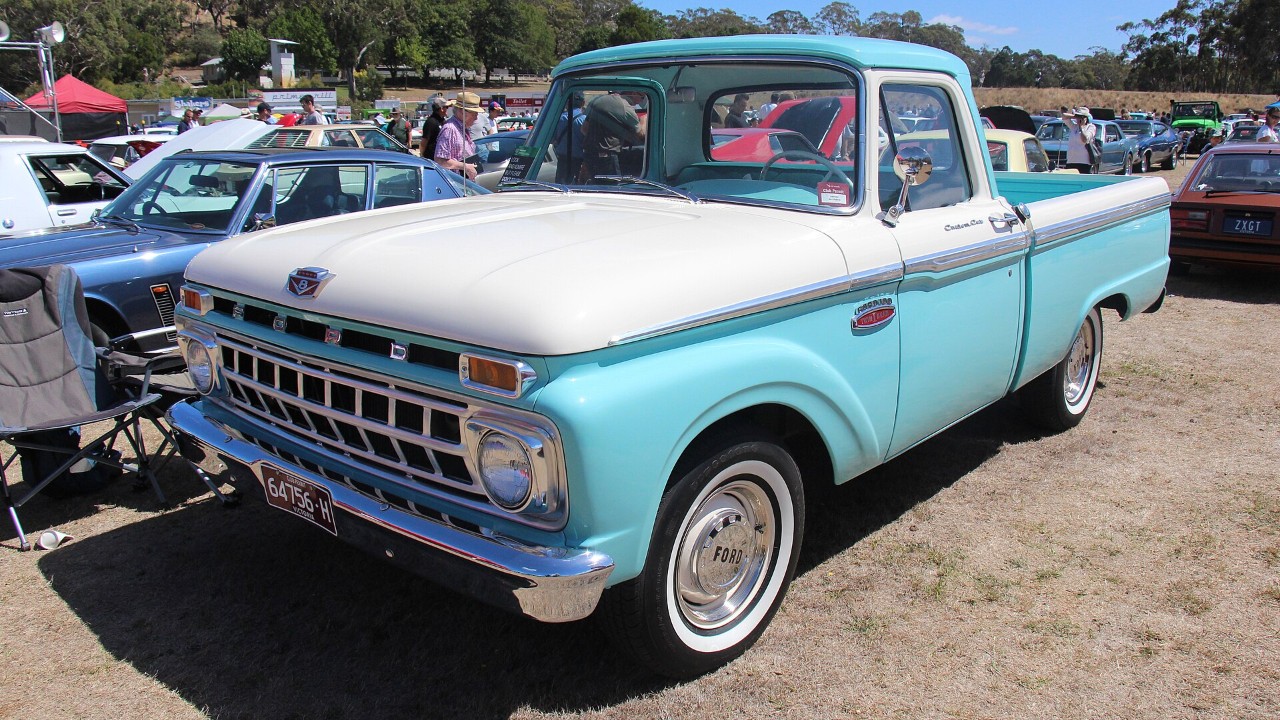
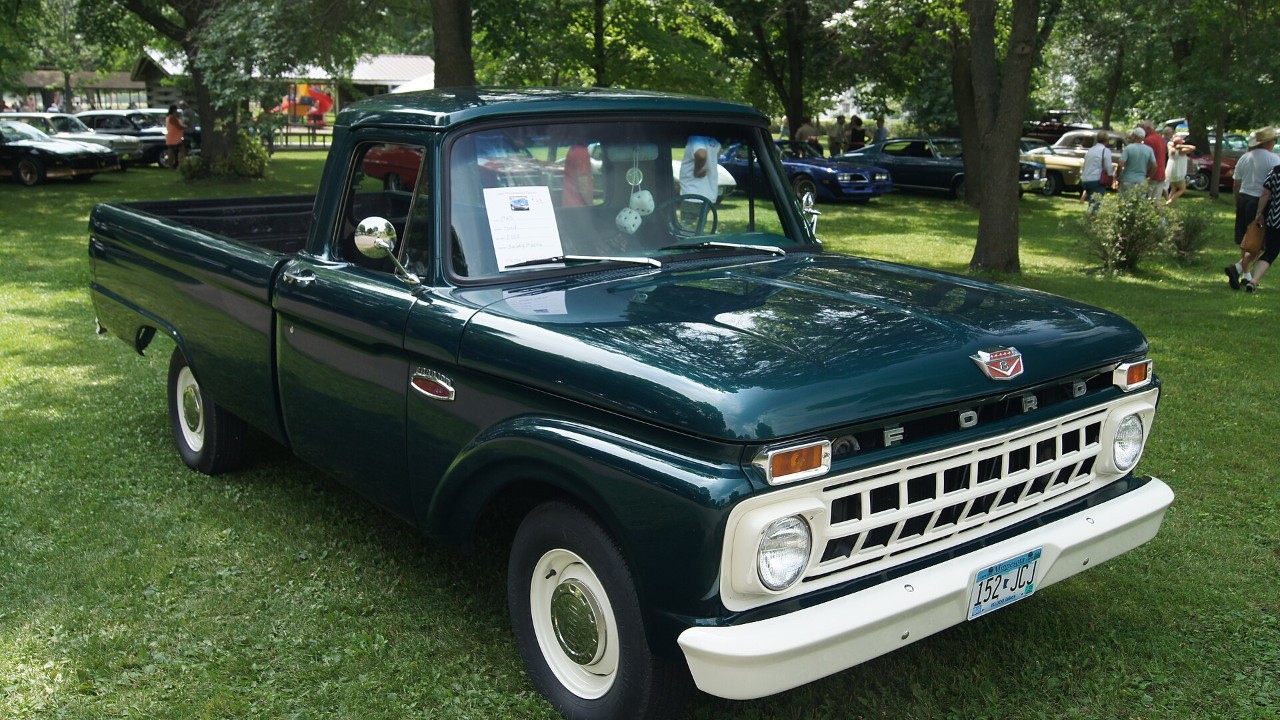
Ford Twin I-Beam arrived in 1965 on the refreshed fourth-generation F-Series, a truck line that had been new for 1961, according to Hagerty’s explainer. Ford offered it on the F-100 through the F-350, while its heavier trucks kept conventional beam axles, Mac’s Motor City Garage notes. Its engineers also documented the 1965 design in SAE paper 650153.
The company sold the idea with a short motto. “Work like a truck, ride like a car,” the company said, Hagerty reports. In other words, the new front end had to do both jobs at once.
How Ford Twin I-Beam crosses two beams
Each beam attaches to the frame rail opposite the wheel it supports, Hagerty explains. So the left wheel’s beam reaches across to a pivot on the right rail, and the right wheel’s beam does the reverse. Mac’s Motor City Garage describes the two axles as “offset and overlapping,” which improved the geometry. Each beam is a heavy chrome-moly steel forging about 36 inches long, the same site says.
Because each beam is long, its wheel swings through a wide arc. That keeps camber change to a “manageable level,” according to Mac’s Motor City Garage. By contrast, a short swing axle would tilt the wheel much more over the same bump.
Ford kept the kingpin steering knuckles from its traditional I-beams, Hagerty notes. However, it replaced the leaf springs with coil springs. Then a radius arm on each side ran fore and aft to keep the tire centered in the fender.
Why the radius arms mattered
On a conventional truck axle, the leaf springs locate the axle as well as hold up the weight. The radius arms took over that job, and they were heavy steel forgings too. As a result, they absorbed the steering and braking loads that the leaf springs used to carry.
That freed the coil springs to do one thing. Therefore, Ford could use a lighter spring rate, which Mac’s Motor City Garage credits with a softer, more comfortable ride.
Ford’s engineers also liked how the layout fed loads into the frame. Their SAE paper argued that “it is usually easier to design a good beam than a good attachment” point, Hagerty reports. In short, a beam directs impacts straight into the frame instead of through a cluster of small joints.
Ford’s case for it, and the trade-offs
Ford listed several advantages, according to Hagerty. A consistent Ackerman angle prevented tire scrub at low speed. Fixed kingpin geometry kept caster and camber fixed and “maintenance-free.” Meanwhile, the beams held up as well as the solid axles they replaced. Ford also claimed better tire wear than A-arm designs, though Hagerty points out that these were the maker’s own claims.
The design had a weak spot, however. The same SAE paper observed “considerably more camber change” than dual A-arms whenever ride height changed. That means a loaded or lifted truck leans its front tires in or out. Mac’s Motor City Garage puts the figure at about one degree per inch of bump or rebound.
The basic idea was not brand new, either. In 1933, British engineer Leslie Ballamy built a cheap independent front conversion for the Austin 7 and Ford light cars by splitting a beam axle at the center, the same site says. That earlier version suffered from adverse camber change in roll. Still, it was light, cheap, simple and durable.
Twin-Traction Beam and the Super Duty
In 1980, Ford adapted the concept for four-wheel drive and called it Twin-Traction Beam. Dana supplied the differential assembly, Hagerty says. A housing was spliced onto the passenger-side beam, and a half-shaft ran from the other beam through a slip yoke to the differential. Later, the layout spread to Ford’s compact Ranger and Explorer.
Eventually, Ford moved its half-ton pickups to dual A-arms, 4x4s included. According to Hagerty, the reasons were compact packaging, more precise alignment control and a smoother ride from lower unsprung weight. The heavier trucks went another way. As of December 2023, the F-250 and F-350 Super Duty continued to use a version of Ford Twin I-Beam front suspension, Mac’s Motor City Garage reported.
More from Fast Lane Only