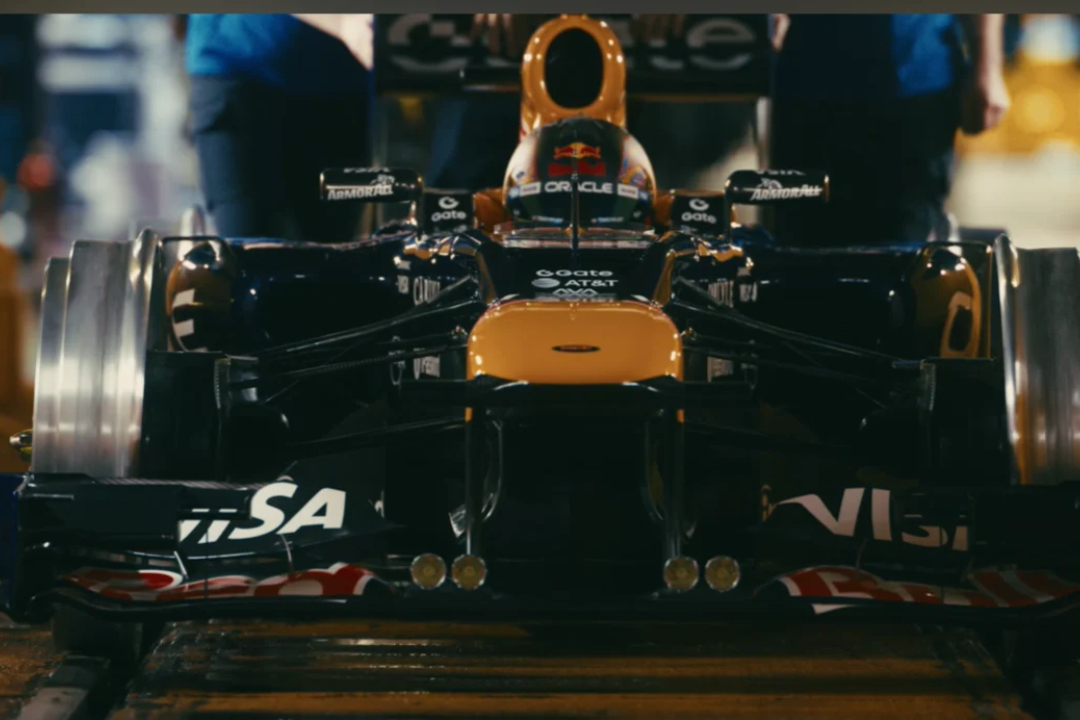
Formula 1 cars are built for racetracks, not underground rail networks. Red Bull Racing decided to challenge that distinction by fitting its 750-hp RB8 with custom metal wheels and sending it through Madrid’s Metro tunnels with former F1 driver Patrick Friesacher behind the wheel.
Getting there took roughly six months of engineering, an abandoned wheel design and a purpose-built test vehicle. Eventually, the 18,000-RPM V8-powered RB8 completed a five-kilometer run through a place no Formula 1 car was ever designed to go.
Madrid’s Metro tracks made the unusual idea possible
The project began around six months earlier with engineer and Andtonic CEO Álvaro Rey working out whether the RB8 could physically run on Madrid Metro rails. Two limitations dictated the engineering: the width of the Metro tracks could not be changed, and the hand-built Formula 1 car could not be modified to accommodate them.
Fortunately, the Metro rail spacing proved compatible with the RB8’s track width, allowing the team to pursue the idea without changing the car’s suspension width. That left the wheels as the biggest engineering problem.
The original solution involved taking an existing Formula 1 wheel and fitting a specially made railway wheel around it. Engineers spent approximately five months designing and manufacturing four prototypes before taking them to Red Bull’s Technology Campus in Milton Keynes for their first fitment test.
The first wheels created a serious weight problem
The wheels fitted, but they were much too heavy. A conventional wheel and tire for the RB8 weighed roughly 16 kilograms, while the initial railway-wheel design came in at close to 50 kilograms per wheel.
That additional unsprung weight created a risk to the RB8’s suspension and other components. The team was initially given a 35-kilogram limit, while the final target became less than 30 kilograms to reduce the risk of damaging the driveshafts, gearbox and other parts of the car.
With only two weeks remaining, the engineers abandoned the original concept and designed a lighter wheel built around an integrated hub. After dozens of hours of machining, they returned to Milton Keynes, where the revised design registered about 29 kilograms on the scale and cleared the required weight target.
A custom go-kart had to test the rails first
Solving the weight problem did not guarantee the RB8 could actually make its way through the Metro network. The team still needed to determine whether a vehicle with the Formula 1 car’s dimensions could negotiate the curves and track switches without putting the RB8 itself at risk.
Engineers therefore constructed a modified go-kart matching the RB8’s track width and wheelbase and fitted it with railway wheels. The test rig was used to evaluate acceleration, braking and its ability to navigate the planned route.
After the go-kart successfully completed its tests, the RB8 was lowered onto the rails for an initial run. Friesacher reported some wheelspin when pulling away but said the car otherwise worked well, giving the team the confidence to proceed with the main event.
Patrick Friesacher finally took the 750-hp RB8 underground
Once regular Metro operations had finished, Friesacher climbed into the RB8 for the final run. The car’s naturally aspirated 2.4-liter V8 produced around 750 horsepower and could rev to 18,000 RPM, only now that power was being delivered through custom metal railway wheels instead of racing tires.
Friesacher drove the Formula 1 car approximately five kilometers through Madrid’s underground Metro network. Red Bull did not disclose a maximum speed for the run, so there is no basis for describing it as an official Metro speed record.
The history-making part was the feat itself. Red Bull describes the journey as making Metro and motorsport history, with the RB8 successfully running on Madrid Metro rails after six months spent turning an improbable idea into a working engineering project.
More from Fast Lane Only
- Unboxing the WWII Jeep in a Crate
- 15 rare Chevys collectors are quietly buying
- 10 underrated V8s still worth hunting down
- Police notice this before you even roll window down
*Research for this article included AI assistance, with all final content reviewed by human editors.