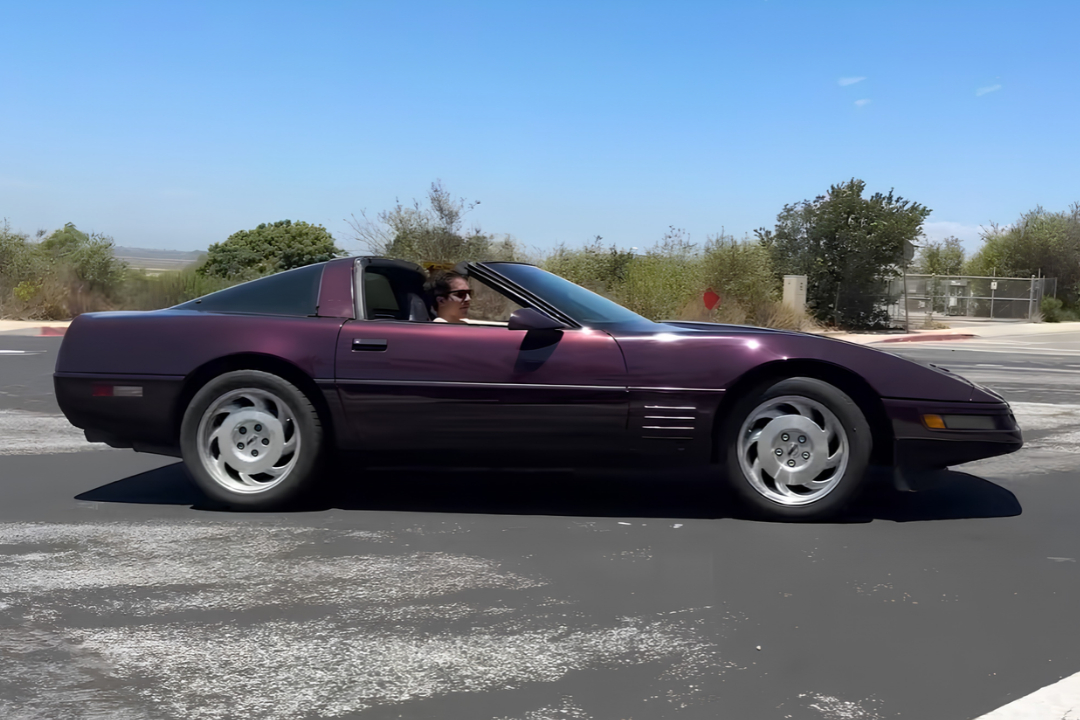
Nobody sets out to fall in love with a leaf spring. It’s the kind of suspension part that quietly does its job for decades and gets zero credit, mostly because it was borrowed from technology that predates the car it’s bolted to by roughly a century. The Chevrolet Corvette C4 has been carrying one since 1984, both front and rear, and it’s exactly the sort of detail that makes an owner start looking at coilover kits.
The C4 has a strange reputation problem. It arrived in 1984 as the car meant to finally answer Porsche and Ferrari on their own terms, and in a lot of ways it did, beating a 911 on acceleration, braking, and cornering, and holding its own against machinery that cost several times as much. Yet decades later it’s often treated as the least desirable Corvette generation, the one people skip past on their way to a C3 or a C7. A $5,600 purchase price for a clean example says everything about where the market has landed on it.
That gap between what the C4 can actually do and what people assume about it is exactly what one owner set out to close, starting with the parts of the car that had aged the least gracefully. The plan touched the exhaust, the wheels, and the suspension, but the leaf springs were always going to be the headline.
A suspension design older than the car itself
The C4’s transverse leaf spring setup isn’t a minor quirk. It runs the full width of the car at both the front and rear axle, standing in for the coil springs most people expect to find tucked into a sports car’s corners. The layout traces back to Ford’s Model T era in the early 1900s, which means the version bolted to a 1984 Corvette was already pushing eighty years old by the time it got there. It survived that long largely because it was already there and it worked well enough not to replace.
Pulling it out meant removing both the front and rear leaf springs entirely and replacing them with a set of double-adjustable coilovers, one at each corner. The rear conversion went in first, bolting a bracket into the factory mounting points without any cutting or drilling required. The front side needed a bit more coaxing, since the sway bar had to be shifted forward slightly just to give the new coilovers room to sit where the old shocks used to live.
What made the swap notable wasn’t just the ride height drop, though the car did sit dramatically lower afterward. It was the shift from a single leaf spring doing double duty as spring and structural element to a coilover setup where the spring and damper share one location and can be tuned independently. That kind of adjustability simply didn’t exist on the car as it left the factory, and it’s the difference between a suspension that reacts to the road and one that can be dialed in for it.
Wheels that make the whole car look like it belongs today
Suspension work rarely photographs well, which is probably why the wheel swap ended up doing so much of the visual heavy lifting. The stock turbine wheels are well liked in their own right, but a set of wider Corvette C5 Z06 wheels, sourced secondhand, brought a wider tire footprint and a noticeably lighter overall package to each corner.
That weight reduction matters more than it might seem. Shaving weight off a hood or a bumper is a nice bonus, but shaving it off the wheels themselves reduces unsprung mass, the part of the car’s weight that isn’t cushioned by the suspension at all. Less of that translates directly into sharper handling and quicker responses, the kind of improvement that’s easy to feel and hard to see in photos.
The wheels arrived mismatched in finish, which meant a full strip and repaint before they could go on the car. Rather than pay for professional powder coating, the refinishing was done by hand with sanded surfaces, light coats of silver paint, and a catalyzed 2K clear coat to lock it all in and protect it from rock chips down the road. The result held up well enough to pass for factory powder coat, at a fraction of the price.
An exhaust and a stereo round out the changes
The last two items on the list were smaller in scope but not in impact. The factory exhaust was restrictive by design, a byproduct of an era when manufacturers hadn’t yet figured out how to balance emissions regulations with anything resembling performance. Swapping in a set of mufflers with built-in tips, clamped rather than welded into place, gave the LT1 V8 a deeper, more present exhaust note without tipping into the kind of drone that makes a car exhausting to drive on a long highway stretch.
A dead Bluetooth radio turned out to be the easiest fix of the entire project. What looked like a failed head unit was actually just a blown fuse, and swapping it out restored wireless audio in a matter of minutes rather than the teardown the problem initially seemed to promise.
None of these changes turned the C4 into something it wasn’t. The car is still built around a 1980s chassis and a V8 that owes more to torque than to redline theatrics. But between the coilovers replacing a suspension design old enough to have a birthday party, the lighter wheels sharpening the way it turns, and an exhaust that finally lets the engine sound like what it is, the C4 comes away feeling like a car that’s finally allowed to compete on modern terms instead of just being compared unfavorably to them.
More from Fast Lane Only
- Unboxing the WWII Jeep in a Crate
- 15 rare Chevys collectors are quietly buying
- 10 underrated V8s still worth hunting down
- Police notice this before you even roll window down
*Research for this article included AI assistance, with all final content reviewed by human editors.