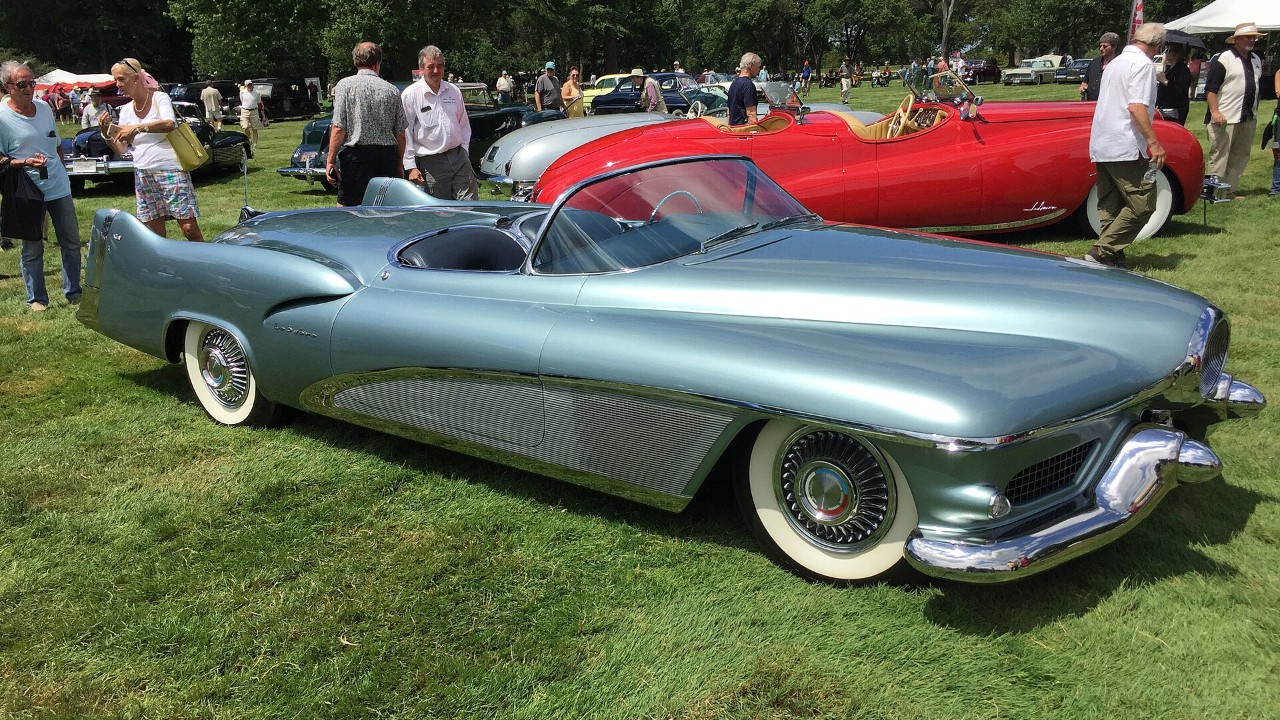
Harley Earl wanted a car that looked like it could take off. The GM Le Sabre concept of 1951 was the result: a low, two-seat convertible named after a jet fighter, with a wraparound windshield and tall tail fins. Two years later, GM was selling cars with that kind of glass.
Earl ran styling at General Motors, and he already had one famous dream car behind him. This one went further. It carried jet-age shapes, a supercharged V8 and a list of gadgets that still sound modern.
Here is what the car was, how it worked and how much of it reached the street.
Why Harley Earl built the GM Le Sabre concept
The Le Sabre was meant to replace a car Earl loved. According to Hagerty, GM’s design vice president proposed it as a successor to the 1938 Buick Y-Job, which he used as his personal car. A Hagerty-issued Detroit Concours release calls the Y-Job the industry’s first “concept car” and says it served as Earl’s daily car for over a decade.
At first, Earl actually asked for two cars. Hagerty says he proposed a pair of two-seat convertibles on identical chassis, one for himself and one for Buick chief engineer Charles Chayne. Work began in 1947 under the codenames XP-8 and XP-9. Later, the XP-8 became the Le Sabre, while the XP-9 took the name XP-300 at its unveiling.
Both cars appeared in 1951. However, the Le Sabre is the one people remember.
A fighter jet on four wheels
The name gave away the inspiration. In fact, the car took its name from the North American F-86 Sabre, the jet fighter that shaped its design, Hagerty says. The Audrain Automobile Museum in Newport, Rhode Island, also ties it to the F-86 rather than to jets in general.
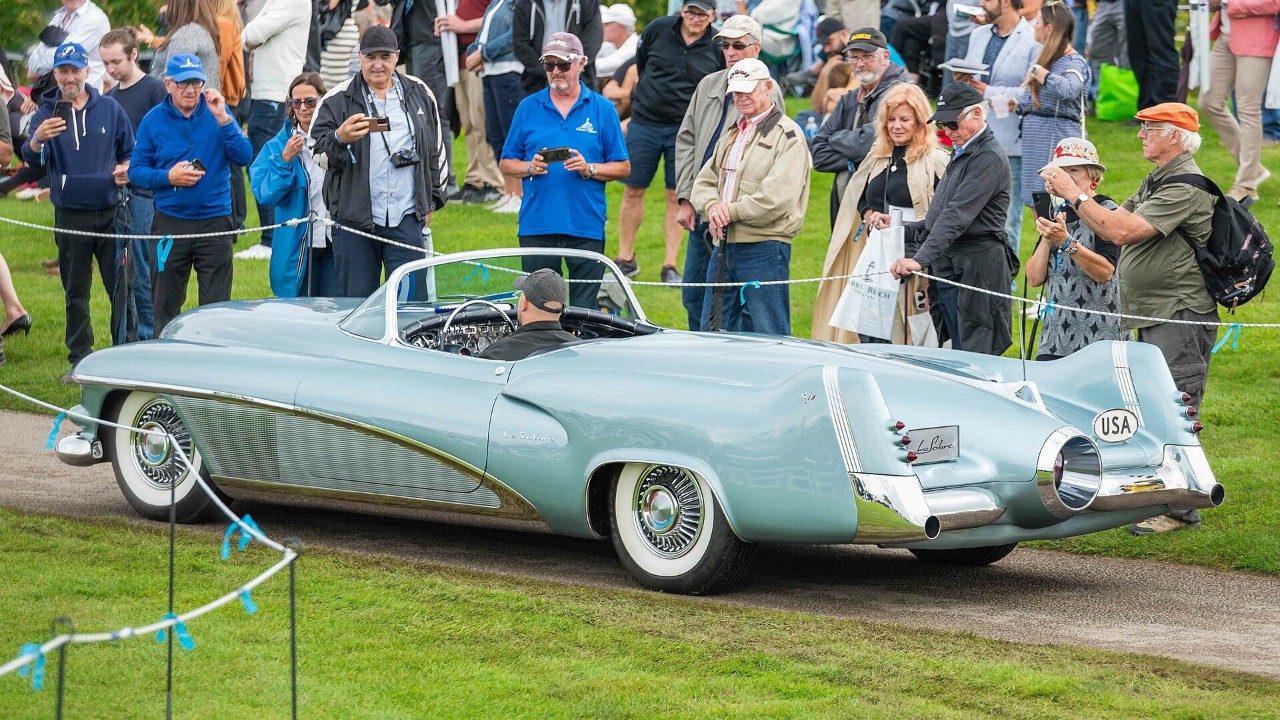
Its shape followed the airplane theme from nose to tail. The center oval grille rotates to reveal two close-set hidden headlamps, according to the concours release. At the back, a large round opening held a red taillight meant to look like a lit afterburner, Hagerty says. The car was also very low. For example, Hagerty puts it at just 50 inches tall, compared with the Y-Job’s 58 inches.
The materials came from aviation too. Hagerty lists cast magnesium parts and hand-formed aluminum panels, while the Audrain museum says the floorboards used honeycomb aluminum.
The windshield and the fins
Two details on the Le Sabre changed Detroit. First, the wraparound “panoramic” windscreen took its cue from jet canopies. Hagerty says GM put that glass into series production in 1953, and Ford and Chrysler followed within a couple of years.
Second came the fins. Tail fins had already appeared on the 1948 Cadillac, Hagerty notes. Still, the Le Sabre’s fins stood much taller and more prominent. They were not just for looks, either. Instead, each one housed a bladder-type fuel tank, according to Hagerty and the concours release.
Classic & Sports Car, for its part, called the high-tipped fins “a taste of what was to come later in the decade.” Hagerty adds that tail fins, panoramic glass and jet-inspired details soon appeared at the Paris, London and Turin motor shows.
What made the Le Sabre run
Under the skin, the Le Sabre was a working car. The concours release lists a 335 hp, 215-cubic-inch V8 and GM’s first rear-mounted Hydramatic transmission. Similarly, the Audrain museum gives the same 335 hp and 215 cubic inches and describes the V8 as supercharged.
Its fuel system was unusual. According to the Audrain museum, one carburetor fed normal fuel, while a second fed methanol to add power under heavy throttle. By contrast, the concours release says the engine ran on gasoline and ethanol. In other words, the car burned an alcohol fuel alongside gasoline.
The gadgets went further. A water sensor raised the power top automatically when rain hit, and the seats were heated, according to the release. It also lists a jack system built into the chassis. The Audrain museum says four hydraulic jacks could lift the car to change a tire.
Earl’s daily driver and the Le Sabre today
The Le Sabre was GM’s centerpiece on the show circuit before it became Earl’s personal car, the concours release says. Sports Car Digest agrees that Earl liked it so much he drove it for several years after its debut. As a result, a show car spent its early life on public roads.
Its influence also reached GM’s own shows. Hagerty says that is because the Le Sabre’s success led to a series of more extravagant concepts for GM’s Motorama shows starting in 1953.
The GM Le Sabre concept survives. Hagerty says the car received a restoration in the 2000s and counts it among the crown jewels of GM’s Heritage collection. On September 18, 2022, it joined the Y-Job in a Cars of Harley Earl class at the Detroit Concours d’Elegance, held at the Detroit Institute of Arts.
More from Fast Lane Only