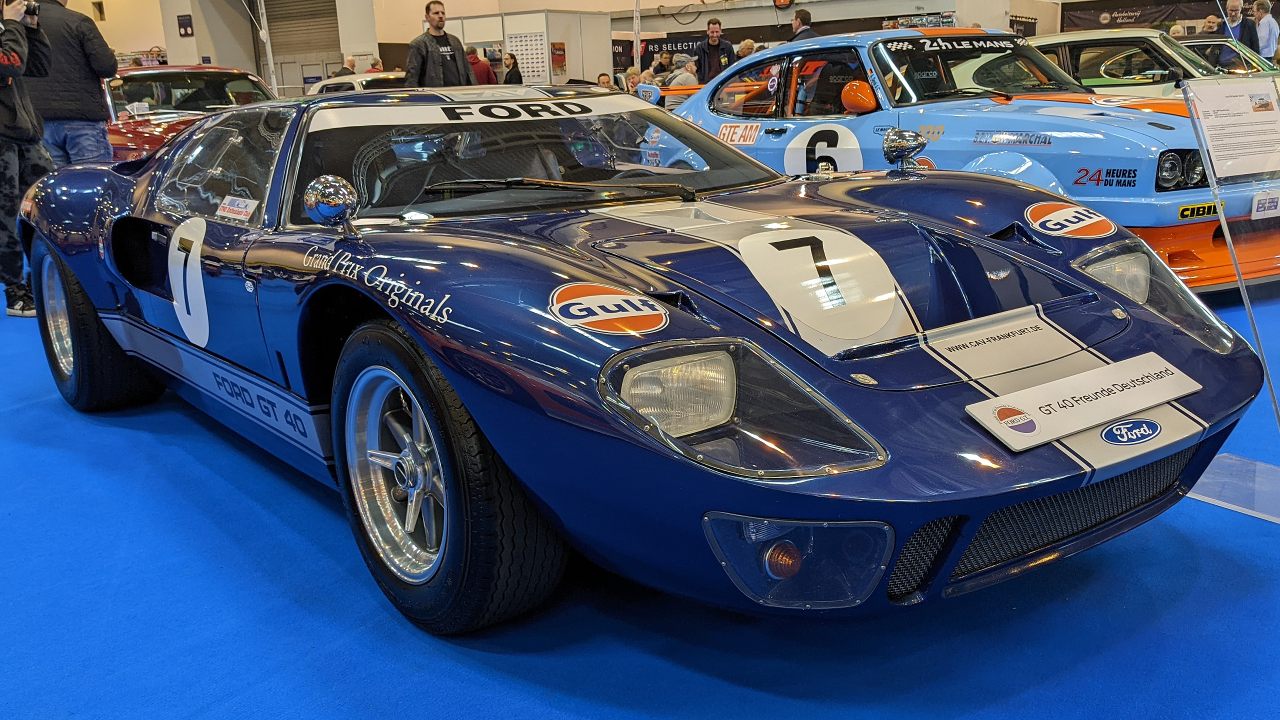
The sight of three Ford GT Mk IIs lining up together at Goodwood would be remarkable in any context. When those cars are the very machines that finished 1-2-3 at Le Mans in 1966, the spectacle becomes something closer to living motorsport archaeology, a rare moment when a legend steps out of the archive and back into the open air.
As Goodwood prepares to welcome this reunion of the Ford GTs that locked out the podium at Le Mans, the crowd is being offered more than a nostalgia parade. The return of these cars, framed by the Goodwood Festival of Speed and Goodwood Revival, turns a famous corporate grudge match into a tangible, audible experience that I expect will reshape how many fans understand that era.
The 1966 Le Mans breakthrough that changed everything
Before I can make sense of why this Goodwood gathering matters, I have to return to the original shock of 1966. The Ford GT Mk II was not just another sports prototype, it was the weapon Ford used to overturn the established order at Le Mans, where European manufacturers had treated the 24-hour race as their private preserve. When the Ford GT Mk IIs swept to a 1-2-3 finish at Le Mans, they did more than win a race, they punctured the assumption that endurance glory belonged by default to European marques and circuits.
That lockout of the podium, achieved by three Ford GT Mk IIs running in formation at the finish, has since become one of the most replayed images in racing history. The fact that those specific Ford GTs are now being brought back together at Goodwood underlines how central that moment remains to the sport’s mythology. Organisers have confirmed that the very Ford GT Mk IIs that finished 1-2-3 at Le Mans will reunite at Goodwood, a detail that turns a familiar story into a rare physical convergence of the original protagonists.
Goodwood’s stage for a rare reunion
Goodwood has long specialised in turning motorsport history into something you can smell, hear and feel, rather than simply read about. In that context, the decision to bring the three Ford GT Mk IIs back together on this particular estate feels entirely in character. Event organisers have described the gathering as a rare reunion of massive historical significance, a phrase that, in my view, is justified when one considers how seldom all three of these Ford GTs have shared the same paddock since their Le Mans triumph.
The plan is for Goodwood to reunite the legendary 1966 Le Mans 1-2-3 at its 2026 motorsport events, using both the Festival of Speed and the Revival as complementary stages. By confirming that the three Ford GT Mk IIs which secured that 1-2-3 result will appear, Goodwood is not merely curating a static display. It is setting up a live, dynamic retelling of a story that has often been flattened into a single photograph of cars crossing the line together.
Marking 60 years with sound, speed and context
The timing of this reunion is not accidental. Goodwood Festival of Speed and Goodwood Revival are using the 2026 season to mark 60 years since the Ford GT Mk IIs achieved their Le Mans podium sweep, and the choice of anniversary lens matters. Anniversaries can sometimes feel like arbitrary marketing hooks, but in this case the 60 year milestone provides a disciplined frame for revisiting how the Ford GT project reshaped both endurance racing and manufacturer ambition.
By explicitly positioning the reunion as a celebration of that 60 year interval, Goodwood is inviting spectators to think about continuity as much as nostalgia. The Ford GT Mk IIs that will run at Goodwood are not museum pieces being wheeled out for a gentle lap, they are the same machines that once ran flat-out through the night at Le Mans. Their presence at the Festival of Speed and the Revival, six decades on, allows the crowd to hear the same engines and see the same silhouettes that once challenged the French circuit, only now framed by the rolling Sussex landscape rather than the Mulsanne Straight.
Why the original cars, not replicas, change the story
In an era when high quality replicas and continuation cars are increasingly common, I find it significant that Goodwood has focused on securing the original Ford GT Mk IIs that actually finished 1-2-3 at Le Mans. Replicas can approximate the look and even the performance of historic racers, but they cannot carry the same narrative weight as the chassis that took the chequered flag. The confirmation that these specific Ford GT Mk IIs will reunite at Goodwood removes any ambiguity about what the crowd is seeing, and it raises the emotional stakes for those who have only ever encountered these cars in photographs or films.
That authenticity also deepens the educational value of the event. When spectators watch the three Ford GT Mk IIs run together at Goodwood, they are observing the real hardware that once contested one of the most intense manufacturer battles in motorsport history. The organisers’ emphasis on reuniting the exact Ford GT Mk IIs that locked out the Le Mans podium, rather than assembling a representative group of similar cars, signals a commitment to historical precision that aligns with Goodwood’s broader reputation for meticulous curation.
What this means for fans and for Goodwood’s future
For the crowd, the return of the Le Mans winning Ford GT Mk IIs to Goodwood offers a rare chance to collapse distance, both geographic and temporal. Many fans will never travel to Le Mans, and even fewer could have witnessed the 1966 race in person. By bringing the three Ford GT Mk IIs together in one place, and by planning to run them in front of spectators at the Festival of Speed and the Revival, Goodwood is effectively exporting a crucial chapter of Le Mans history to a different stage without diluting its essence.
For Goodwood itself, the reunion reinforces its status as a custodian of motorsport memory rather than a mere event promoter. The decision to host a gathering of this scale, involving the Ford GT Mk IIs that finished 1-2-3 at Le Mans and to frame it around the 60 year anniversary, suggests a long term strategy in which the estate continues to serve as a meeting point for machines and stories that might otherwise remain scattered. As I look ahead to the 2026 season, it is hard to imagine a clearer statement of intent than inviting the most famous Ford GTs of all back to the same strip of English tarmac, and letting them tell their story in their own mechanical voice.
More from Fast Lane Only