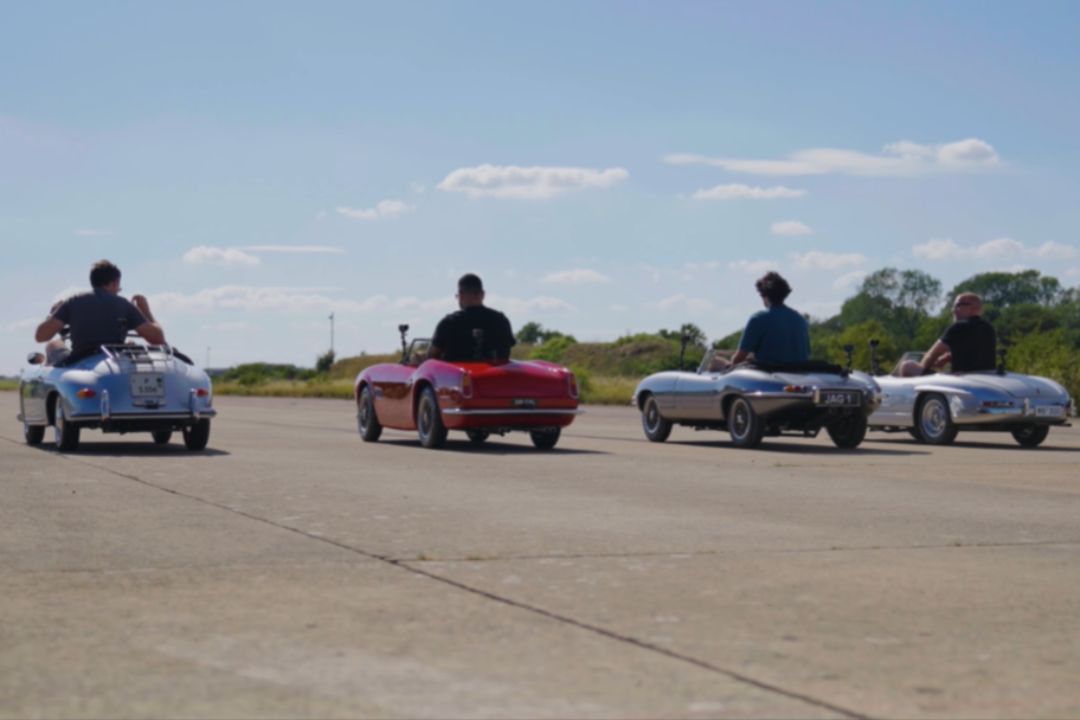
Picture four classic cars. A Porsche Speedster. A Ferrari 250 GT California. A Jaguar E-Type. A Mercedes-Benz 300 SL. Now shrink every one of them down until they look like something you’d find under a Christmas tree, not in a garage.
That is exactly what a group of grown men decided to race. These are not toys pulled off a shelf. They are fully built miniature versions of some of the most valuable cars in the world, complete with steel chassis, fiberglass bodywork, leather seats, and real engines. The catch is that each one makes just 9 horsepower.
Somehow, that tiny number did not stop the competition from getting intense. What started as a fun idea to line up four shrunken classics turned into a full afternoon of drag races, driver swaps, mechanical breakdowns, and at least one driver arguing about who gets which car.
The First Runs
Each of the four cars comes from a company called Junior Car Company, built for adults rather than kids despite the scaled-down size. They run a 125cc air-cooled single-cylinder engine paired with a 3-speed sequential gearbox, sending power to the rear wheels, and weigh around 250 kilograms each. Fitting into them was its own challenge. Drivers had to bend their ankles at odd angles just to reach the pedals, and legroom inside the two-seat Porsche in particular was tight enough that one driver complained about his foot getting stuck near the accelerator before the race even started.
With four cars and four drivers, the group lined up for a standing quarter-mile drag race. The Jaguar E-Type driver got the best launch off the line and pulled away cleanly, taking the win in the opening round.
The second race brought a twist. Drivers swapped cars to even things out, since the group figured the results were coming down to power-to-weight ratio rather than raw driving skill. One driver accidentally selected reverse instead of first gear right at the start, which ended that run before it began. The Jaguar E-Type won again.
A third race followed to settle things once and for all, with a close finish between the Ferrari and the Jaguar down the final stretch. The Jaguar took that one too, making it three wins in a row.
Then Things Got Weird
Just when the Jaguar looked unbeatable, its exhaust pipe worked itself loose and dropped out from underneath the car. The team fixed it trackside with a couple of spanners in under a minute, treating the repair like it was a pit stop during an actual race rather than a toy car falling apart in a parking lot.
The fix did not last. Shortly after, the Jaguar’s throttle cable gave out completely, ending its day early despite its perfect record. That left the group with three working cars and one very good excuse.
To keep things competitive, two drivers squeezed into the two-seat Porsche together for the next race, with one operating the pedals and the other working the gear lever and steering wheel at the same time. The added weight from a second adult crammed into a car built for one person slowed the Porsche down considerably, and the Ferrari took that round instead.
Doing the Math on 9 Horsepower
By the end of the day, official quarter-mile times were logged for every car. The Jaguar E-Type ran the fastest single time of the day at 30.5 seconds before its mechanical issues took it out of contention. The Porsche came in at 31.7 seconds with just one driver aboard. The Ferrari finished in 32.2 seconds, and the Mercedes-Benz 300 SL crossed in 32.9 seconds. With two adults packed into it, the Porsche’s time dropped all the way to 35.5 seconds, proving that extra weight matters just as much in a 250-kilogram car as it does in a full-size one.
Those numbers sound slow next to a real quarter-mile run, but for an engine barely bigger than what powers some scooters, getting a car and driver moving at all in under 35 seconds says something about how seriously these machines were built.
Before wrapping up, the group ran one more test, accelerating up to speed and slamming the brakes at a marked cone to find the shortest stopping distance. The wheels locked up hard, making it clear these little cars do not actually have working anti-lock brakes despite earlier claims. One driver managed the shortest stopping distance of the group, closing out the day with a final win.
Small Cars, Big Effort
What makes this whole afternoon worth watching is not the horsepower number or the lap times. It is watching grown adults treat a race between 9-horsepower toy cars with the same intensity as a real motorsport event. There were driver swaps, trackside repairs, arguments over who got which car, and a genuine sense of competition over tenths of a second.
That contrast is the whole point. These cars look like something built for a child’s birthday party, but the people racing them clearly were not playing around.
More from Fast Lane Only: