For 1939, Chrysler Fluid Drive took the heavy steel flywheel out of the driveline and put a sealed, oil-filled coupling in its place. The engine no longer had a solid link to the transmission. Instead, it drove a wheel of oil, and the oil drove the car. The idea sounds simple, but it changed what driving in traffic felt like.
Fluid Drive was not a full automatic. Drivers still had a clutch pedal and a gear lever. However, they could stop at a light in gear, idle there without stalling and pull away with only the gas pedal. That trick alone made it a selling point for more than a decade.
Here is how the coupling worked, how Chrysler built on it and why it eventually gave way to the PowerFlite automatic.
What Chrysler Fluid Drive replaced
In a normal manual car of the 1930s, the engine bolted to a flywheel. The clutch clamped against that flywheel, so the engine and gearbox turned together whenever the clutch pedal came up. If the driver stopped without pressing the clutch, the engine stalled.
Chrysler’s answer was a fluid flywheel. As historian Kit Foster explains on his CarPort site, a “driving wheel” attached to the engine is filled with special oil. That oil pushes against a “runner wheel” connected to the driveshaft. As the driving wheel spins faster, the runner turns with it, and power arrives smoothly. Foster notes that Chrysler’s brochure called the special oil “Gyrol.”
The concept was not new. Foster writes that fluid couplings were developed in Germany and that the British Daimler used a fluid flywheel as early as 1933. Chrysler’s move was to put it in American showrooms under a friendly name.
Two fans in a bath of oil
The best plain-English description may come from Mac’s Motor City Garage, which posted a 1940 Chrysler film about the system. “Fluid coupling is just a fancy term for a pair of fans or turbines in a bath of fluid,” the site explains. One fan drives the other through the oil, with no metal contact between them.
That design has one key limit. A fluid coupling gives a 1:1 ratio with no torque multiplication, so it cannot add pulling power the way a modern torque converter does. Instead, its job is to slip. At idle, the engine fan turns slowly and the oil barely moves the other side. As engine speed rises, the oil grips harder and the car moves.
Because the engine is never solidly connected, the car can roll to a stop, idle at a light, hold on a grade or pull away without the clutch. Mac’s Motor City Garage notes that a driver could even start in second or third gear, though more slowly than in first. In fact, third gear could handle all driving without the clutch if the driver was not in a hurry.
How you drove it
Fluid Drive kept a conventional clutch, which Chrysler called the “Safety Clutch.” Behind it sat a three-speed manual gearbox. Kit Foster describes the setup in an Old Cars Weekly reader Q&A, where he also lays out the basic routine. You can drive the car like any three-speed, using the clutch. Alternatively, you can pick a gear, use the brake to stop and take off again in that same gear.
On a basic Dodge, Foster writes on CarPort, the driver used the clutch only to get into gear. After that, the right foot did everything. The usual example was to drop it into third and simply drive. Chrysler’s brochure sold the feeling as a “cushion of power.”
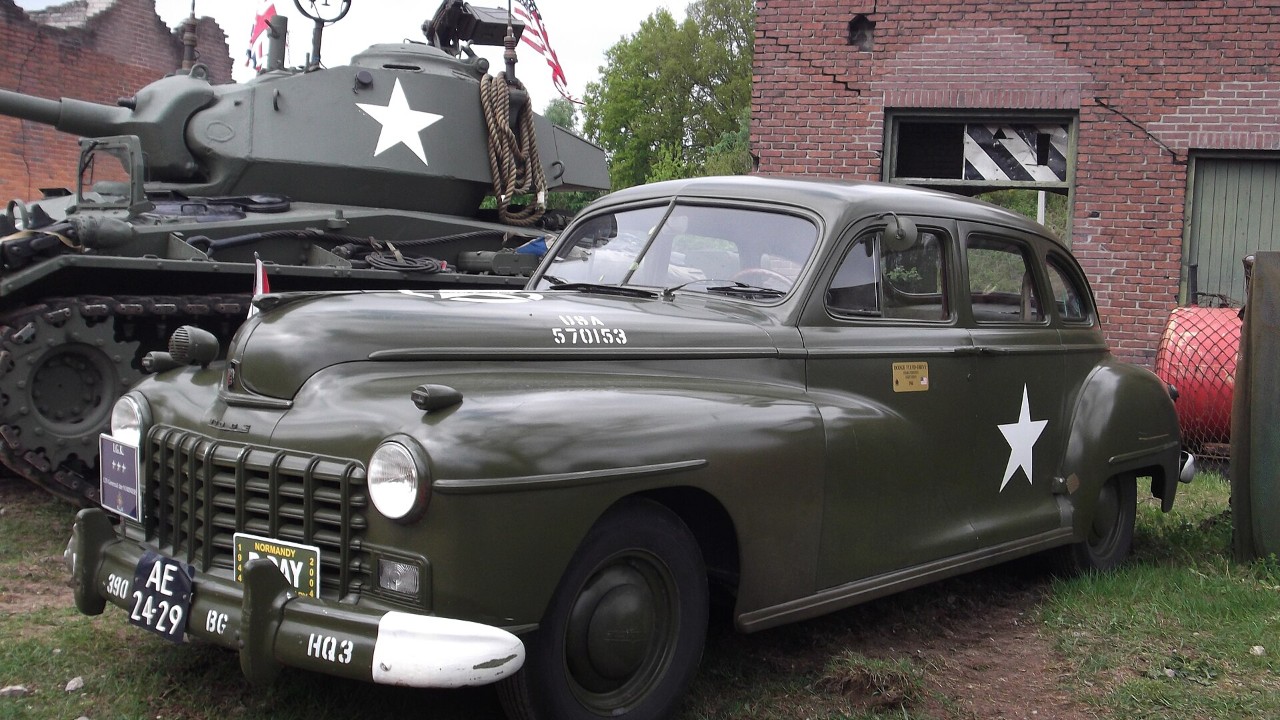
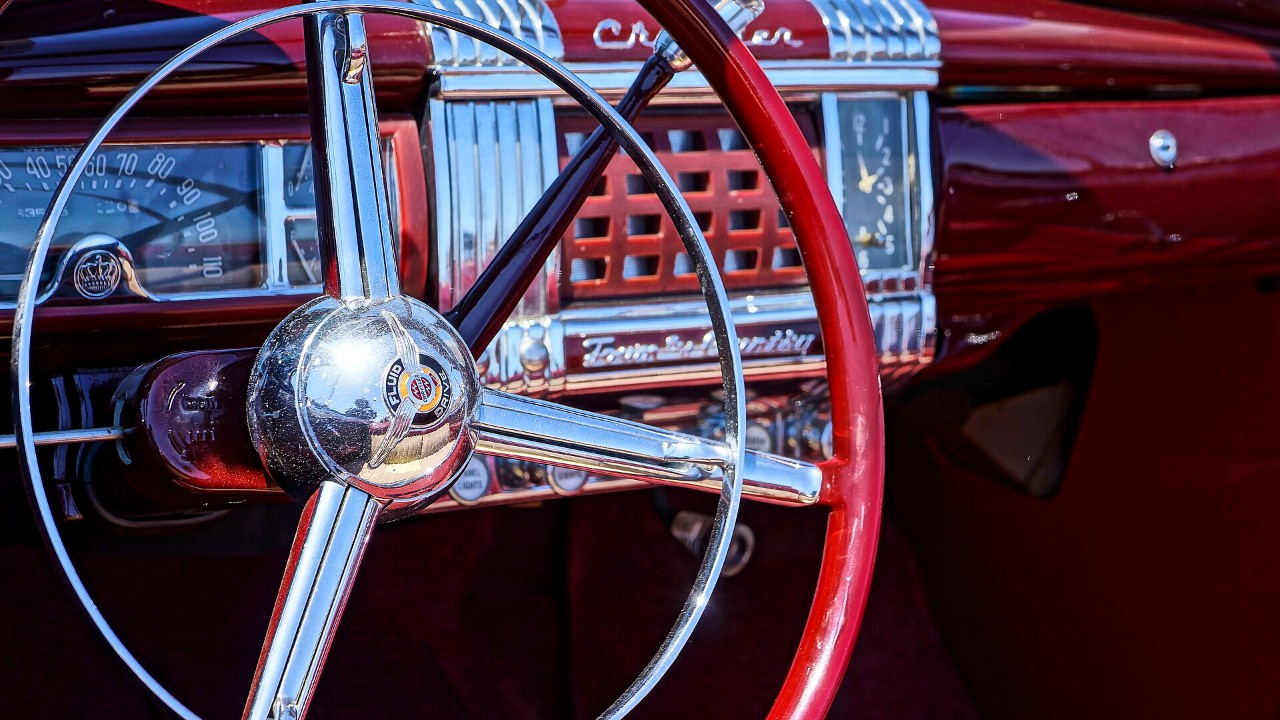
The emblems told everyone what was under the floor. According to Foster, the words “Fluid Drive” appeared on the Dodge rear bumper, the DeSoto front fender and the Chrysler stop lamp. Chrysler did not use “matic” names on the cars themselves. The badges simply read “Fluid Drive.”
From Imperial to DeSoto and Dodge
Foster’s Old Cars Weekly answer gives the rollout. Fluid Drive debuted on the 1939 Imperial, spread to all Chryslers for 1940 and reached DeSoto and Dodge for 1941. Mac’s Motor City Garage puts DeSoto a year earlier, in 1940, so sources differ on that brand. Either way, the 1940 Chrysler film it posted shows a 1941 Dodge.
Plymouth never offered Fluid Drive, Foster writes. So a buyer who wanted it had to step up to one of the corporation’s pricier brands. He also notes that Chrysler’s brochure line “Adopted in 1938” referred to the 1939 model year.
Timing mattered, too. Foster writes that Fluid Drive arrived a year before General Motors’ Hydra-Matic. In his view, it also did better than earlier attempts such as the Reo Self Shifter and Lincoln’s Liquimatic.
Vacamatic, Tip-Toe Shift and the semi-automatics
The coupling soon gained company. Chrysler’s Vacamatic and DeSoto’s Simplimatic added vacuum-shifted gearboxes with two gears in each of two ranges. To shift, the driver lifted off the throttle and waited for the “clunk,” Foster explains. Fluid Drive could be ordered without these gearboxes, but not the other way around.
After the war came a hydraulically shifted unit known as the M5. Chrysler sold its version as “Prestomatic,” while DeSoto called it “Tip-Toe Shift.” Otherwise, Foster writes, the two were the same. Dodge offered Gyro-Matic from 1949. Then, from 1951, a torque converter replaced the fluid coupling in some models, sold as Fluid-Torque or Gyro-Torque.
Plymouth finally got its own version for 1953. Its Hy-Drive used a torque converter rather than a fluid coupling. Foster says its 2.6:1 multiplication ratio was the highest in the industry at the time, and it cost $146.
Why Chrysler Fluid Drive faded
The weak point was slip. Mac’s Motor City Garage notes that slippage hurt both performance and efficiency. Meanwhile, rivals were moving to gearboxes that shifted themselves. GM’s Hydra-Matic led that work, and buyers came to expect a car with no clutch pedal at all.
Chrysler answered in 1954. According to Mac’s history of the PowerFlite, it was Chrysler’s first fully automatic transmission, and it came “after 15 years of producing a multitude of semi-automatic transmissions.” The two-speed PowerFlite used a torque converter instead of a simple fluid coupling. Foster adds that PowerFlite had replaced Plymouth’s Hy-Drive by April 1954.
The three-speed TorqueFlite followed in 1956. Even so, PowerFlite remained available on Plymouth, Dodge and some DeSoto passenger cars through 1961, the last stop on a road that began with an oil-filled flywheel in the 1939 Imperial.
More from Fast Lane Only