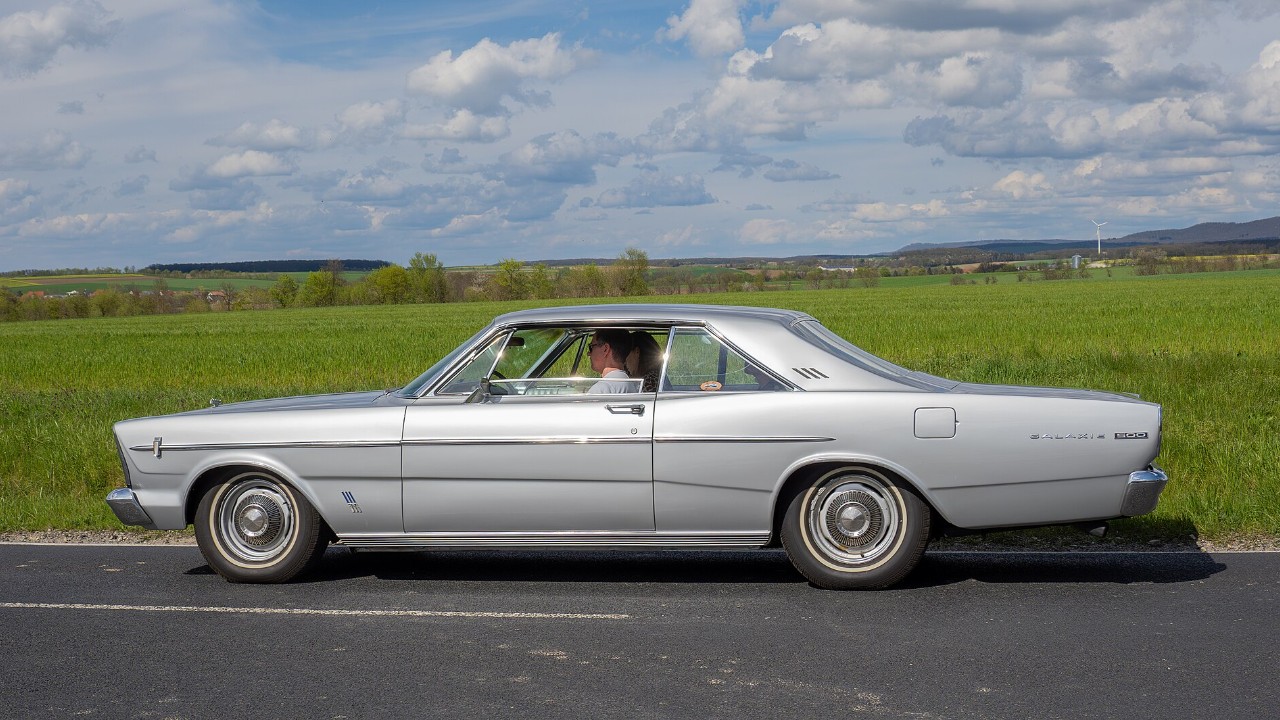
The Galaxie name arrived halfway through Ford’s 1959 model year, and by the mid-1960s the Ford Galaxie 500 was the backbone of the company’s full-size lineup. Most of them were family sedans and wagons with sensible V8s.
Tucked inside those huge numbers, though, were a handful of Galaxies built for a narrower crowd. Some carried racing engines, some carried a folding steel roof, and one was so quiet that Ford compared it to a Rolls-Royce. A few came in batches small enough to count by hand.
These are our picks, the seven rare Galaxie models we think Ford got exactly right. Each entry gives the facts that set it apart, then our take on why it works.
1. 1959 Ford Galaxie Skyliner

The Skyliner was Ford’s retractable hardtop, and 1959 was its last year. It debuted in 1957 as the first American production car with a retractable hardtop, according to RM Sotheby’s description of a 1959 car. Early in the 1959 model year, Ford sold it as a Fairlane 500. Then, halfway through the year, it became a Galaxie, a change RM calls “a simple matter of new script.”
The roof was a small engineering project of its own. RM counts 600 feet of wiring, 10 power relays, eight circuit breakers, 10 limit switches, three drive motors and four lock motors. At the push of a button, the top folded under a reverse-hinged rear deck. Ford sold 12,915 of them in that final year, and the car RM offered sold for $66,000.
Our take: a steel roof that disappears into the trunk was pure late-1950s optimism, and Ford made it work in volume. The catch, however, was space. With the top folded, there was very little trunk room left. In our view, that trade is the whole charm, because nobody buys a Skyliner to haul luggage. If you find one, test the full cycle before you buy, since all those relays and switches have to work together.
2. 1962 Ford Galaxie 500XL 406
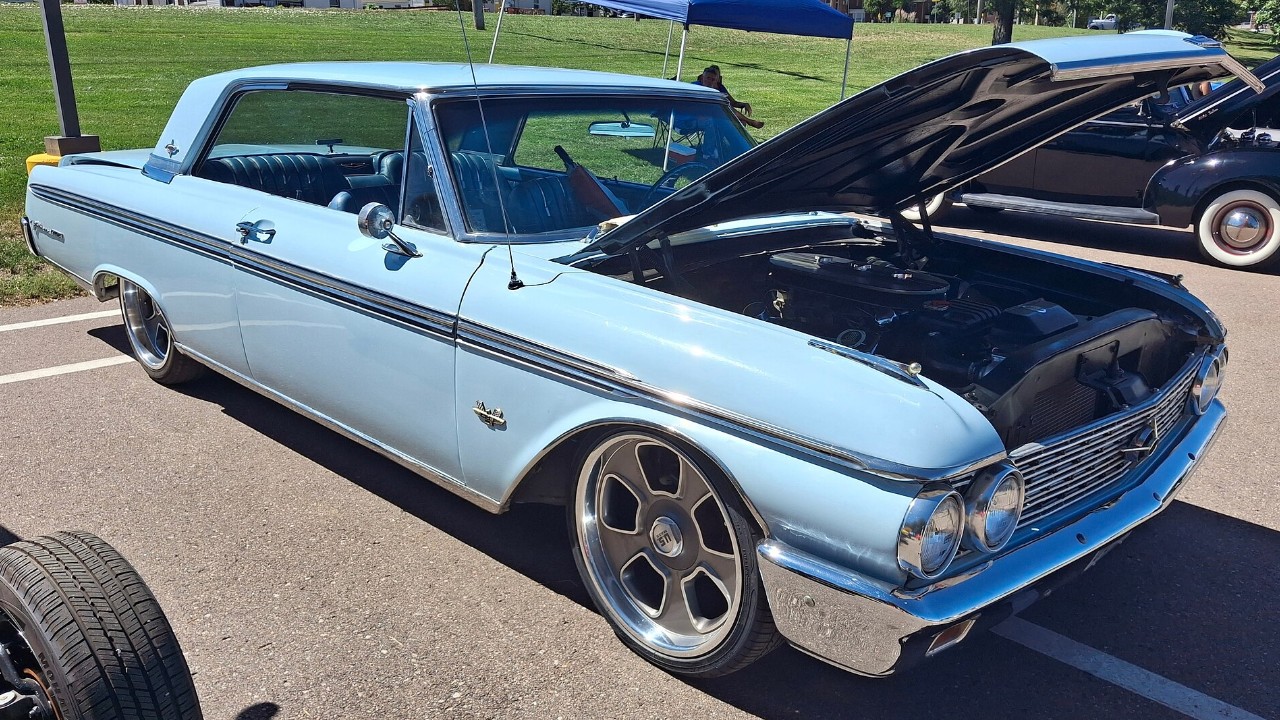
The XL added a sporty edge to Ford’s big car. Ford’s sales literature said XL stood for “Xtra Lively,” and the package brought bucket seats and a console. At the base level, a 292 V8 was standard. However, the engine that mattered was the optional 406.
The 406 was a big-bore version of the FE V8, with a 4.13-inch bore and a thicker-walled block. Testing for racing led Ford to cross-bolt its main bearing caps. With a single four-barrel and 11.4:1 compression, Ford rated it at 385 horsepower. The triple two-barrel setup, often called the “six-barrel,” made 405 horsepower. The 406 lasted only through 1963 before the 427 took its place. Ford also offered it in 1963 Mercurys, but the Galaxie XL is where we’d want it.
Our take: this is the moment the big Ford went from comfortable to quick. A buckets-and-console XL with a factory 406 is a short-lived combination, so it feels special in a way later Galaxies don’t. We’d look hard at documentation before paying for one, because an engine swap is easy to fake. For more on how the model evolved, see our story on why the Ford Galaxie disappeared for decades.
3. 1963 Ford Galaxie 500 Sports Hardtop 427

Ford changed the roof halfway through 1963 to win races. The new Sports Hardtop used a lower fastback roofline that cut drag and aerodynamic lift for NASCAR. Ford made it the industry’s first official “½ year” model. In fact, it outsold the square-roof “boxtop” cars it was supposed to complement.
The engine changed during the year too. Also that year, Ford introduced the 427 for racing, replacing the 406. With two four-barrel Holley carburetors and a solid-lifter camshaft, Ford rated it at 425 horsepower. Despite the name, the 427’s true displacement was 425.98 cubic inches. Later, in 1965, Ford changed the block to a side-oiler design, but the 1963 cars used the earlier top-oiler layout with its own oil routing.
Our take: the 1963½ fastback is the Galaxie at its best-looking. A performance roof that also sold well on the street is a rare win for a racing program. In our view, a 427 Sports Hardtop is the cleanest single statement of Ford’s early-1960s full-size racing push. Buyers should treat any car claiming a factory 427 the same way they treat a 406 car: prove it with paperwork.
4. 1964 Ford Galaxie 500 427 lightweight
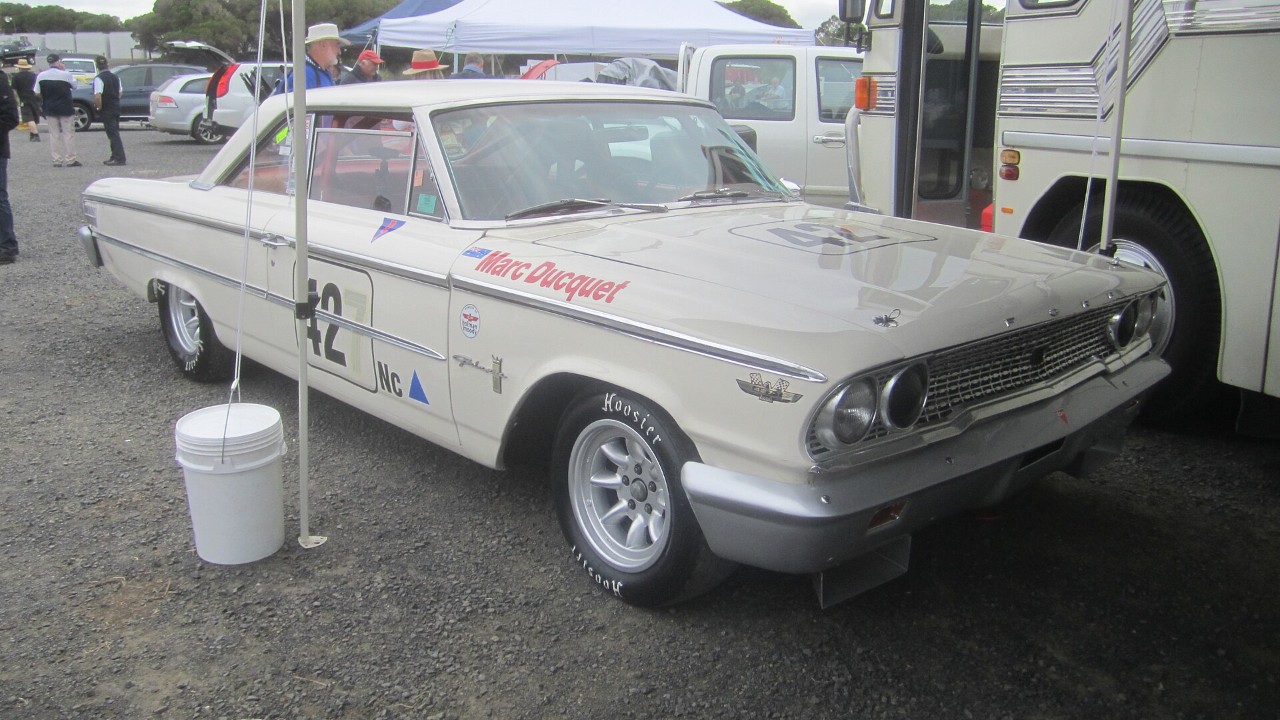
These were drag cars with Galaxie badges. Sports Car Market reports that Ford limited production to 50 units, evenly split between four-speeds and automatics. By 1964, fiberglass was limited to the hood. Even so, the body was about 150 pounds lighter than the 1963 version, and the batteries moved to the trunk.
Underneath, meanwhile, sat an updated high-rise 427. SCM says the cars typically ran low-12-second quarter miles at 110 to 120 mph. One car, with a racing history that includes owner “Crazy Nate” Cohen, sold for $121,000 at Mecum’s Louisville auction on September 21, 2019. SCM’s own valuation of that car was $159,500.
Our take: the 1964 lightweight has the smallest production count we found for any car here, and it is the most single-minded. A full-size Ford was never going to be the lightest drag car, and Ford soon moved to the Fairlane Thunderbolt. That said, in our view, the Galaxie version deserves credit for pushing a family car that far. If one ever comes up, expect experts and documentation to decide the price, not paint. With only 50 built, a single missing receipt can matter a great deal.
5. 1965 Ford Galaxie 500 LTD

The LTD turned the Galaxie into a luxury car. It became the new top-of-the-line model for 1965. As Hagerty’s Sajeev Mehta explains, Ford’s advertising with agency J. Walter Thompson made the hardtop LTD famous for being “quieter than a Rolls-Royce.”
Better yet, the hardware behind that claim was new. Hagerty describes a body-on-frame design with torque boxes and rubber body mounts, tuned for less noise and vibration. A new three-link rear suspension with a Panhard bar swapped leaf springs for coils. By comparison, Hagerty notes, the Lincoln Continental of the day used rear leaf springs. Hagerty also counts 978,429 Galaxie-line sales for 1965, more than 55,000 above the year before.
Our take: the LTD is the model that changed what a big Ford meant. It showed buyers they could get near-luxury calm without paying luxury prices. In our view, that idea outlived the Galaxie itself, since the LTD name had replaced the Galaxie brand by 1974. Later Galaxies leaned even harder into highway comfort, as our story on the 1969 Ford Galaxie 500 explains. Even so, a clean 1965 LTD hardtop is the time capsule of that shift. For a buyer, it is also a comfortable way into 1960s Ford ownership, with coil springs doing the work at the back.
6. 1966 Ford Galaxie 500 7-Litre

The 7-Litre was Ford’s big-car muscle model for exactly one year. According to Old Cars Weekly, its standard 428 V8 was rated at 345 horsepower. A 360-horsepower Police Interceptor version also existed. Buyers who wanted more could order 427s rated at 410 or 425 horsepower, but those required a four-speed manual.
On top of that, the standard list was generous. It included a C6 automatic, power front disc brakes, an XL-style interior, a simulated wood-grain steering wheel and 7-Litre badges. Ford built 11,174 of them for 1966, and 2,368 were convertibles. For 1967, the 7-Litre became an option package rather than a separate model.
Our take: this is the most complete Galaxie package Ford ever sold as its own model. Today, the market seems to agree. Hagerty lists $60,000 for a 428 7-Litre hardtop in #2 condition and $141,000 for a 427 car. We’ve written before about how Ford’s 1966 Galaxie 500 delivered big-block performance, and the 7-Litre is the sharpest version of that story. Notably, it was the only full-size Ford of its era to come standard with an engine over 400 cubic inches.
7. 1960 Ford Galaxie Starliner
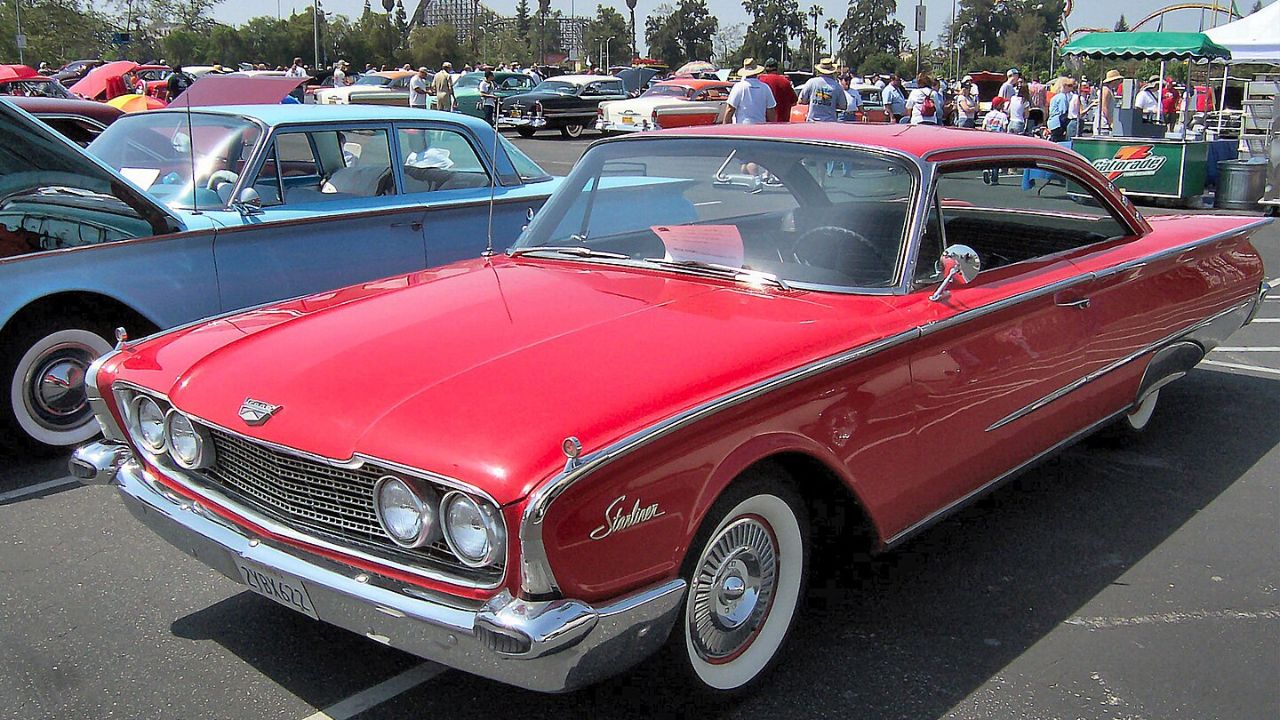
The Starliner gave the 1960 Galaxie a sleek, pillarless hardtop roof with a large curved rear window. Ford offered it for 1960 and 1961, then dropped it. An Old Cars Weekly column places it among the “airy, fastback-styled two-door hardtops” of the era. Ford had used that kind of roofline in 1957 and 1958, skipped it for 1959, then brought it back.
The Starliner’s fate came down to a formal roof. By 1961, it shared the lineup with the square-roofed Victoria, and in 1962 the Victoria took over. The same column notes that racers tried to bolt a Starlift-style top to some 1962 convertibles. Officials then banned the roof as a non-production item, which ended the idea.
Our take: the Starliner is the Galaxie that looked fast even when parked. In our view, its slim roof pillars and huge glass make it the best-looking Ford of 1960. Because it lasted only two model years, survivors are not easy to find. The columnist reports photographing just two 1960 Starliners and two 1961 cars over the years. For us, that scarcity makes every one at a show worth a long look.
More from Fast Lane Only