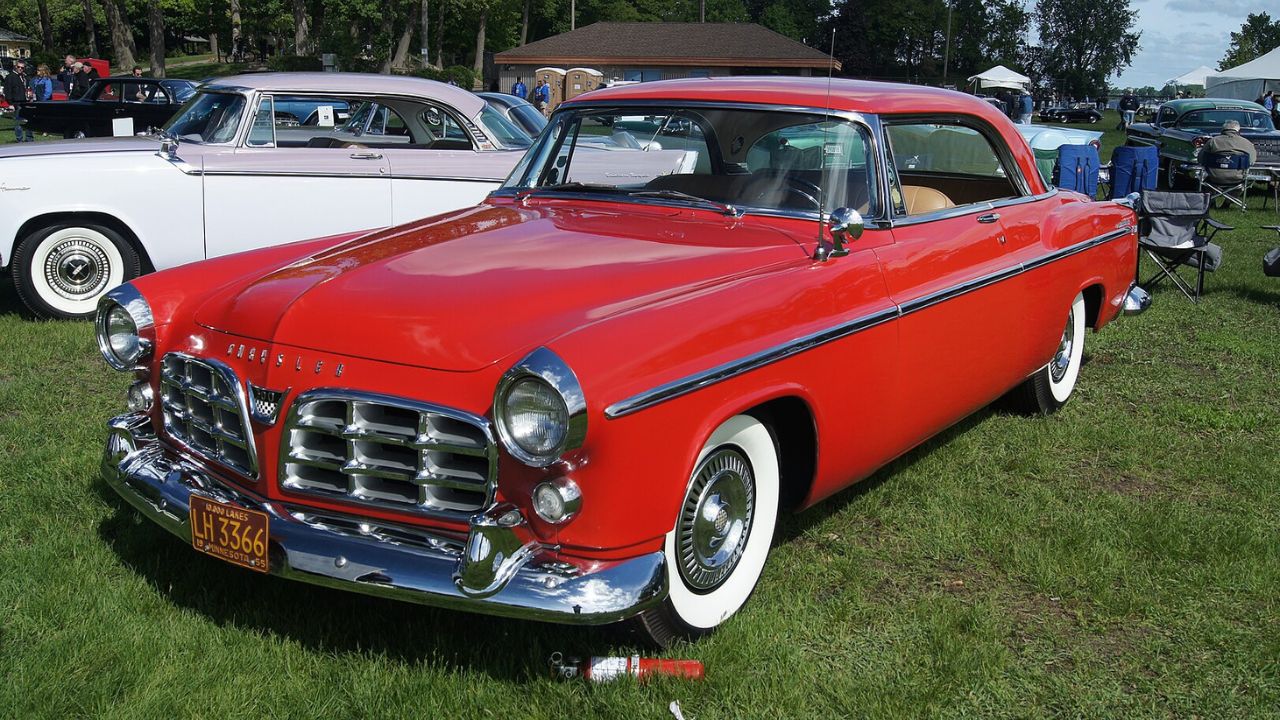
The 1955 Chrysler C-300 arrived at a moment when American cars were getting larger, flashier and more powerful, but few were genuinely engineered as all-around performance machines. Chrysler’s answer was a big, formal two-door that packed race-ready horsepower, heavy-duty hardware and understated styling that looked more country club than drag strip. The result was a car that reset expectations for what a full-size American performance car could be.
Seven decades later, the C-300 still shapes how enthusiasts think about power, luxury and speed in a single package. Its blend of NASCAR pedigree, high-output V8 power and restrained design continues to echo through modern interpretations of the 300 badge and through the broader idea of the American sport sedan.
From conservative giant to horsepower benchmark
In the early 1950s Chrysler had a reputation for engineering excellence, but not for excitement. The company’s cars were solid, conservative and often overshadowed by flashier offerings from rivals. That changed when Chrysler’s engineers combined the new 331 cubic inch Hemi V8 with a two-door body and a package of heavy-duty components intended as much for the racetrack as for suburban driveways.
The C-300’s Hemi was tuned to roughly 300 horsepower, a figure that made it one of the first production cars to legitimately reach that benchmark. Enthusiast accounts describe how this early 1955 model stood at the front of a small group of road cars that could claim 300 horsepower from the factory, and sources that track early high-output models consistently place the Chrysler among the leaders in that race for power. One detailed overview of early performance cars credits the Chrysler 300 with being the first American production car to reach a 300 horsepower rating, and sets it alongside other pioneering high-output machines in a short list of game changers, as seen in coverage of the first production cars to break that barrier.
Chrysler did not stop at the engine. The C-300 received stiffer suspension, heavy-duty brakes and a focus on stability at high speed. Period accounts describe a car that could cruise at speeds that would have challenged many sports cars of the era, while still carrying four adults in comfort. Its understated body, derived from Chrysler’s New Yorker and Windsor lines, avoided the tailfin excess that would define the later 1950s and instead projected a serious, almost formal presence.
How the C-300 rewrote the American performance formula
The C-300’s impact went well beyond straight-line speed. Chrysler entered the car in NASCAR, where it quickly dominated stock car racing. The combination of the 300 horsepower Hemi and the car’s high-speed stability turned it into a fixture at early superspeedways. That success created a feedback loop: racing victories gave the 300 a reputation on the street, and customer demand justified continued investment in performance engineering.
Histories of the 300 line describe how the C-300 inaugurated a run of “letter cars” that carried the 300 name forward through the late 1950s and early 1960s. These cars, from the 300B through later variants, gradually increased displacement and power, but they all traced their identity back to the 1955 original. A detailed brand history of Chrysler’s big performance sedan points out that the C-300 set the tone for a series that blended luxury and speed in a way few domestic rivals could match, a story laid out in depth in the history of the.
By pairing genuine motorsport credentials with a full-size body, the C-300 helped define a new niche. It was not a lightweight sports car and not a stripped drag special. Instead it previewed what would later be called the muscle car and the sport sedan: a powerful engine in a comfortable, everyday-usable package. Later icons like the Pontiac GTO and Chevrolet Chevelle SS would follow a similar recipe, but Chrysler’s 300 had already shown that buyers would pay for a big, fast, premium-feeling car with real performance capability.
Collectors and historians now often list the C-300 among the most influential American cars of the twentieth century. Surveys of Chrysler’s greatest hits routinely include the 1955 model as one of the company’s defining achievements, highlighting its combination of the early Hemi engine, NASCAR success and restrained styling. One retrospective on Chrysler’s centenary singles out the original 300 as a milestone for the brand, placing it in a top group of ten vehicles that shaped the company’s identity, as seen in a feature on Chrysler at 100.
Why the C-300 still matters in the 300’s final chapter
The C-300’s legacy has been especially visible during the long run of the modern Chrysler 300, which arrived in the mid-2000s as a bold, rear-wheel-drive sedan with available Hemi V8 power. Reviewers repeatedly linked that car’s stance and presence to the original letter series, noting how its long hood, upright grille and rear-drive proportions echoed the 1955 formula even as it adopted contemporary styling language.
Over the years, performance versions like the 300C and 300C SRT8 carried the heritage forward. Road tests of the 300C SRT8 highlighted its big-displacement V8, rear-wheel drive and surprising agility for such a large sedan, describing a car that felt more like a modern interpretation of a classic American performance sedan than a typical front-drive family car. One detailed evaluation of the 300C SRT8 emphasized how its power and chassis tuning gave it a character that clearly descended from the original 300 idea.
As the current generation aged, reviewers of more recent 300 models continued to stress that the car’s appeal lay in its traditional American attributes: a big, comfortable cabin, rear-wheel drive and available V8 power. Test drives of late-model 300 sedans described them as “big, bold” and unapologetically old-school, a theme that runs through coverage of the 2017 Chrysler 300 and similar variants.
The end of production for the modern 300 has thrown the C-300’s influence into sharper relief. Chrysler built a final run of 2023 Chrysler 300C models, equipped with a 6.4 liter Hemi V8 rated at 485 horsepower, as a send-off for the line. Official statements around that final model emphasized its link to the 1955 original, noting that the 300 badge had first appeared on a 300 horsepower Hemi-powered coupe that went on to dominate NASCAR. The final 300C was presented as a modern bookend to that story, a last high-performance sedan before Chrysler pivots toward electrified models, a moment captured in the announcement that the 2023 Chrysler 300C had ended production.
Forgotten muscle, lasting blueprint
Compared with later legends like the Dodge Charger or Plymouth Road Runner, the C-300 can seem like a connoisseur’s choice. It lacks the wild graphics and drag strip image of late 1960s muscle cars, and its restrained styling can read more executive express than street racer. That has led some commentators to place it in the category of “forgotten” or underappreciated American performance cars, even as they acknowledge its importance to the evolution of the genre.
Enthusiast retrospectives that revisit overlooked V8 machines often highlight the C-300 and its letter series successors as key stepping stones between early postwar performance and the muscle car boom. One such survey of forgotten American muscle points to the early 300s as examples of big, powerful coupes that delivered serious speed long before muscle car marketing took hold.
That perspective helps explain why the C-300 continues to appear on lists of the most influential production cars. Evaluations of the 50 most significant road cars often include the original 300 among vehicles that changed how manufacturers and buyers thought about performance. One such ranking of influential production cars places the C-300 in a select group that shaped later engineering and marketing trends.
What the C-300’s legacy suggests about the future
With the modern 300 line now ended, Chrysler faces a turning point. Official communications around the final 300C have framed the brand’s future in terms of electrification and new segments. Yet the story of the C-300 suggests that the core idea behind the 300 badge is less about cylinders and more about character.
More from Fast Lane Only
- Unboxing the WWII Jeep in a Crate
- 15 rare Chevys collectors are quietly buying
- 10 underrated V8s still worth hunting down
- Police notice this before you even roll window down
*Research for this article included AI assistance, with all final content reviewed by human editors