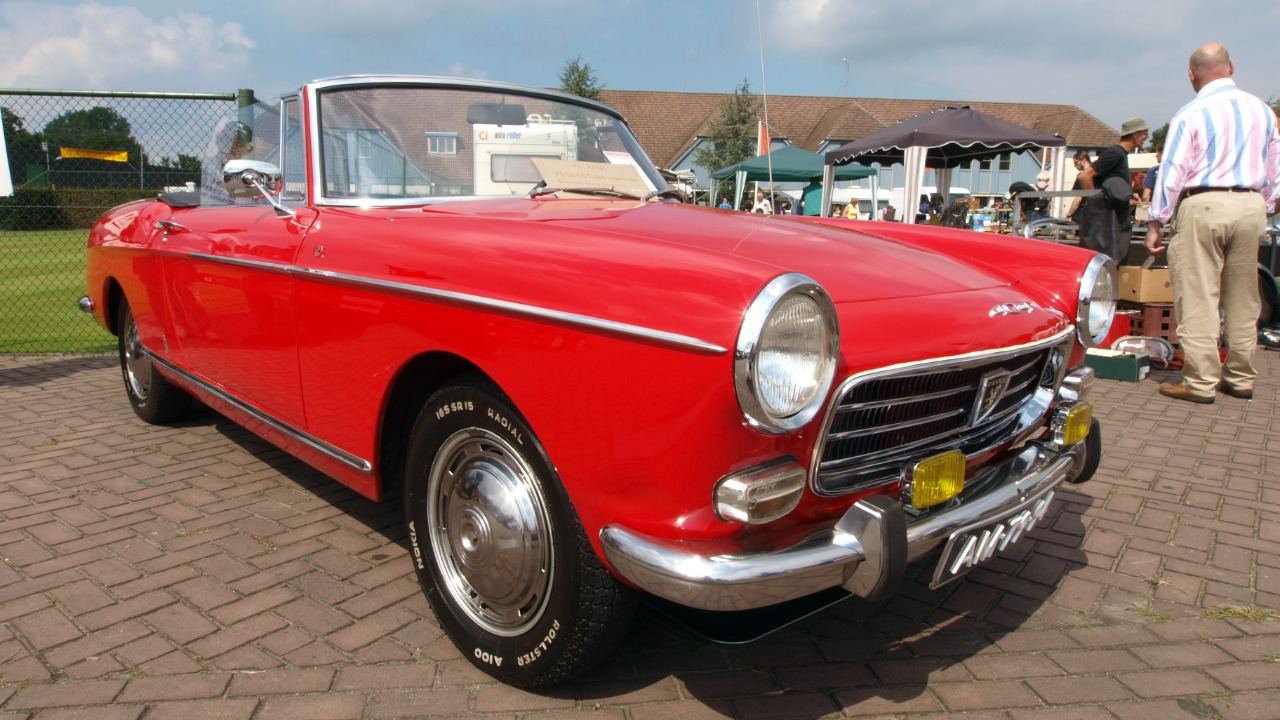
The Peugeot 404 arrived in the early 1960s as a sensible family car, yet it quietly became one of the most respected workhorses on several continents. Its mix of elegant design, mechanical toughness and global reach turned a modest saloon into a benchmark for reliability from Europe to Africa and beyond. When I look at how the 1966 Peugeot 404 is remembered today, I see a car that earned its reputation not through flash, but through sheer staying power in the real world.
To understand how that reputation formed, it helps to trace how the 404 was conceived, how it was engineered, and how it proved itself in everyday service and in brutal competition. The story runs from design studios in Italy and factories in Sochaux to dusty rally stages in Africa and long distance record runs that pushed diesel technology to its limits.
From quiet launch to worldwide workhorse
When I go back to the origins of the Peugeot 404, what stands out is how deliberately it was positioned as a solid, modern car rather than a showpiece. The Peugeot 404 was developed at Peugeot and Pininfarina in the 1958 to 59 period, and that collaboration gave it a clean, almost understated shape that aged unusually well. Styled by the Italian studio, the body that emerged was practical and upright, yet the proportions were so well judged that the car still looks coherent decades later, which is why enthusiasts still talk about it as a kind of “French Mercedes” in miniature.
That restrained approach did not stop the car from becoming a phenomenon. It is easy to forget now that the 404 was not just a European success but a global one, embraced by buyers who valued durability over fashion. One retrospective notes that the Peugeot 404, introduced in 1960, was never especially flashy or a technical tour de force, yet it became a worldwide hit that remained in demand even as newer models appeared, a point underlined when a later anniversary piece described it as a car that, at 65 years on from launch, still inspires affection among owners who prize its unpretentious competence in everyday use in the way Peugeot 404 – 1960 (65 years) enthusiasts do.
Design and engineering that punched above its class

Looking closely at the 404’s structure, I am struck by how much thought went into making it both comfortable and tough. The car was Styled by Pininfarina, and that partnership produced a saloon, estate and other body styles that shared a strong, box section structure and generous glass area. The result was a cabin that felt airy and refined, but also a shell that could cope with rough roads without flexing itself to pieces, something that would later prove vital in export markets with poor infrastructure.
Under the bonnet, The Peugeot engineers focused on smoothness and longevity rather than headline power figures. Contemporary accounts of the 1969 cars describe how The Peugeot engineers paid close attention to internal balancing and refinement so the four cylinder engine would run with minimal vibration, even at sustained cruising speeds. That kind of engineering discipline did not make for exciting brochure copy, but it meant that owners could drive long distances on indifferent fuel and still expect the car to start the next morning, which is exactly how reputations for reliability are built.
Production scale and the Sochaux backbone
For a car to become a global reference point, it has to be built in serious numbers, and the 404 certainly was. Production of the saloon and the Break estate was concentrated at Sochaux in eastern France, and Until 1975, further examples of the 404 sedan and 404 Break were produced in Sochaux, France, contributing to a total of 1,847,568 units. That figure alone tells me how central the model was to Peugeot’s business, and how widely it must have been distributed across continents.
What makes that production story more interesting is how the 404’s basic platform was adapted. Alongside the saloon and estate, a truck body style variant was marketed until 1988, which meant the same underlying architecture was hauling goods as well as families in markets far from Europe. The fact that a design introduced in 1960 could still underpin working vehicles nearly three decades later speaks volumes about the inherent strength of the structure and the confidence operators had in the 404 name, a confidence that was reinforced every time another batch of cars rolled out of Production figures at Sochaux and its satellite plants.
Proving ground: Africa, rallies and endurance
If there is one arena where the 404 truly forged its legend, it is Africa. Peugeot built its reputation for robustness in Africa mainly thanks to its multiple participations in Competition, rally and endurance events, where the combination of rough terrain, extreme temperatures and long distances punished any mechanical weakness. In everyday service, the same qualities made the car a favourite of taxi drivers and government fleets, who valued a chassis that could shrug off corrugations and potholes that would cripple more delicate machinery.
The East African Safari Rally became the most visible stage for this toughness. A 404 scored a class victory in the 1961 East African Safari Rally and the event outright in 1963, 1966, 1967 and 1968, a run of results that showed the car was not just surviving but winning in one of the world’s hardest events, as detailed in accounts of the East African Safari Rally and the broader rally scene. Later reflections on the model note that it, Peugeot 404, achieved repeated success in events like the East African Safari Rally, often by simply staying intact when others fell apart, a pattern that cemented its status among competitors and spectators alike, as highlighted in coverage of the Peugeot, East African Safari Rally story.
Diesel records, media memory and a lasting image
Beyond rallies, the 404 also played a quiet but important role in changing perceptions of diesel engines. In the mid 1960s, a specially prepared 404 diesel set a remarkable endurance mark when it covered over 11,000 km in 3 days without blowing up, giving up or even slowing significantly, a feat that showed how far diesel reliability had come and that is still discussed in modern retrospectives on the 11,000 km record run. For me, that story captures the essence of the car: not spectacular speed, but the ability to keep going, hour after hour, in conditions that would break lesser machines.
Today, when I watch enthusiasts revisit the model on screen, I see the same themes repeated. A television feature from Jul takes a fresh look at a car from the 1960s with capabilities that have almost been forgotten, highlighting how the Peugeot 404 combined comfort, handling and durability in a way that still surprises modern drivers, as seen in the Jul episode devoted to it. Another anniversary piece from Aug reflects on how the 404, now 65 years on from its debut, continues to be cherished not because it is rare or exotic, but because it represents a kind of honest engineering that is increasingly hard to find, a sentiment that echoes through the Aug reflections on Peugeot’s mid century workhorse.
More from Fast Lane Only: