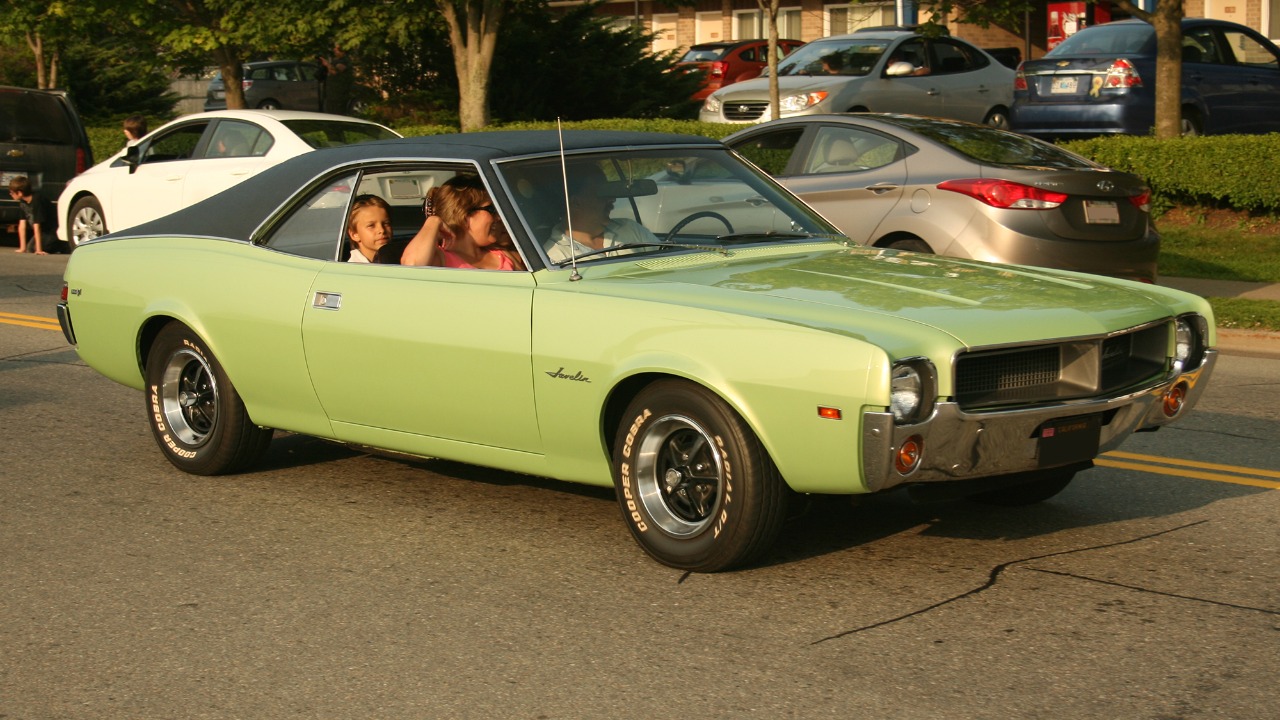
The 1968 AMC Javelin arrived at a moment when the Ford Mustang and Chevrolet Camaro seemed to own every inch of the pony-car conversation, yet it refused to play the role of a me-too coupe. Instead of chasing its rivals spec for spec, it carved out a lane as the roomier, more practical, and quietly sophisticated alternative that still had the hardware to run with Detroit’s quickest. I see that first-year Javelin as the car that proved American Motors Corporation could step into the arena with the Big Three and, on its own terms, belong there.
To understand how it positioned itself against those pony elites, you have to look at more than quarter-mile times. The Javelin’s proportions, cabin, marketing, and racing program were all tuned to answer the Mustang and Camaro without simply copying them, and that is what makes its story so compelling today.
AMC crashes the pony-car party
In the late 1960s, American Motors Corporation was better known for frugal family transport than for tire smoke and spoilers. Reports on that era make it clear that In the late 1960s, American Motors Corporation, or AMC, was seen as the company that built economy and practical cars, and that reputation shaped how people viewed its sudden move into performance. They were the underdog, and they knew that if They were going to challenge the Ford Mustang and Chevrolet Camaro, they had to do it with a clear, differentiated pitch rather than brute-force marketing dollars.
That is why the 1968 AMC Javelin was framed from day one as AMC’s bold answer to the established pony crowd. Contemporary descriptions call the 1968 AMC Javelin AMC’s answer to the Ford Mustang and Chevrolet Camaro, a car meant to give the company credibility in the muscle car market rather than just showroom traffic. Later retrospectives note that AMC thrust its directly into the herd of pony cars that were battling the Ford Mustang and Chevrolet Camaro, a deliberate attempt to show that the smallest of Detroit’s players could still build a serious performance coupe.
Longer, roomier, and deliberately different
Where the Javelin really separated itself was in its basic shape and packaging. Instead of simply cloning the Mustang’s compact footprint, the car was engineered to be slightly larger, with sources noting that car was longer and roomier than the Ford Mustang and Chevrolet Camaro, yet it stopped short of the bulk of the Plymouth Barracuda. Another period account explains that The Javelin was planned to look like a Mustang, Cuda, or Camaro in size, but to provide four full seats inside, with a 12 inch stretch in wheelbase over AMC’s smaller AMX to make that possible, a detail laid out in The Javelin design brief.
Inside, that strategy paid off. Reports on the first generation note that Inside, the Javelin offered more interior and luggage space than its rivals, and some trims added touches like reclining front seats and upscale trim that you did not always find in a bare bones pony car. Another overview of the lineup stresses that the first generation AMC Javelin was quite different from any other car in AMC’s lineup, aimed at buyers who wanted pony car looks and performance but were not willing to give up real back seats and trunk space.
Engines, hardware, and the AMX connection
Under the skin, AMC knew it had to back up the styling with serious hardware. The first generation powertrain range has been described as having a split personality, with coverage of What Engine Did the First Gen AMC Javelin Have explaining that the car could be ordered with six cylinder engines for economy or with V8s that displaced 290, 343, and 390 cubic inches, a spread laid out in What Engine Did generation spec sheets. Later references to the same family of engines note that AMC V8s in this era also came in 304, 343, 390, and 360 cubic inches, reinforcing how much choice the company built into the Gen AMC Javelin lineup.
Beyond the catalog engines, AMC quietly developed a deep bench of performance parts. Technical write ups point out that these parts included dual four barrel cross ram intake manifolds, high performance camshaft kits, needle bearing rocker arms, and other racing grade components, details preserved in the AMC Javelin record. That engineering push was closely tied to the company’s two seater sibling, the AMX, and enthusiasts still highlight how Under the hood, its 1968 AMC AMX powerful V8 options delivered serious speed, proving that Under the AMC AMX skin was a genuine muscle car, not just a styling exercise.
Marketing against Detroit’s finest
Because AMC could not match the advertising budgets of Ford, Chevrolet, or Dodge, it leaned on attitude and contrast. One retrospective on the brand notes that over the course of the 1980s, the Wisconsin based brand had its moments of muscle car glory alongside Detroit’s finest during the height of the horsepower wars, a point that comes through in a video on Wisconsin muscle. That underdog swagger shaped how the Javelin was pitched, not as a copy of a Mustang, but as a car for buyers who wanted something a little different from what Detroit was pushing in every magazine spread.
Period advertising leaned into that comparison. One campaign, preserved in later analysis, describes how This American Motors ad draws obvious parallels between the Javelin and its rivals, positioning the This American Motors pitch as an image buster that challenged the idea that only the Big Three could build an aspirational pony car. Another summary of the broader context notes that While never as successful as their Big Three competitors, a constant in AMC’s existence, the Javelin still earned the respect of its colossal competitors, a verdict captured in a look back at how While the Big Three dominated the sales charts.
Racing, reputation, and the long game
On track, AMC understood that credibility in the pony car world depended on more than showroom brochures. A detailed history of the program notes that AMC thrust its Javelin into competition in an attempt to market the coupe against the herd of pony cars that were battling the Ford Mustang and Chevrolet Camaro, a strategy that later helped lift AMC thrust its collector values. Another retrospective on the broader pony car wars explains that The rest of the story is that, while never as successful as their Big Three competitors, the Javelin’s racing efforts were still a hit by AMC standards and helped the company earn the respect of its colossal competitors, a point underscored in coverage of how The rest of the story unfolded.
That competition focus fed back into the street cars and into how enthusiasts see the Javelin today. One modern overview notes that unlike other pony cars, the Javelin was marketed as a more spacious and comfortable pony car than its rivals, and it was complete with a serious racing program that gave it real credibility, a balance described in a feature that opens with Unlike other pony cars. Another piece, framed as The Real Javelin Story, points out that collectors have watched the price points skyrocket, translating to a bump in demand and respect from car collectors, a trend summed up in Real Javelin Story that compares it directly with the Mustang.
More from Fast Lane Only: