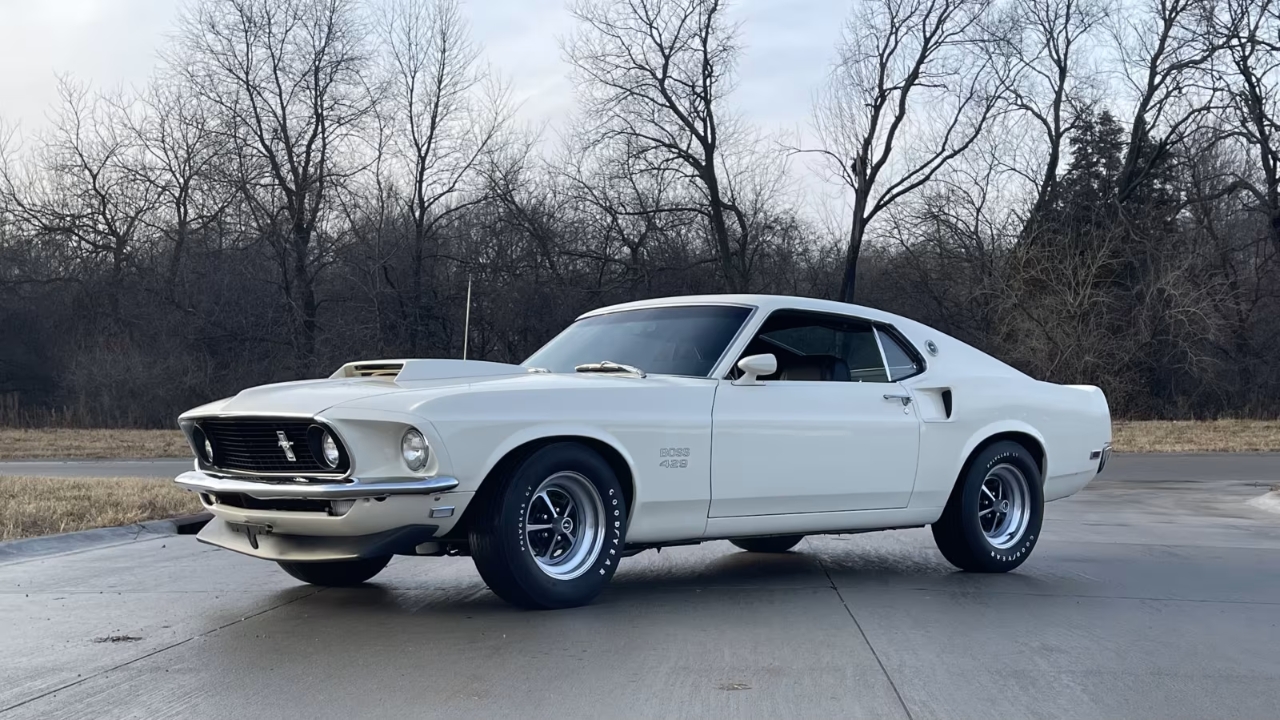
The Ford Mustang has worn many different identities throughout its long history.
Since its debut in 1964, the Mustang has been everything from an affordable sporty coupe to a luxury-oriented cruiser, a road-racing machine, a drag-strip contender, and a modern high-performance sports car. Few nameplates have proven as adaptable, and that versatility has helped the Mustang remain successful for more than half a century.
Yet even among the countless Mustang variants produced over the years, the 1969 Boss 429 occupies a category almost entirely its own.
It wasn’t created primarily to boost sales. It wasn’t designed as a mainstream performance package. In fact, many buyers who walked into Ford dealerships in 1969 had little understanding of why the car existed at all. The Boss 429 was born from a very specific racing objective, and its development required engineering solutions unlike anything applied to a Mustang before or since.
The result was one of the rarest, most specialized, and most fascinating factory Mustangs ever built.
While many performance cars of the era focused on attracting the broadest possible audience, the Boss 429 existed because Ford wanted to win races. The street version was largely a means to that end, which helps explain why the car feels so different from nearly every other Mustang produced during the muscle car era.
More than fifty years later, that uniqueness remains a major part of its appeal.
NASCAR Was the Real Target
To understand the Boss 429, it’s important to start with NASCAR rather than the Mustang itself.
During the late 1960s, manufacturers were deeply invested in stock car racing. Success on NASCAR’s high-speed tracks translated into prestige, publicity, and showroom credibility. Ford, Chrysler, and General Motors all viewed racing as an essential battleground.
Ford’s engineers developed a new engine specifically for NASCAR competition.
The massive 429-cubic-inch V8 featured advanced cylinder-head designs intended to improve airflow and maximize high-speed performance. The engine represented one of the company’s most ambitious racing projects.
However, NASCAR homologation rules required manufacturers to offer qualifying engines in production vehicles.
That requirement created an interesting challenge.
Ford suddenly needed a street car capable of housing an engine that was originally designed with racing in mind.
The Mustang Became the Chosen Platform
Several vehicles within Ford’s lineup could theoretically have served as the homologation platform.
Ultimately, the company selected the Ford Mustang.
The choice may seem obvious today, but it presented significant engineering challenges at the time. The Mustang was relatively compact, and the new Boss 429 engine was anything but small. Installing the powerplant would require extensive modifications that went far beyond a typical engine swap.
Ford viewed the effort as worthwhile.
The Mustang already possessed strong performance credentials and considerable public visibility. Associating the new engine with the company’s most famous performance model offered clear marketing advantages.
Even so, fitting the engine proved far more difficult than many people realized.
The Engine Barely Fit
One reason the Boss 429 became so unusual was the amount of work required to install its engine.
The standard Mustang engine bay simply wasn’t designed for a powerplant of this size and configuration. Significant modifications were necessary to create adequate space.
Ford contracted much of the conversion work to Kar Kraft, a specialty firm with extensive experience preparing performance vehicles. Engineers revised suspension mounting points, altered sheet metal, and made numerous structural changes to accommodate the enormous engine.
The process was remarkably involved.
Boss 429 Mustangs essentially underwent partial reconstruction before reaching dealerships. Few production cars of the era required such extensive modifications.
That complexity contributed directly to the car’s rarity and mystique.
The Engine Was Unlike Other Mustang Powerplants
Although Ford offered several powerful engines throughout the Mustang lineup, the Boss 429 stood apart from all of them.
The engine’s design reflected its racing origins. Large cylinder heads, specialized combustion chambers, and advanced breathing characteristics distinguished it from more conventional Ford V8s. The powerplant emphasized high-performance potential rather than everyday practicality.
This gave the car a unique personality.
While many muscle car engines relied heavily on brute force and displacement alone, the Boss 429 represented a more sophisticated engineering approach. It was designed to perform exceptionally well under demanding racing conditions.
Owners appreciated the exclusivity.
The engine felt special because it genuinely was special.
Very few people had access to anything similar.
The Exterior Remained Relatively Subtle
Interestingly, the Boss 429 avoided some of the visual excess common during the muscle car era.
Many competitors relied on oversized graphics, dramatic hood treatments, and aggressive styling cues to advertise their performance credentials. The Boss 429 certainly looked purposeful, but Ford exercised a surprising degree of restraint.
The car featured unique body modifications and distinctive badging, yet it generally avoided excessive decoration.
This understated approach reflected the model’s mission.
The Boss 429 wasn’t intended primarily as a marketing exercise. It existed because of homologation requirements, and its appearance often seemed secondary to its engineering.
That subtlety appeals strongly to enthusiasts today.
The car’s capabilities speak for themselves.
It Was Not Built in Large Numbers
Because the Boss 429 served such a specialized purpose, production remained limited.
Ford only needed to build enough examples to satisfy NASCAR requirements and support the homologation effort. The company had no intention of turning the model into a mass-market performance package.
This limited production immediately set the car apart.
Even when new, Boss 429 Mustangs were relatively uncommon. Buyers understood they were purchasing something unusual and highly specialized rather than a typical performance model.
Rarity became part of the car’s identity from the very beginning.
That exclusivity continues influencing collector interest today.
The Boss 429 Shared Little With Other Mustangs
Another reason the car feels unusual is how different it was from the rest of the Mustang lineup.
Most Mustangs were developed with broad customer appeal in mind. Ford carefully balanced performance, affordability, practicality, and comfort. The Boss 429 largely ignored those priorities.
Instead, the car focused on satisfying racing requirements.
Its engineering, production process, and overall purpose differed significantly from other Mustangs. Even compared with respected variants such as the Ford Mustang Boss 302, the Boss 429 occupied its own category.
The car often felt more like a racing program disguised as a street vehicle.
That distinction makes it fascinating.
Performance Was Only Part of the Story
The Boss 429’s legend extends beyond acceleration figures and horsepower ratings.
Certainly, the car offered impressive performance. Yet its significance stems just as much from the story behind its creation. Enthusiasts appreciate the engineering challenges, NASCAR connections, and unusual development process that made the vehicle possible.
In many ways, the Boss 429 represents an era when manufacturers were willing to undertake extraordinary efforts for racing success.
Modern performance cars often emerge from carefully calculated business decisions.
The Boss 429 feels different.
It exists because racing mattered enough to justify substantial complexity and expense.
That perspective enhances its appeal.
Collectors View It as a Crown Jewel
Today, the Boss 429 ranks among the most desirable Mustangs ever produced.
Collectors value the car for its rarity, historical significance, and unique engineering. The combination of NASCAR heritage and limited production creates an irresistible package for enthusiasts.
The car occupies a special place within Mustang history.
Many famous Mustangs have appeared over the decades, but few possess a story quite like the Boss 429’s. It represents a singular moment when racing requirements directly shaped a production vehicle in extraordinary ways.
Its reputation continues growing as enthusiasts learn more about its origins.
The Mustang That Existed for Racing
Looking back, the Boss 429 succeeded because it fulfilled its intended purpose.
Ford needed a production car capable of homologating a NASCAR engine, and the company accomplished that goal. Along the way, it created one of the most memorable and unusual Mustangs ever built.
The car was never meant to be ordinary.
Every aspect of its existence reflected that reality.
A Mustang Unlike Any Other
The 1969 Boss 429 became one of Ford’s most unusual Mustangs because it was created for reasons that had little to do with conventional showroom competition.
Developed primarily to satisfy NASCAR homologation requirements, the car featured a specialized racing-derived engine, extensive structural modifications, limited production numbers, and a mission unlike that of any other Mustang. It wasn’t simply a high-performance version of Ford’s popular pony car.
It was a race-bred machine wearing Mustang sheet metal.
More than fifty years later, that unique origin story remains one of the biggest reasons enthusiasts continue celebrating the Boss 429.
Many Mustangs are fast.
Many are collectible.
Only one exists because Ford needed to put a NASCAR engine on the street.
And that’s what makes the Boss 429 so special.
More from Fast Lane Only