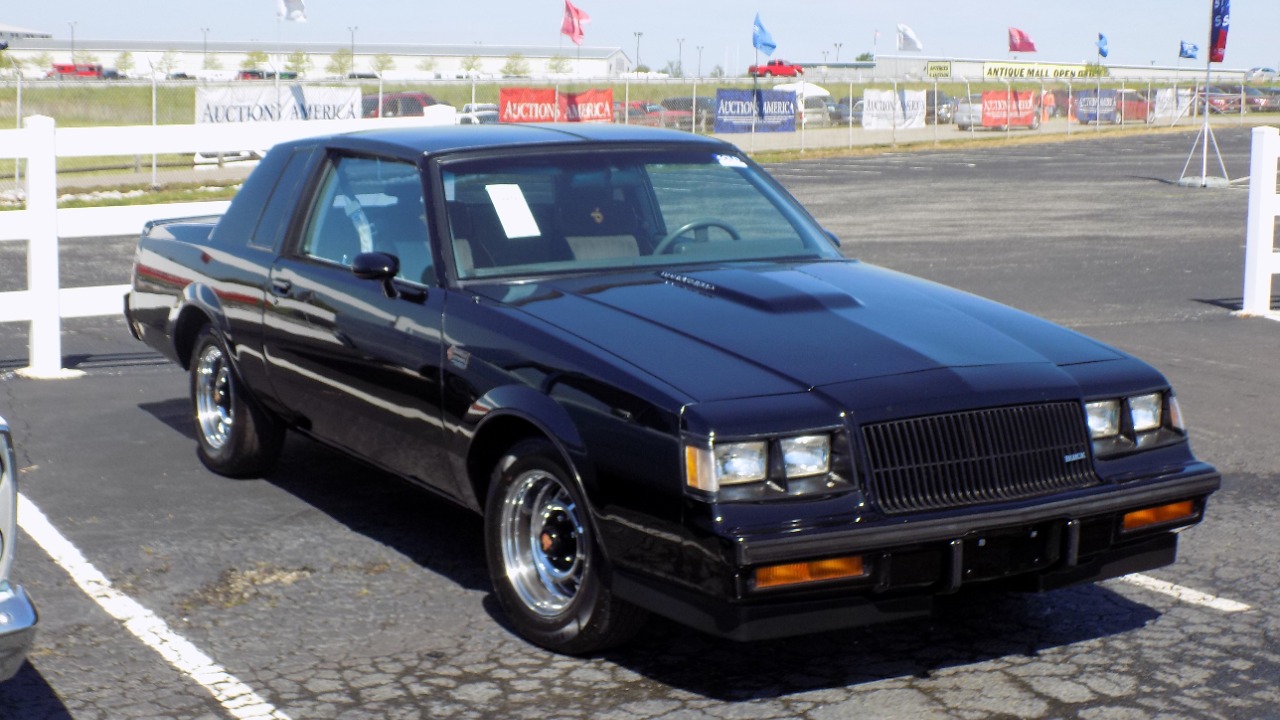
During the 1980s, when stricter emissions regulations and rising fuel economy concerns had slowed the muscle car era, Buick surprised the automotive world with an unlikely performance icon. The Grand National proved that advanced engineering could deliver impressive speed without relying on massive V8 engines. Its turbocharged V6 changed perceptions of American performance and sparked a new chapter in muscle car history.
Turbocharging Replaced Traditional Muscle
Instead of following the traditional formula of installing the largest available V8, Buick engineers focused on extracting more performance from a smaller engine. The result was a turbocharged 3.8-liter V6 that combined strong low-end torque with impressive horsepower, allowing the Grand National to compete with—and often outperform—many V8-powered rivals.
Turbocharging was still relatively uncommon in American performance cars at the time, making the Grand National stand out from the competition. The engine delivered quick acceleration while maintaining respectable efficiency, proving that forced induction could be both practical and exciting.
This innovative approach challenged long-held assumptions about what defined a true muscle car. Performance no longer depended solely on engine displacement.
Buick’s willingness to embrace new technology became the foundation of the Grand National’s success.
Engineering Focused on Real-World Speed
The Grand National was engineered to deliver usable performance rather than simply impressive specifications. The turbocharged V6 produced abundant torque across a wide range of engine speeds, giving drivers strong acceleration during everyday driving as well as impressive straight-line performance.
Buick also equipped the car with a suspension and drivetrain capable of handling its increased power. Automatic transmissions were carefully matched to the engine’s torque characteristics, helping the Grand National launch quickly and consistently from a standstill.
Continuous refinements throughout production improved reliability, throttle response, and overall drivability. Engineers focused on creating a balanced package that owners could enjoy both on the street and at the drag strip.
The result was a performance car that felt remarkably advanced for its era.
The GNX Took Performance Even Further
Near the end of the Grand National’s production, Buick introduced the legendary GNX, a limited-production model developed with significant performance upgrades. Enhanced turbocharging, revised suspension tuning, and additional engineering refinements made it one of the quickest American production cars of its time.
The GNX demonstrated just how much potential remained in Buick’s turbocharged V6 platform. It earned widespread praise from automotive journalists and enthusiasts, outperforming several well-known sports cars despite its understated appearance.
Its combination of rarity, performance, and innovative engineering quickly made the GNX one of the most collectible American cars of the 1980s.
The model cemented Buick’s reputation as an unexpected leader in high-performance engineering during an era of significant industry change.
A Legacy That Changed American Performance
The Buick Grand National proved that innovation could redefine American muscle. By embracing turbocharging instead of relying on traditional large-displacement engines, Buick introduced a new way of achieving exceptional performance while meeting the changing demands of the automotive market.
Its influence extends far beyond its production years. Modern turbocharged performance cars from many manufacturers reflect the same philosophy of combining advanced technology with everyday usability and impressive power.
Collectors continue to seek Grand Nationals and GNXs because they represent a turning point in automotive history. Their unique engineering, unmistakable styling, and remarkable performance have secured their place among America’s greatest performance cars.
The Grand National’s revolution was built not on bigger engines, but on smarter engineering that forever changed expectations for American performance.
More from Fast Lane Only
- Unboxing the WWII Jeep in a Crate
- 15 rare Chevys collectors are quietly buying
- 10 underrated V8s still worth hunting down
- Police notice this before you even roll window down
*Research for this article included AI assistance, with all final content reviewed by human editors