When Chevrolet introduced the Monte Carlo for 1970, many buyers weren’t quite sure what to expect.
The company already offered one of the broadest lineups in the American automotive industry. Customers could choose from practical compact cars, full-size family sedans, Corvettes, muscle cars, station wagons, and luxury-oriented models. On paper, it seemed like Chevrolet had nearly every segment covered.
Yet there was room for something new.
During the late 1960s, a growing number of buyers wanted vehicles that combined sporty styling with personal luxury. They liked the appearance of performance cars but weren’t necessarily interested in sacrificing comfort. They wanted upscale features without stepping into the price range of a true luxury automobile. Most importantly, they wanted a car that felt special.
Chevrolet’s answer was the Monte Carlo.
At first glance, some people assumed it was simply a dressed-up Chevelle. Others viewed it as Chevrolet’s attempt to chase emerging personal luxury trends. In reality, the Monte Carlo became something more significant. It blended styling, comfort, performance, and value in a way that surprised customers almost immediately.
The result was one of the most successful new models Chevrolet introduced during the era.
And from the moment it arrived, it challenged expectations.
Chevrolet Entered a Growing Market
The Monte Carlo did not appear by accident.
By the end of the 1960s, personal luxury coupes were becoming increasingly popular. Cars such as the Ford Thunderbird and Pontiac Grand Prix demonstrated that many buyers wanted something beyond traditional family transportation.
These customers valued style and comfort as much as outright performance.
Manufacturers began recognizing that there was substantial demand for vehicles that projected sophistication while remaining attainable for middle-class buyers. Chevrolet carefully studied these trends and concluded that its lineup lacked a direct competitor.
The Monte Carlo filled that gap.
Rather than creating a traditional luxury car, Chevrolet developed a vehicle that offered premium character at a more accessible price point.
The timing proved excellent.
The Styling Was More Dramatic Than Expected
One of the first things buyers noticed about the Monte Carlo was its appearance.
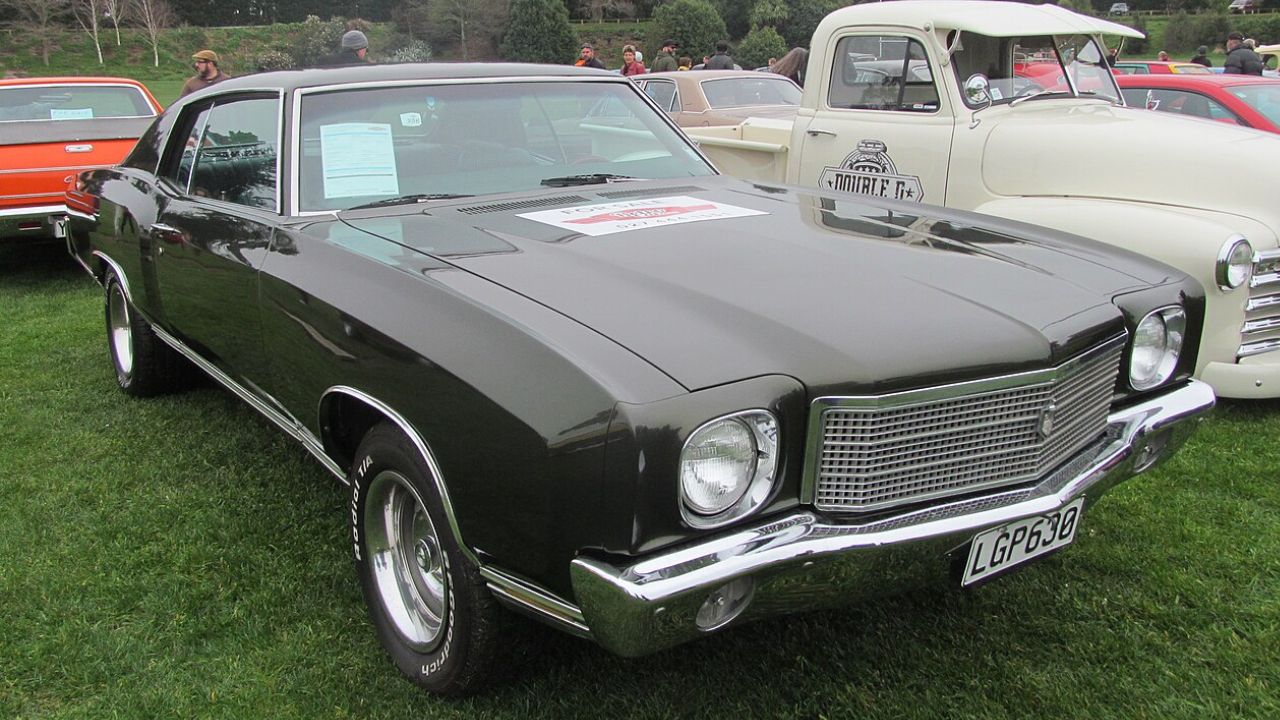
Chevrolet’s designers gave the car a long hood, short rear deck, and elegant proportions that immediately distinguished it from many other vehicles in the showroom. The styling borrowed cues from luxury automobiles while maintaining a distinctly sporty character.
The front end was particularly striking.
A prominent grille, carefully sculpted body lines, and balanced proportions helped create an upscale impression that exceeded many buyers’ expectations. The Monte Carlo looked more expensive than its price tag suggested.
This visual sophistication became a major selling point.
People often walked into dealerships expecting another intermediate-sized Chevrolet and discovered a vehicle that felt considerably more exclusive.
The styling played a major role in that first impression.
It Shared Bones With the Chevelle—but Felt Different
One reason some buyers initially underestimated the Monte Carlo was its platform.
The car shared much of its underlying architecture with the highly successful Chevrolet Chevelle. Because of this relationship, some observers assumed the Monte Carlo was little more than a rebodied Chevelle.
The reality was more complicated.
While the shared platform helped control development costs and ensured proven engineering, Chevrolet invested significant effort into creating a distinct personality. Different styling, interior appointments, suspension tuning, and overall presentation separated the Monte Carlo from its corporate cousin.
Drivers noticed the difference.
The car felt more refined, more mature, and more focused on comfort than many traditional muscle cars.
Its character was unique.
Buyers Expected Luxury, Then Found Performance
Another surprise involved performance.
Many customers approached the Monte Carlo expecting a comfortable cruiser. While the car certainly excelled in that role, Chevrolet also offered engine options capable of delivering impressive acceleration and strong highway performance.
The available V8 lineup gave buyers substantial flexibility.
Those seeking relaxed driving could choose more moderate powerplants, while enthusiasts could select larger engines that transformed the Monte Carlo into a genuinely quick automobile. Chevrolet understood that many personal luxury buyers still appreciated strong performance.
This combination broadened the car’s appeal.
The Monte Carlo wasn’t forced into a single category.
It successfully balanced multiple identities at once.
The SS 454 Changed Perceptions Immediately
If any version demonstrated the Monte Carlo’s unexpected capabilities, it was the SS 454.
Equipped with Chevrolet’s formidable 454-cubic-inch V8, the model challenged assumptions about what a personal luxury coupe could be. The massive engine delivered abundant torque and serious performance credentials.
The idea itself was unusual.
Most luxury-oriented coupes emphasized comfort first and performance second. The Monte Carlo SS 454 offered both simultaneously. Buyers could enjoy plush accommodations and impressive straight-line speed without choosing between them.
This formula attracted attention quickly.
The existence of the SS 454 helped establish the Monte Carlo’s reputation as something more than an upscale cruiser.
It had genuine muscle beneath the elegance.
Comfort Was a Major Priority
While performance generated headlines, comfort remained central to the Monte Carlo’s mission.
Chevrolet devoted significant attention to ride quality, interior design, and overall refinement. The car’s cabin provided a more upscale experience than many buyers expected from a mainstream Chevrolet.
The seating was comfortable, the controls were thoughtfully arranged, and the overall atmosphere emphasized relaxation.
These qualities mattered because they aligned with shifting consumer preferences. As the 1970s approached, many buyers increasingly valued comfort alongside performance. The Monte Carlo anticipated that trend effectively.
Owners discovered a car that was enjoyable not only during spirited driving but also during everyday use.
That versatility became one of its greatest strengths.
The Price Made It Even More Attractive
Part of the Monte Carlo’s success stemmed from value.
The car delivered styling and features that often resembled more expensive automobiles, yet Chevrolet kept pricing within reach of a broad audience. Buyers appreciated the opportunity to enjoy a premium-looking vehicle without entering true luxury-car territory.
This positioning proved extremely effective.
The Monte Carlo occupied a sweet spot within the market. It felt upscale enough to stand apart from ordinary transportation while remaining affordable enough for many middle-class consumers.
Chevrolet understood the appeal.
People enjoy feeling like they received more than they paid for.
The Monte Carlo consistently delivered that impression.
It Appealed to Multiple Types of Buyers
Another reason the Monte Carlo surprised people was the diversity of its customer base.
Performance enthusiasts appreciated the available big-block engines. Luxury-oriented buyers enjoyed the comfort and styling. Professionals liked the sophisticated image. Families valued the practicality and spaciousness.
Few vehicles successfully appealed to so many different groups.
The Monte Carlo achieved this balance because Chevrolet avoided making the car overly specialized. Instead, it emphasized versatility.
The result was a vehicle capable of wearing many hats.
That flexibility contributed enormously to its popularity.
Chevrolet Created a New Identity
The Monte Carlo’s success also demonstrated Chevrolet’s ability to expand beyond established categories.
The company already had muscle cars, family sedans, and sports cars. The Monte Carlo introduced something different—a personal luxury coupe that blended elements of each.
This hybrid identity became one of the model’s defining characteristics.
It wasn’t quite a muscle car.
It wasn’t quite a luxury car.
It wasn’t simply a stylish coupe.
It occupied a space all its own.
Buyers responded positively to that originality.
Sales Confirmed Chevrolet’s Instincts
The market’s reaction validated Chevrolet’s strategy almost immediately.
Customers embraced the Monte Carlo in large numbers, and the model quickly became one of the company’s most successful introductions of the era. Buyers clearly appreciated the blend of style, comfort, performance, and value.
The strong sales figures demonstrated that Chevrolet had identified a genuine opportunity.
The company wasn’t merely following a trend.
It was helping shape one.
The Monte Carlo’s influence would remain visible throughout the decade.
The Car That Exceeded Expectations
Looking back, the Monte Carlo’s success seems logical.
It arrived at the perfect moment, offered the right mix of attributes, and delivered a driving experience that exceeded many buyers’ expectations. The car looked expensive, drove comfortably, and offered surprising performance when properly equipped.
Those qualities made a powerful impression.
People expected one thing.
They got something better.
A Chevrolet Unlike Any Other
The 1970 Chevrolet Monte Carlo surprised buyers from day one because it refused to fit neatly into a single category.
It combined personal luxury styling, strong performance options, impressive comfort, and attractive pricing into a package that felt more sophisticated than many customers anticipated. Whether equipped as a comfortable cruiser or a powerful SS 454, the Monte Carlo delivered a level of versatility that few competitors could match.
More than fifty years later, the model remains an important chapter in Chevrolet history.
Not because it reinvented the automobile.
Because it exceeded expectations in almost every area that mattered.
And sometimes, that’s exactly what buyers remember most.
More from Fast Lane Only