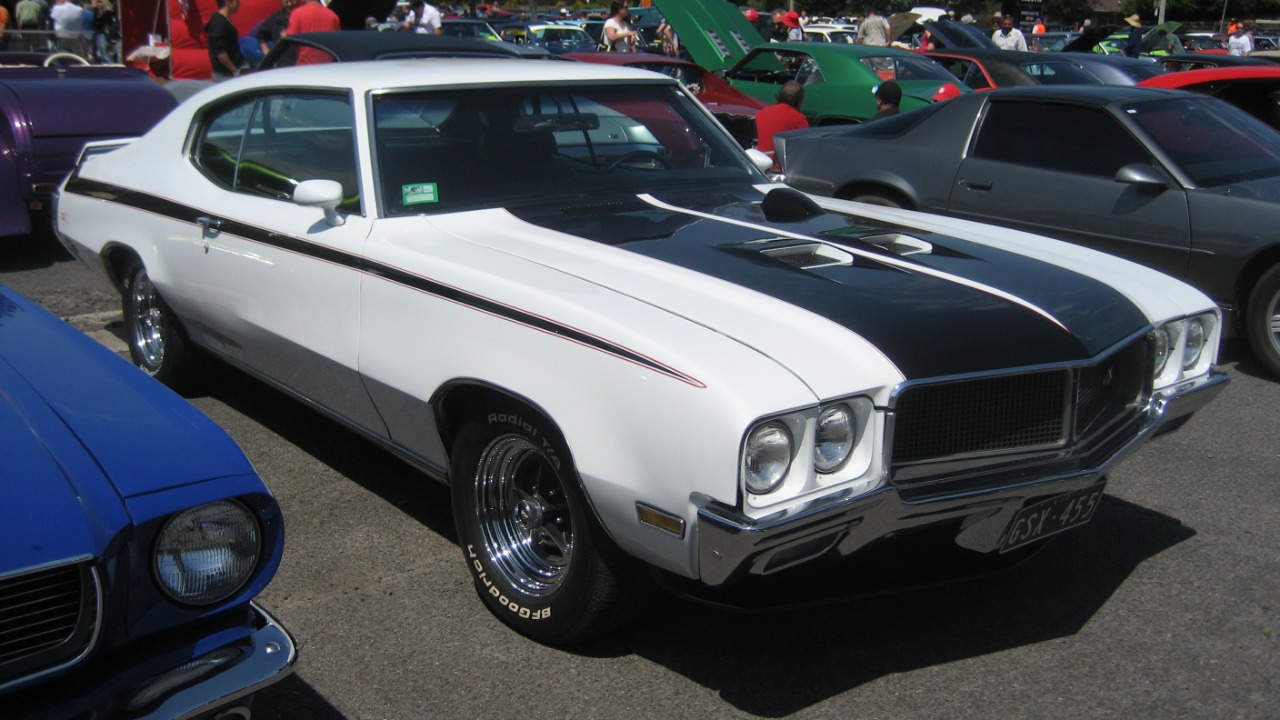
The 1970 Buick GSX arrived at a moment when American muscle cars were getting louder, brighter and less concerned with manners, yet it managed to look almost restrained while delivering brutal performance. Buick wrapped big-block torque and serious quarter-mile credentials in a body that still carried the brand’s reputation for comfort and polish. In doing so, it turned subtle into something genuinely savage, and half a century later that contradiction is exactly what keeps the GSX lodged in my mind.
When I look at the GSX today, I see a car that refused to choose between luxury and speed. It took the polite lines of the Skylark, added just enough visual attitude to make a point, then backed it up with a 455 cubic inch V8 that could embarrass more flamboyant rivals. That tension between quiet confidence and outright violence is what makes the 1970 GSX feel so modern, even now.
From gentleman’s Buick to street brawler
Buick had long been the brand of doctors, managers and careful spenders, so the idea of turning its midsize coupe into a drag-strip threat felt almost subversive. The company started with the Skylark and created the Buick GSX as a focused performance package that still carried the comfort and finish buyers expected from Buick. Under the hood, Its Stage 1 455 V8 engine gave the car the kind of instant shove that could turn a quiet boulevard cruiser into a tire-smoking spectacle, which is why enthusiasts still describe the Buick GSX as Buick’s answer to muscle car dominance.
What fascinates me is how deliberately Buick balanced that aggression with civility. Period descriptions of the 1970 Buick Skylark GSX Stage 1 talk about a fusion of brute force and unexpected elegance, a car that could pull hard yet still feel composed and upscale inside. Owners and historians alike lean on that contrast, calling the Buick Skylark GSX 1 a blend of muscle and refinement that stood apart from the more bare-knuckle offerings of the era.
Velvet glove, iron fist: the 455 Stage 1
At the heart of the GSX’s split personality was its big-block V8. The Buick GSX Stage 1 455ci V8 was rated at 360 horsepower and a towering 510 lb-ft of torque, figures that even today command respect. That combination, paired with either a TH400 Auto or a 4-Speed Manual The transmission, meant the car could be tailored to boulevard duty or serious strip work, and enthusiasts still cite the Buick GSX Stage 1 as a torque king that was underrated on paper.
That same 455 layout appears again and again in accounts of the car, reinforcing how central it was to the GSX identity. Descriptions of the 1970 Buick Skylark GSX Stage 1 call it a velvet-gloved sledgehammer, subtle in looks yet savage in performance, explicitly crediting its 455 cubic inch engine for that dual nature. When I read enthusiasts praising the 455 for delivering both smoothness and ferocity, it becomes clear that the motor was the bridge between Buick’s luxury roots and its new-found savagery.
Subtle lines, loud colors, and just enough attitude
Visually, the GSX walked a careful line. The basic Skylark shape remained clean and almost conservative, but Buick layered on stripes, spoilers and bright hues that signaled intent without turning the car into a caricature. There were 678 G SX cars built in 1970 and they were available only in Saturn Yellow and Apollo White, a detail that comes from a poll of surviving examples and factory records, and that limited palette made each car instantly recognizable. When I see those figures, especially the breakdown that 491 of them wore the more extroverted yellow, I understand why collectors treat a documented GSX as something special rather than just another muscle car.
Yet even in those loud colors, the car never quite loses its sense of restraint. Contemporary enthusiasts describe the 1970 Buick GSX as both subtle and outrageous, a masterpiece of muscle and luxury that turned heads without abandoning Buick’s reputation for quality. That duality shows up in accounts of auction pairings where a GSX 455 Stage 1 shared the spotlight with a GS 455 Stage 1 prototype, with observers noting how the Buick GSX managed to be visually striking while still reading as a premium car rather than a stripped-out racer.
On the strip and in the record books
Numbers matter in the muscle car world, and the GSX’s performance figures back up its reputation. Accounts of the closely related 1971 Buick GSX Stage 1 coupe note that Most people, including NHRA, determined that the engine achieved over 400 horsepower, even if official ratings were lower. Running a 13.38 E.T. and reaching 105.5 m ph in quarter-mile testing, that package earned a reputation as one of the quickest American production muscle cars of its time, and it is hard not to see the 1970 specification as sharing that same deep well of performance when I look at those NHRA-backed numbers.
Top speed rankings tell a similar story. Modern performance tables list the Buick GSX with a 7.5-liter Engine and a top speed in the 135 M PH range, placing it among the fastest Buicks ever built and underscoring how serious the car was even by today’s standards. When I see the GSX sitting alongside later performance models in those Buick GSX overview charts, it reinforces the idea that this was not a marketing exercise but a genuinely fast machine that happened to wear a Buick badge.
Rarity, value, and the GSX legacy
Scarcity has only sharpened the GSX’s appeal. While the 1970 model is the one that cemented the formula, later variants became even harder to find, with the 1972 Buick GSX Is The Rarest Gran Sport Model Ever It in part because production dropped drastically. That car’s competition history, including a streak where it was undefeated for 33 races, adds to the mythology that surrounds the GSX nameplate, and modern write-ups of The Series 2 Viper that eventually surpassed it only highlight how ambitious Buick’s engineers were when they created the Buick GSX Is.
That history translates directly into money. Price guides note that the value of a 1970 Buick GSX can vary greatly depending on condition, mileage, options and history, but Typically the average sale price over the last three years has hovered in six-figure territory. Separate analyses of unrestored Stage 1 cars point out that Hagerty’s Price Tool values even a Fair example at $80,000, while a Concours find can fetch as much as $199,000, figures that make an original After GSX feel more like a blue-chip asset than a used car. When I browse valuation tools that track the Buick GSX, that financial reality underlines just how enduring the car’s reputation has become.
More from Fast Lane Only: