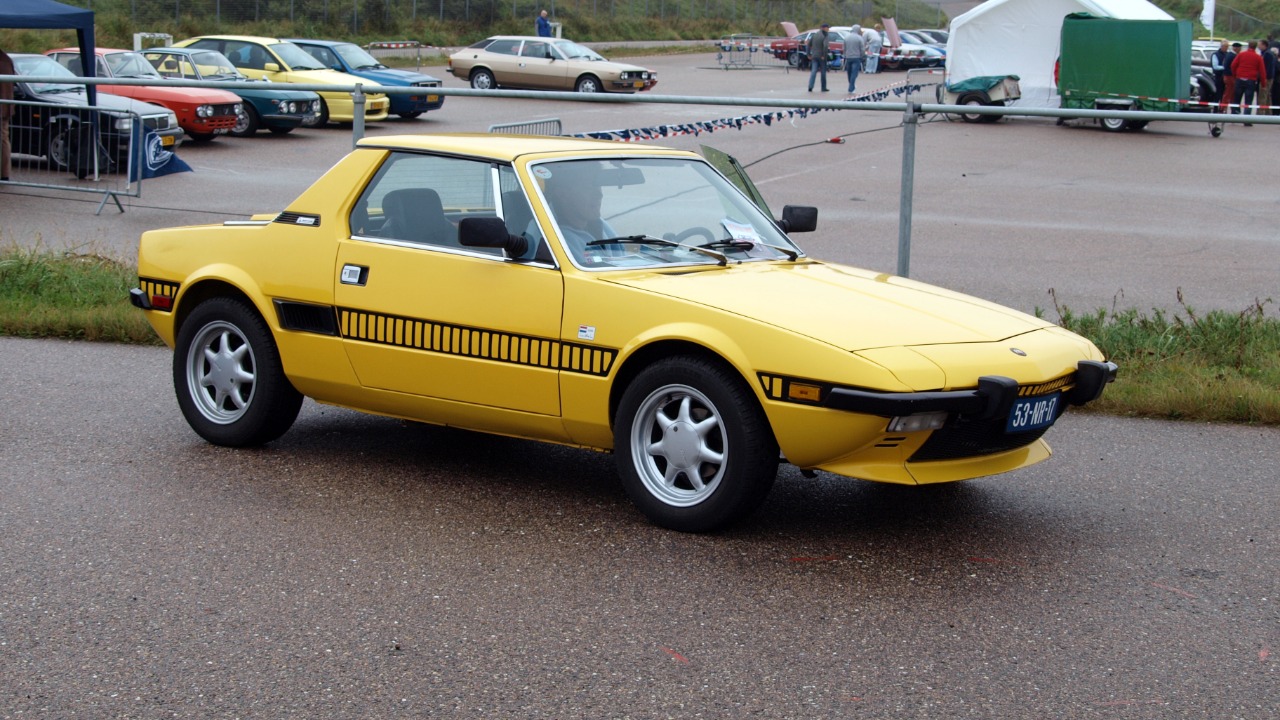
The 1976 Fiat X1/9 arrived in showrooms with modest power figures and a humble badge, yet it delivered the kind of balance, style, and engineering usually reserved for far more expensive exotics. By putting a mid‑engine chassis, sharp Italian design, and clever packaging within reach of ordinary drivers, it quietly outperformed expectations in almost every area that matters to an enthusiast. I see that specific model year as the moment when this “Italian wedge” stopped being a quirky experiment and started proving just how far a small sports car could go without brute force.
The mid‑engine revolution on a budget
At a time when mid‑engine layouts were largely the preserve of halo cars, the Fiat X1/9 took that configuration and priced it for people who might otherwise be shopping for a family saloon. The decision to put the engine behind the seats was deliberate, a move that, as period engineering notes explain, aligned the car with sports cars such as the Lamborghini Miura while keeping it approachable and usable. That choice meant the 1976 car shared its basic philosophy with far more exotic machinery, and it is why enthusiasts now talk about how it democratized the mid‑engine idea for everyday drivers, a point echoed in later reflections on how the layout was “something that at that time was typically reserved for” much more rarefied machines linked to the Lamborghini Miura.
That configuration did more than give the X1/9 a talking point, it transformed how the car behaved on the road. With the mass of the drivetrain concentrated near the center, the little Fiat could change direction with a lightness that belied its output, which is why later commentators describe it as a mid‑engine sports car that “democratized the mid‑engine layout” and made exotic handling feel accessible and beautiful to a wider audience, a sentiment captured in an Aug reflection on its significance. In 1976, that meant a driver could step out of an ordinary compact and into something that felt poised, neutral, and eager, without needing the budget or temperament for a temperamental supercar.
Design drama in a small footprint
If the engine placement gave the X1/9 its dynamic edge, the styling gave it a presence that far exceeded its size. The car was shaped by Marcello Gandini at Bertone, the same designer responsible for the Lamborghini Miura and Countach, and he applied that wedge‑era drama to a compact, approachable format. Contemporary design notes describe how the exterior used a sharp wedge profile and crisp surfacing to create a miniature Italian exotic, and later enthusiasts still single out the way Styling and Design Styled by Marcello Gandini at Bertone distilled the drama of the Lamborghini Miura and Countach into something you could park in a tight city space.
Underneath that shape, the car’s footprint was genuinely small, which only heightened the sense that it was doing more with less. Factory figures list the Fiat X1/9 Length for the early run as “1972–78: 3,830 m (150.8 in)” before later cars grew to “78, 3,830 m, 150.8, 89, 3,969 m” in overall size, numbers that underline just how compact the original package really was according to the official Length data. In 1976, that meant you were looking at a car barely longer than a supermini, yet with proportions and stance that made it feel like a scaled‑down concept car, something that still turns heads in traffic today.
From budget coupe to cult classic
The X1/9 story actually began a few years before 1976, when the Fiat X‑1 9 Debuted in 1972 as a budget sports coupe that would later also be known as the “Bertone” X1/9 after 1980. That early positioning as an affordable two‑seater set the tone, and by the time the 1976 model arrived, the formula was well honed: a targa‑top body, mid‑engine layout, and everyday usability wrapped in Italian style. Period retrospectives on the first‑series cars stress how the Fiat Debuted as a budget sports coupe, yet carried the design cachet of Bertone, which helped it stand out in a market crowded with more conventional coupes.
By 1974, the formula had already matured into the version that would define the mid‑decade cars. Enthusiast accounts describe how the 1974 Fiat X1/9, designed by Marcello Gandini, brought mid‑engine performance to an affordable targa‑top sports car, Featuring details that made it both practical and engaging. Those same accounts note that the 1974 Fiat X1/9 helped establish the car as a cult classic among enthusiasts, a status that the 1976 model inherited and reinforced as the concept was refined, something that later owners still celebrate when they talk about how the Fiat Debuted and how the Bertone name added cachet.
Handling, engineering, and the “unexpected weapon” effect
On paper, the 1976 X1/9 did not look like a giant killer, which is precisely why its real‑world performance surprised so many drivers. The car’s lightweight construction and mid‑engine balance gave it exceptional handling, something that later write‑ups of the 1978 Fiat X1/9 describe in detail when they call it a mid‑engine, two‑seater sports car known for its lightweight design and exceptional handling. That same basic chassis and layout were already in place in 1976, which meant the car could carry speed through corners in a way that embarrassed more powerful rivals, a trait that enthusiasts still celebrate when they talk about the Fiat as a driver’s car rather than a straight‑line machine.
Under the engine lid, the car’s four‑cylinder might have looked ordinary, but its engineering was anything but lazy. Technical breakdowns highlight features such as a thin wall cast iron block with Siamesed cylinders and extremely rigid crank support design, details that show how much thought went into making the engine compact, strong, and eager to rev. Those same analyses point out how the cylinder head and breathing were tuned to make the most of modest displacement, which helped the car feel more responsive than its numbers suggested, an insight captured in a detailed Then discussion of its Siamesed cylinder design. Put together, the chassis and engine created what one enthusiast later called an “Unexpected Weapon,” a Fiat Italian wedge that punched above its weight not through raw power, but through balance, design icon status, and all soul, a phrase that lives on in an Unexpected Weapon tribute.
Racing roots, tuner culture, and lasting legacy
Part of what made the X1/9 feel so special in 1976 was the sense that it had real motorsport potential baked in, even if most examples never saw a circuit. Earlier in the decade, a Group 5 racing version of the Fiat X1/9 had been developed, with reports noting how the Fiat X1/9 is a two‑door sports car designed by Marcello Gandini at Bertone for Fiat and how that racing derivative could produce as much as 230 hp at 9700 rpm. Those figures, far beyond the road car’s output, showed just how capable the basic platform was when pushed, and they helped fuel a tuner culture around the car, something that still surfaces in enthusiast posts that begin with lines like “Anything to stop the Zakspeed and Porsche posts” before diving into the details of the Anything Zakspeed and Porsche comparisons.
More from Fast Lane Only: