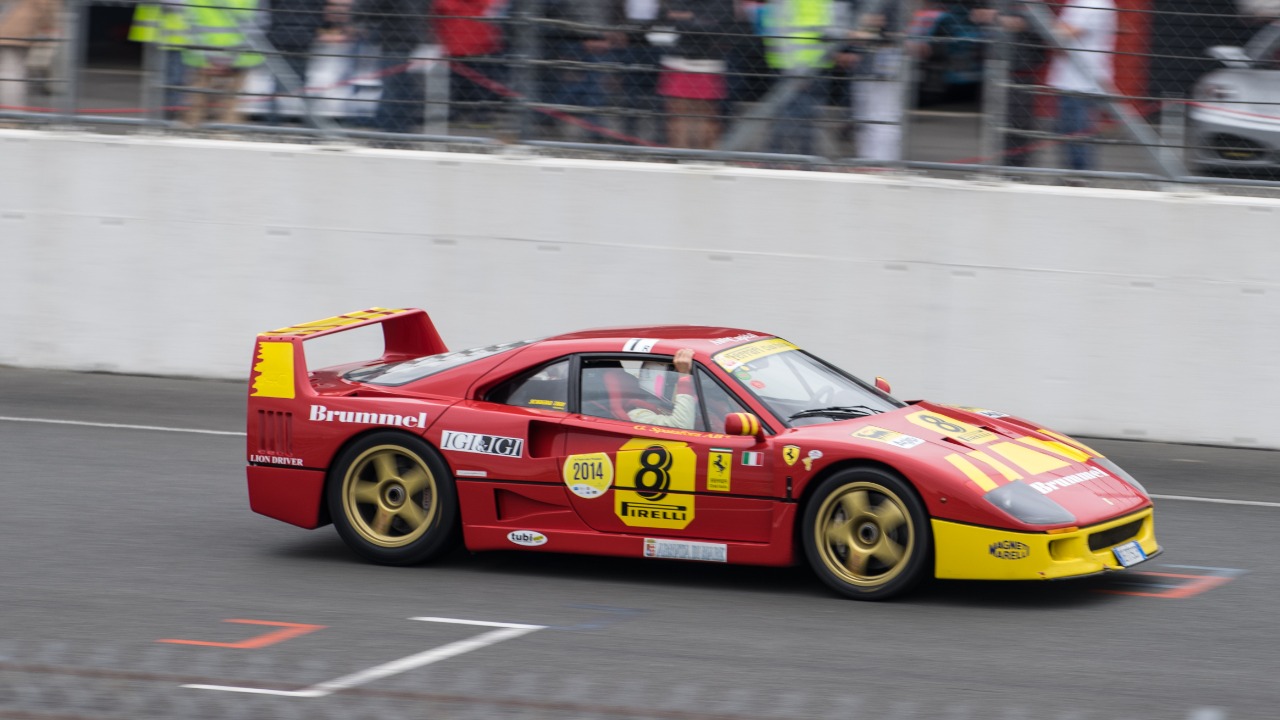
The 1987 Ferrari F40 was built with a single priority: speed at any cost. Comfort, refinement, and everyday usability were not just secondary, they were treated as dead weight to be stripped away. In an era when supercars were starting to flirt with luxury, the F40 went the other way and showed what happens when a road car is engineered with the mindset of a race program.
When I look at the F40 today, I see a machine that treats comfort as a distraction from the job of going fast. From its bare carbon interior to its lack of driver aids, every choice pushes the driver closer to the edge, both physically and mentally. That is exactly why it still feels so raw, and why it still fascinates anyone who cares about what a no-compromise Ferrari really means.
The brief: a road car that thinks it is a race car
The F40 did not appear out of nowhere. As the successor to the 288 GTO engineered by Materazzi, it was created to celebrate Ferrari’s 40th anniversary and to be the most extreme road car the company had ever sold. That heritage matters, because the 288 GTO was already a homologation special with racing in its DNA, and the F40 simply pushed that logic further. Rather than soften the formula for a broader audience, Ferrari treated the new car as a statement that the brand still cared about pure performance more than plushness.
The development story underlines how deliberate that stance was. The 1987 Ferrari F40 arrived as what one account calls the first no-compromise Ferrari built for speed, a car that was effectively a race machine allowed to wear a license plate so it could be driven on public roads. That same reporting notes that the project was framed from the start as a celebration of Ferrari’s history, not as a comfortable grand tourer, which helps explain why the engineers were given such freedom to ignore everyday usability in favor of outright pace and drama, a point that comes through clearly in the description of the first no-compromise Ferrari built for speed.
Inside the cockpit: comfort stripped to the bone

If you want to understand how thoroughly the F40 turned its back on comfort, you start by opening the door. Instead of a sculpted handle, you pull a simple cable, one of several weight-saving measures that also included eliminating interior door furniture altogether, as highlighted in a list of weight-saving measures. Once inside, you are greeted by exposed carbon fiber, thin bucket seats, and almost no sound insulation. The cabin feels more like a prototype racer than a road car, and that is the point: every missing trim piece is a reminder that comfort was treated as unnecessary mass.
From the driver’s seat, the F40 interior strips luxury to its absolute essence. One detailed look at the car’s cabin, framed under the heading Inside the Cockpit, describes how the designers focused on function over feel, with simple analog gauges, a gated shifter, and pedals that seem positioned for heel-and-toe work rather than relaxed cruising. The Ferrari F40 interior is not trying to cosset you, it is trying to plug you directly into the mechanical heart of the car, and the lack of padding, insulation, and gadgets is what makes that connection so intense.
Brutal hardware, zero electronic safety net
The F40’s mechanical package is just as unforgiving as its interior. Under the rear clamshell sits a twin turbocharged V8 that delivers serious power and demands serious respect. One breakdown of the car’s performance notes that the twin-turbocharged V-8 helps the F40 reach a 0 to 60 mph time of 4.2 seconds, a figure that still commands attention today and is spelled out in a list of fun facts about the twin-turbocharged V-8. That kind of acceleration, combined with the car’s light weight, means the driver is constantly managing boost, traction, and balance without any electronic help.
Ferrari did not care about smoothing out that experience with modern driver aids. Several detailed rundowns of the car’s specification stress that the F40 has no driver aids at all, and that if the paint was sparingly applied in a bid to lower the car’s weight, nearly every other comfort feature was treated the same way. One such account notes that If the paint was sparingly applied, it was because every gram mattered more than visual perfection. Another report spells out that Ferrari did not care about adding traction control or stability systems, instead pairing the engine’s 426 ft lbs of torque with a completely analog chassis, a combination captured in a discussion of how Ferrari did not care about electronic helpers.
The absence of a safety net is even clearer when you look at the F40’s braking and control systems. One detailed sales description of a Ferrari F40 GT variant notes that There was no ABS, no traction control, no electro-hydraulic paddle shifting, and no stability control, even though the car was capable of a 201 m top speed, a stark summary of how little the engineers were willing to compromise in the name of ease of use, as laid out in the line that begins There was no ABS. On the road, that means every braking zone and every corner is entirely in the driver’s hands, with no computer to tidy up mistakes.
Driving experience: respect required, comfort optional
Living with an F40 is not like living with a modern supercar that can be tamed with a comfort mode. Owners who have spent real time behind the wheel describe a car that is physically demanding and emotionally intense, even at moderate speeds. One long term account of what it is like to own and drive the car notes that the same can be said of the brakes as of the steering: the racing-style box does not provide much feeling, but there is still great braking power once you learn to work with it, and that the pedals and controls feel more like competition hardware than road car components, a point captured in the observation that The same can be said of the braking system.
Even professional racers have spoken about how seriously the F40 must be treated. One official retrospective from Ferrari recalls how Gerhard Berger, who was racing for Scu at the time, emphasized that the F40 is a car that demands major respect from anyone fortunate enough to drive one. That same piece notes that the car clearly means business, and that its combination of power, lightness, and lack of electronic aids makes it a machine that rewards skill and punishes carelessness, a sentiment preserved in the description of how Gerhard Berger, who was racing for Scu, spoke about the car. Comfort, in that context, is not just irrelevant, it would actively dilute the experience that makes the F40 so revered.
Why the F40’s discomfort still matters today
For all its rough edges, the F40’s refusal to coddle the driver is a big part of why it remains such a legend. One detailed history of the model points out that the 1987 Ferrari F40 arrived at a time when performance cars were starting to gain more luxury features, yet it chose to be the first no-compromise Ferrari built for speed, a stance that still feels radical in a world of configurable dampers and adaptive cruise control, and that is underscored in the description of the 1987 Ferrari F40 as a car that arrived with no interest in compromise. The car’s rawness has become part of its mythology, a benchmark for what an unfiltered supercar can feel like when engineers are allowed to ignore comfort entirely.
When I think about the F40 now, I see more than just a fast Ferrari. I see a snapshot of a philosophy that prioritized driver engagement over everything else, even if that meant noisy cabins, heavy controls, and a complete lack of electronic safety nets. That approach, rooted in the lineage that runs from the 288 GTO to the F40 and captured in the way enthusiasts still talk about its turbocharged heart and stripped-back cockpit, explains why the car continues to be held up as one of the most unfiltered supercars ever built, a machine that chose to ignore comfort so it could focus on speed, sensation, and the kind of connection that modern cars rarely attempt.
More from Fast Lane Only: