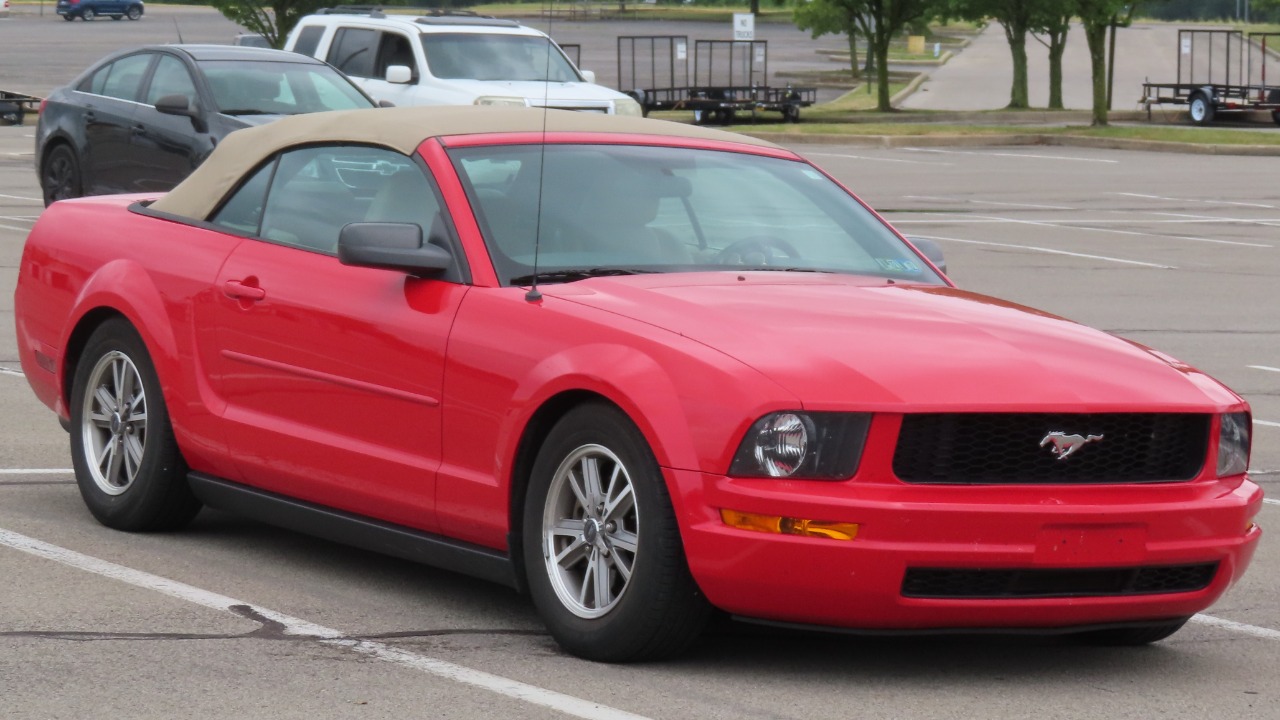
The 2005 Ford Mustang arrived at a moment when nostalgia could easily have turned into kitsch. Instead of serving up a cartoon of the 1960s original, it used memory as raw material and rebuilt the pony car for a new century. The result was a coupe that felt instantly familiar yet genuinely modern, and it quietly reset the template for how carmakers mine their own heritage without getting trapped in it.
Looking back now, I see that car as the pivot point between the Mustang’s wandering middle age and its confident present. The 2005 model did not just copy old styling cues, it rethought proportion, performance and everyday usability so the past and present could share the same driveway. That is why it still reads as the rare nostalgia play that got almost everything right.
The design that made memory feel new again
When I picture the 2005 Mustang, what stands out first is not a single detail but the stance. Designers pulled the wheels to the corners, tightened the overhangs and carved in those crisp shoulders so the car sat on the road with the same purpose as the late‑1960s fastbacks, yet it avoided the softness that had crept into earlier generations. Contemporary reviewers called The New Mustang’s look a Design Was Game Changer, and that is not hyperbole, because the S197 generation deliberately echoed the long hood, short deck and three‑bar taillights of the original while cleaning up the surfacing and glasshouse to suit modern crash and visibility standards, a balance that helped make it the most important Mustang in roughly forty years according to The New Mustang Design Was Game Changer.
What impressed me then, and still does, is how disciplined that retro work was. The designers resisted the urge to paste on every old cue, instead choosing a few strong references and letting the basic proportions do the heavy lifting. That restraint is why the car could be praised again as The New Mustang Design Was a genuine Game Changer in later coverage that compared it directly with its immediate predecessor and found the S197’s lines far more confident and cohesive, a verdict that underlined how Arguably the biggest change was visual rather than mechanical in the eyes of The New Mustang Design Was Game Changer Arguably.
Why this “Retro reboot” landed when others missed

Plenty of brands tried to cash in on heritage in the 2000s, but the Mustang’s Retro moment arrived with better timing and a clearer sense of purpose. By the early 2000s, the first SUV wave had hammered the personal coupe market, and the Mustang itself had drifted away from the crisp simplicity that made it an icon. Analysts later described the fifth generation as a Retro reboot that helped reconnect the car to its pony‑car roots just as crossovers were swallowing everything else, a move that kept the Mustang visible as both a street racer and a symbol for the blue oval, as chronicled in a look at the model’s Retro reboot SUV era.
Inside Ford, that pivot was not inevitable. Earlier efforts on the DEW98 platform had produced a car that critics felt looked soft and, for a Ford, relatively expensive, and that experiment was not renewed. By the early part of the 2000s, design leadership wanted something that could cut through all those lost generations and speak directly to the original pony car idea. The 2005 shape did exactly that, and one retrospective on J Mays’ tenure notes bluntly that Not that the underlying DEW98 platform was bad, Also that it simply did not capture what Ford needed the Mustang to be, whereas the S197 seemed to do the opposite and ensured The pony car lives on for Not Also Ford legacy.
Mechanical choices that respected fans, not focus groups
Styling alone cannot carry a performance nameplate, and the 2005 Mustang’s hardware showed a similar mix of tradition and pragmatism. Under the hood of the GT sat a 3‑valve per cylinder version of Ford’s 4.6-liter all‑aluminum single‑cam V8, an engine that did not chase exotic technology but delivered the broad, accessible torque that owners expected. Period tests highlighted how this V8, paired with either a manual or automatic, gave the car the kind of flexible performance that made it feel like a true GT rather than a nostalgia prop, a point underscored in road impressions of the Ford 4.6-liter GT.
Out back, Ford made a decision that still sparks debate but made perfect sense for the audience it was courting. Instead of switching to an independent rear suspension, engineers stuck with a solid axle and were candid about why. Company reasoning at the time was that more Mustang fans would favor the solid‑axle rear suspension for their recreational track days and drag racing, a choice that kept costs down and durability up for the core buyer, as explained in coverage of how Ford reasons that more Mustang ( Ford Mustang ) drivers wanted that setup for Ford Mustang track days.
An interior that borrowed the past but lived in the present
Open the door of a 2005 Mustang and the first impression is pure 1960s, but the second is how usable it feels as a daily driver. The new Mustang ( Ford Mustang ) cabin arrived well equipped, with a 60s‑era twin‑hood dash and a 3, 6, and 9 o’clock spoked steering wheel that nodded directly to the original, yet it layered in modern conveniences and safety features that owners in the muscle‑car era could only dream about, as detailed in early tests of the Mustang Ford Mustang interior.
The convertible version reinforced that blend of nostalgia and practicality. With the top down, What is left is an open‑air view of the new Mustang ( Ford Mustang ) interior, where the same twin‑hooded dash and 3‑spoke wheel are joined by thoughtful touches like an instrument cluster whose backlighting color can be changed to one of 125 hues, a small but telling example of how the car mixed retro form with modern personalization, as reviewers noted when praising the What Mustang Ford Mustang cabin.
How the S197 shaped every Mustang that followed
The real test of any reboot is what happens next, and the S197’s influence is written all over the Mustangs that came after it. Commentators have pointed out that, with the introduction of the S197 in 2005, each new Mustang has essentially followed exactly the same design playbook, carrying forward the basic proportions and key cues that car re‑established. One analysis even framed the era with a simple contrast, noting that However tempting it might have been to reject retro entirely, the Mustang instead chose a path that proved so successful it has guided every redesign since, a point made in a piece that imagines how Ford could have taken the However Mustang different road.
By the time the 2015 model arrived, Ford was ready to modernize the chassis and globalize the car, but even then the company described the styling as radically new yet still retro. Executives said the original idea had been to evolve the existing platform, But once Ford ( Ford Motor ) decided the new car needed independent rear suspension and a broader international appeal, they still preserved the essential Mustang look and proportion, a continuity that traces straight back to the S197’s reset, as explained in a deep dive on how But Ford Ford Motor shaped 2015.
The culture that grew up around the 2005–2009 cars
One of the clearest signs that the 2005 Mustang struck the right nostalgic chord is how fiercely owners still defend it. In enthusiast circles, you can find passionate arguments that the 05‑09 S197 is the BEST Mustang Model Ever Created, with fans urging viewers PLEASE SUBSCRIBE, LIKE, COMMENT, AND share their love for the car’s blend of old‑school feel and modern reliability, a sentiment captured in a video that celebrates the Apr PLEASE SUBSCRIBE, LIKE, COMMENT, AND.
That affection extends to the little quirks owners keep discovering. One clip about 05‑09 Mustang features and tricks includes a comment that When a driver took an 06 GT for a test run, the previous owner was not even aware of the O/D button on the gear shift, a small reminder that these cars still have layers for new caretakers to uncover, as seen in a video where the creator responds with a friendly “Your video helped a lot, Thanks!!!” and walks through hidden details of the Apr When Your 06 GT.
From instant classic to “Cars That Changed the World”
Two decades on, the 2005 Mustang is no longer just a beloved used car, it is being written into the broader story of the automobile. In one survey of 100 Cars That Changed the World, curators place the 2005 Ford Mustang alongside machines like the Benz Patent Motorwagen, arguing that From the first true motorcar to modern icons, certain vehicles reset expectations in their segment, and that the 2005 model revived the pony car formula in a way that influenced every modern Mustang that followed, a case made visually in an Nov 100 Cars That Changed the World From the Benz Patent Motorwagen.
The S197’s legacy also lives on in specific variants and in how Ford continues to package nostalgia. The 2007‑2008 Ford Mustang Shelby GT, for instance, built on the fifth‑generation platform that was produced from 2005 onward and drew heavily from the first‑generation Mustangs produced from 1964‑1970, a lineage highlighted in a post that celebrates the Ford Mustang Shelby GT Ford Mustang heritage.
The template nostalgia packages still follow
Even the way Ford handles special editions today traces back to the confidence of that 2005 reboot. Recent packages that honor the Fox‑body era, such as an FX appearance kit that pays homage to third‑generation cars from 1987‑1993 with Oxford White wheels, classic white badges and Fox Body–inspired cabin trim, follow the same basic playbook: pick a clear era, translate its cues carefully and layer them on a thoroughly modern platform, an approach that echoes how the fifth‑generation Ford Mustang was framed as a bridge between 1964‑1970 styling and contemporary hardware in a post that also spotlights the Ford Mustang Shelby GT, Ford Mustang.
Inside the car, that template shows up in the way later S197s refined the cabin without abandoning its retro core. By 2009, the dashboard featured chrome‑ringed air vents and large barrel‑style gauges, along with an available color‑configurable instrument panel and upgraded trim and audio options, a set of changes that kept the interior feeling current while preserving the twin‑hood theme introduced in 2005, as described in a rundown of 2009 Ford Mustang what’s new.
More from Fast Lane Only: