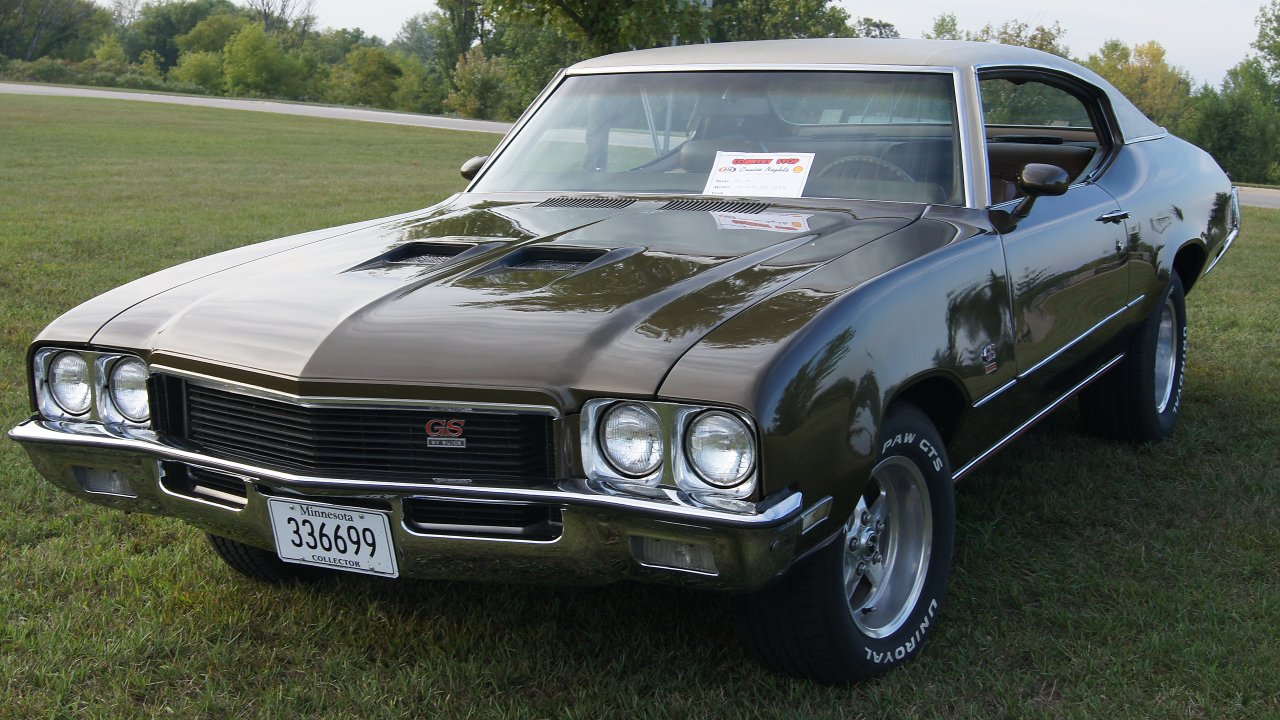
The Buick GS 455 arrived at the height of the muscle car era with a mission that sounded almost contradictory: deliver towering torque and quarter mile credibility without abandoning the quiet manners expected of a traditional Buick. Rather than chase the loudest stripes or the highest advertised horsepower, the Gran Sport package wrapped a massive big block in restrained styling, a plush cabin, and a chassis tuned as much for composure as for speed. The result was a car that could idle through a country club parking lot in near silence, then flatten its occupants into the seatbacks with a twitch of the throttle.
That balance between civility and brute force is what has turned the GS 455, particularly in its Stage 1 forms, into one of the most intriguing muscle machines of its era. It was neither the cheapest nor the flashiest option, yet it quietly delivered performance that rivaled or exceeded more famous rivals while maintaining the comfort and refinement that defined Buick in the late 1960s and early 1970s.
From gentleman’s Buick to torque monster
Buick entered the muscle car wars from an unusual starting point, with a reputation built on doctors’ sedans and well appointed family cars rather than street brawlers. The Gran Sport badge, applied to the Buick GS line, signaled that the brand was ready to compete, but it did so with a different emphasis from its corporate siblings. When General Motors lifted its internal cap on engine size in intermediate cars, described in period coverage as a moment when General Motors ended the 400 cubic inch ceiling, Buick seized the opportunity to install its largest V8 in the GS 455 and transform a polite mid size into a serious performance contender.
The heart of that transformation was the Buick 455 cubic inch V8, which combined large displacement with a focus on low end twist rather than sky high revs. Contemporary technical descriptions note that the engine developed 350 hp at 4,600 rpm and delivered 510 lb ft of torque at just 2,800 rpm, figures that made it ideal for both heavy luxury cruisers and a relatively lighter Gran Sport chassis. In the 1970 Buick GS, that same 455 was rated at 350 hp and 510 lb⋅ft of torque in base form, with the optional Stage 1 package adding more aggressive internals and breathing for even stronger real world performance.
Luxury muscle, not bare bones racer
Where many muscle cars of the period were stripped to save weight and cost, the Buick GS 455 leaned into comfort and equipment. Enthusiast descriptions of the 1970 Buick Gran Sport repeatedly emphasize that it was a luxury muscle car that blended brute force with refinement, calling out its underappreciated status among collectors. The 1970 Buick GS (Gran Sport) is often described as a powerful yet refined muscle car that offered luxury and performance in one sleek package, with the GS 455 at its core providing the thrust while the rest of the car delivered the quiet ride, sound insulation, and upscale trim expected of a Buick.
That philosophy extended beyond a single model year. Later accounts of the 1972 Buick GS (Gran Sport) describe it as a refined muscle car that balanced brute strength with Buick luxury, highlighting a bold grille and sculpted bodywork paired with a comfortable interior. These descriptions reinforce that the GS 455 family was never intended as a bare bones drag special. Instead, it was engineered as a car that could cross states in comfort, then surprise unsuspecting rivals at a stoplight, a dual personality that underpins its enduring appeal.
Chassis tuning that walked a fine line
Delivering both comfort and control required more than a big engine and soft seats. Buick engineers reworked the GS 455 suspension so that the car could handle its torque without losing the brand’s trademark ride quality. Detailed technical write ups of the GS 455 Stage 1 Convertible note that it used a perimeter frame with stiffened, 142-pound front coil springs and 1 inch Delco shocks at all four corners, along with boxed lower control arms. That combination gave the car the structure and damping it needed to manage weight transfer under hard acceleration while still filtering out the worst road imperfections.
Period road tests of the STAGE I GS-455 describe how the car could pull 4,000 pounds through the traps in the low 14s, a remarkable figure for such a well equipped machine. Those same tests characterize The GS 455 ride as a compromise type, firm enough to keep the big Buick composed at speed yet still compliant enough to satisfy buyers accustomed to traditional Buick smoothness. In other words, the suspension was deliberately tuned to sit between a boulevard cruiser and a track focused special, which is precisely where the GS 455’s character lives.
Stage 1: the quiet powerhouse
If the standard GS 455 was impressive, the Stage 1 package turned it into a genuine performance benchmark while preserving its understated demeanor. Contemporary and retrospective accounts repeatedly describe the 1970 Buick GS 455 Stage 1 as one of the most powerful muscle cars of its time, often underrated compared to more famous rivals. The Stage 1 option added revised cylinder heads, a hotter camshaft, and improved induction and exhaust, all while retaining the same 455 cubic inch displacement that defined the line. Enthusiast commentary stresses that the Buick GS 455 Stage 1 Made Far More Power Than Claimed, suggesting that factory ratings were conservative compared with what the cars actually produced on dynamometers and at the drag strip.
The Stage 1 treatment did not strip away the car’s civility. Descriptions of the Buick GS 455 Stage 1 Convertible emphasize that it was one of the most powerful and refined muscle cars of its time, a true blend of brute strength and comfort. Another account of the Buick GS 455 Stage 1 4 Speed calls it a legendary American muscle car, combining raw power with aggressive styling while still being Powered by Buick’s big block in a package that remained usable every day. Even later references to the 1971 Buick GS 455 Stage 1 Automatic describe it as a legendary blend of brute strength and refined comfort, with the Stage 1 performance parts integrated into a car that still behaved like a Buick in traffic.
GSX and the evolution of subtle aggression
For buyers who wanted the GS 455’s performance with a little more visual drama, Buick created the GSX. The 1970 Buick GSX is described as a true muscle car legend, blending brute force with Buick luxury. Based on the Gran Sport, the GSX added bold colors, stripes, and spoilers to the existing GS 455 hardware, turning the previously understated coupe into a more overt statement without sacrificing the underlying refinement. Accounts of how the 1970 Buick GSX turned subtle into savage note that Buick had long been the brand of careful spenders, so the idea of a bright, spoilered GSX built on the same big block V8 was a dramatic shift in image.
Even with its more aggressive appearance, the GSX still reflected the same philosophy that guided the rest of the GS 455 range. It relied on the 455 cubic inch engine’s immense torque rather than chasing the highest advertised horsepower, and it retained the comfortable interior and composed ride that defined the Gran Sport. In that sense, the GSX did not abandon the balance between civility and brute force, it simply turned up the visual volume to match what the drivetrain had been capable of all along.
More from Fast Lane Only