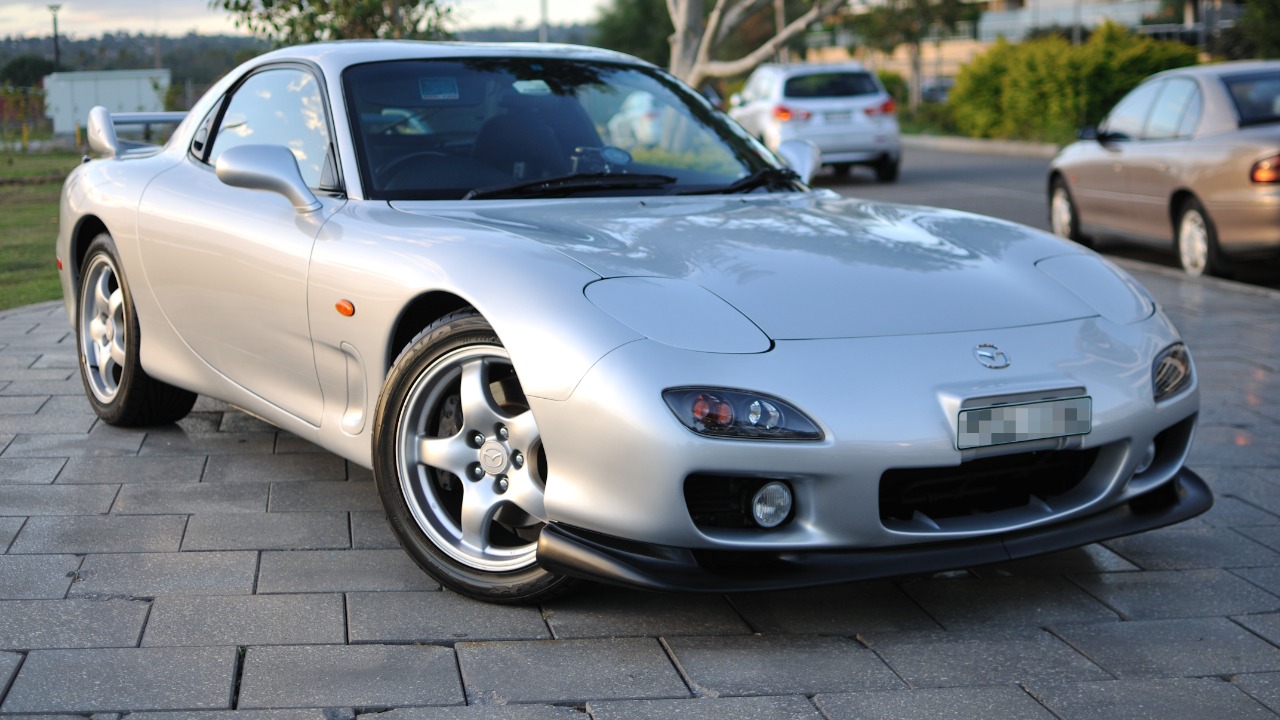
The third-generation Mazda RX-7 FD turned low mass into a weapon, pairing a featherweight body with a powertrain and chassis that punished sloppy drivers as quickly as it rewarded smooth ones. Rather than chasing headline horsepower, Mazda treated weight, packaging, and response as the real performance multipliers, which is why the car still feels unnervingly sharp in an era of 4,000‑pound “sports” coupes. I see the FD not just as a pretty rotary coupe, but as a case study in how making a car lighter can also make it more demanding, more involving, and, in the wrong hands, more than a little lethal.
Designing a lightweight that looked like a supercar
The FD RX-7 arrived with proportions that could pass for an exotic, yet its most radical decision was invisible: Mazda put the car on a crash diet. Instead of following rivals into heavier, more luxurious territory, Mazda kept the base FD under 2,800 lbs (which is listed as 1,270 kg), a figure that would be impressive for a compact hatchback, let alone a twin‑turbo sports car. That number framed every other decision, from the compact cabin to the low cowl and impossibly slim pillars that gave the driver a clear view of the car’s corners and made the FD feel smaller than it already was.
Keeping the weight that low let the styling team stretch the body over the mechanicals like shrink‑wrap, which is why the FD’s surfacing still looks clean rather than overdrawn. The long hood and short rear deck are classic sports‑car cues, but the real trick is how low the whole car sits relative to its wheels, a stance made possible by the compact rotary engine and the obsessive packaging around it. I read the FD’s shape as a visual promise: this is not a grand tourer that will flatter you, it is a lithe tool that expects precision, and the lightness baked into its structure is what makes that promise real.
Rotary power that hits harder than the spec sheet

On paper, the FD’s engine looks modest, almost quaint, which is part of why it still surprises people. The heart of the car is a 1.3-liter twin‑rotor 13B‑REW engine, a displacement figure that would barely register in a modern crossover brochure. Yet that tiny number is misleading, because the rotary’s geometry and firing pattern let it behave very differently from a conventional piston four, spinning freely to high revs and delivering a smooth, almost electric surge when the boost comes in. The compact size of the 13B‑REW also helps keep the mass low and pushed back, which is crucial to how the FD changes direction.
Mazda did not stop at the basic rotary layout. The twin‑rotor 13B‑REW was turbocharged by not one but two turbos arranged in sequence, a setup designed specifically to boost low‑end response and then keep the power coming at higher revs. In a car that weighs under 2,800 lbs, that kind of delivery feels explosive, especially once the second turbo wakes up and the rotary’s smooth hum turns into a frantic wail. I find that combination of small displacement, sequential boost, and low mass is what gives the FD its reputation for being deceptively quick: the numbers do not sound outrageous until you realize how little weight they have to move and how suddenly the power arrives.
Chassis balance that flatters and punishes
The FD’s handling reputation did not happen by accident, and it did not come from power alone. With the engine pushed far back and low in the bay, the car achieved a near‑ideal weight distribution that made it feel neutral and eager to rotate. That layout, combined with the light curb weight, is why the FD is still described as one of the best‑handling cars ever built, a point underlined by detailed driving impressions that frame the RX-7 FD as uniquely communicative and responsive. The steering is light but not vague, the body control is tight without feeling brittle, and the car seems to pivot around the driver’s hips rather than its nose, which is exactly what you want in a serious sports machine.
That same balance, however, is what makes the FD unforgiving when the driver oversteps. With so little mass and such a willing rear axle, the car transitions from mild understeer to oversteer quickly if you lift off or add boost mid‑corner, and the rotary’s sudden rush of torque can overwhelm the rear tires if you are not smooth. I see this as the essence of how the FD turns lightness into something that can feel lethal: the chassis gives you all the tools to carve a perfect line, but it also removes the safety net of inertia that slows down your mistakes in a heavier car. In the RX‑7, errors happen at the same speed as your inputs, and that immediacy is both intoxicating and intimidating.
The FD in the modern era: still sharp, still demanding
Three decades on, the FD’s character has not softened with age. Contemporary drives of well‑kept examples show that this is still a twinturbocharged rotary powered sports car that feels shockingly modern in its responses, even when sampled in 2025. In one detailed video review, the host introduces the car with the line that “this is the FD RX7” and sets out to show what this twinturbocharged rotary is like today, underscoring how its steering, seating position, and visibility remain benchmarks for driver engagement. I read those modern impressions as confirmation that Mazda’s weight‑first philosophy aged better than the brute‑force power strategies of its contemporaries.
What stands out in these present‑day evaluations is how analog the FD feels compared with current performance cars. There is no thick insulation to mute the rotary’s vibrations, no overboosted steering to hide the front tires, and no electronic safety net that can fully mask a clumsy throttle input. The car’s low mass means every bump, camber change, and weight transfer is transmitted directly to the driver, which is thrilling when you are focused and potentially disastrous when you are not. In my view, that is why the FD still commands such respect: it demands the same level of attention now that it did when new, and its lightness ensures that the consequences of inattention arrive quickly.
Why the FD’s philosophy still matters
In an era when performance cars routinely weigh well over 3,500 pounds, the FD RX‑7’s numbers read like a rebuke. Keeping the base car under 2,800 lbs (1,270 kg) was not just a spec‑sheet flex, it was a statement that agility, feedback, and efficiency matter as much as raw output. The 1.3-liter 13B‑REW, with its sequential turbos and compact packaging, shows how creative engineering can extract serious performance from a small, light package instead of simply bolting on a larger engine. I see that approach as deeply relevant today, when electrification and safety regulations are pushing curb weights higher and higher.
The FD’s legacy is not just that it was fast or beautiful, but that it proved how a car could be both delicate and dangerous, depending on the respect it was given. Its combination of low mass, sharp chassis tuning, and explosive rotary power created a machine that amplified driver skill rather than smoothing it over. For enthusiasts and engineers alike, the lesson is clear: when you strip away weight and filters, you do not just make a car quicker, you make every decision behind the wheel matter more. That is how the Mazda RX‑7 FD turned the simple idea of being light into something that still feels, in the best and worst ways, lethal.