Hyundai is betting that the next big leap in electric mobility will not come from ever larger batteries or faster chargers, but from turning the car itself into a power plant. By embedding solar cells into roofs, hoods and even body panels, the company is sketching a future in which some drivers rarely, if ever, plug in, and others gain a meaningful boost in range that can approach 30 percent under favorable conditions. The strategy builds on years of experimentation with solar roofs and is now accelerating through a dedicated venture, Solarstic, that aims to make plug-free commuting a realistic prospect rather than a marketing slogan.
From novelty roof to serious range extender
Hyundai’s solar journey began with a relatively modest proposition: put Silicon solar panels on the roof and let them quietly top up the battery while the car sits or moves. Early systems attached Silicon cells to the roof so they could charge the vehicle on the move, turning unused surface area into a trickle charger that reduced fuel consumption and emissions. The company said that, under suitable conditions, this configuration could increase annual driving distance by about 30 percent for certain hybrid applications, a figure that hinted at the technology’s potential if panel efficiency and surface coverage improved.
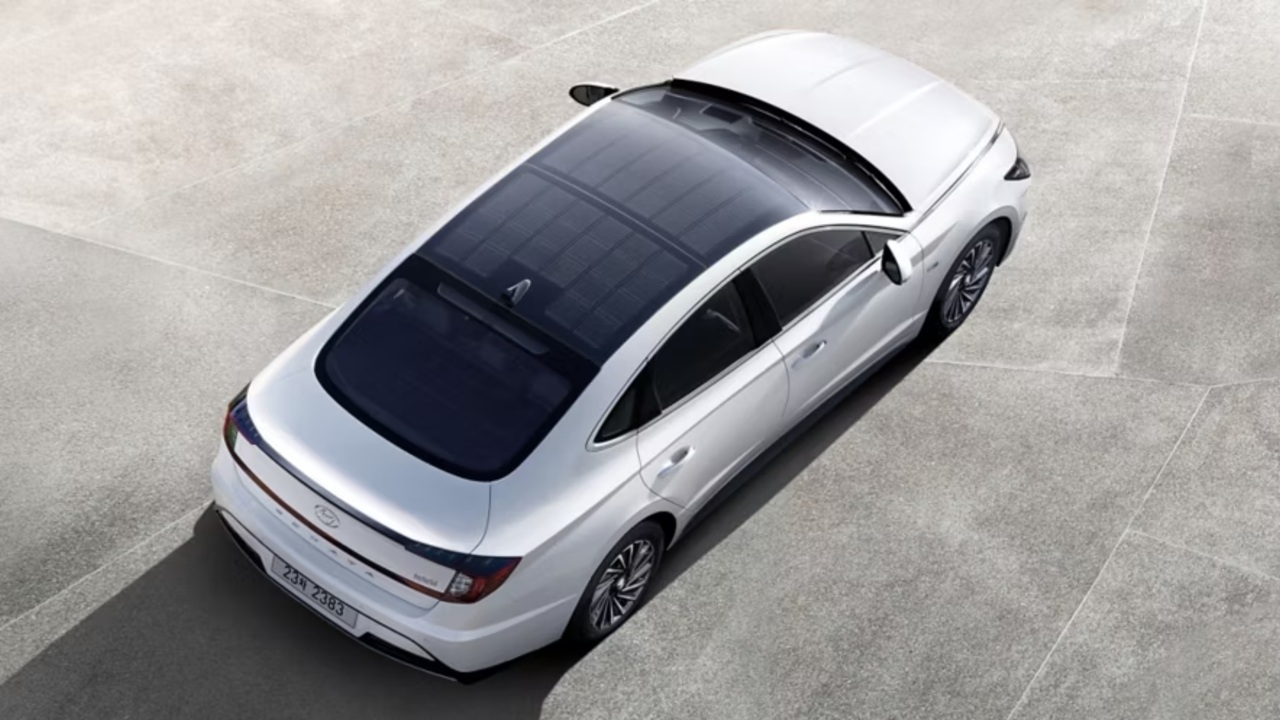
The concept matured with The Sonata Hybrid, which adopted a dedicated solar roof consisting of two panels with a total system output of 205 watts. Each panel was housed in glass, integrated into the roof structure and wired directly to the car’s battery so that electricity generated by the solar cells flowed straight into the hybrid system. Hyundai later argued that “charging for 5.8 hours per day adds 1,300 km per year to the total driving distance,” a calculation that translated the abstract wattage into real-world kilometers and showed that even a relatively small array could offset weeks of urban driving. Those figures were not transformative on their own, but they established solar roofing as more than a gimmick and provided a data-backed foundation for more ambitious designs.
Solarstic and the shift from roof panels to solar skins
The next phase of Hyundai’s plan moves far beyond a single glass panel on the roof. Solarstic, an in-house venture spun out of Hyundai Motor Group, is developing vehicle-integrated solar that embeds cells directly into multiple exterior surfaces. Instead of treating the roof as the only viable location, Solarstic’s approach spreads solar modules across the hood, trunk and other body panels, effectively turning the car into a rolling solar array. When deployed across multiple exterior surfaces, this design dramatically increases the total collection area compared with a traditional roof-only system and opens the door to the kind of range gains that make a noticeable difference on the dashboard.
Solarstic’s engineers are working on flexible vehicle designs that can incorporate these cells without compromising styling or structural integrity, including techniques to mold solar cells into curved panels without damaging them. The company has framed the benefits in starkly practical terms: for short-distance drivers, integrated Solar built into the body could mean they “may not need to charge” their EVs at all during typical daily use, while long-distance drivers would still see a meaningful reduction in how often they need to plug in. By moving from a bolt-on roof accessory to a full-body solar skin, Hyundai and Solarstic are positioning solar integration as a core part of the EV architecture rather than an optional extra.
How a plug-optional EV would actually work
Hyundai’s vision of a plug-optional electric car rests on a simple but powerful idea: let the vehicle harvest energy whenever it is exposed to light, then manage that trickle intelligently so it covers as much routine driving as possible. The Hyundai Solar Roof concept is designed to passively charge a vehicle’s battery whenever sunlight is available, effectively turning parking time into charging time. What Is the Hyundai Solar Roof describes this as free energy that accumulates in the background, reducing the need for drivers to seek out public chargers or remember to plug in at home. The Hyundai Solar Roof therefore becomes a quiet partner to the main traction battery, constantly working to offset standby losses and low-speed urban trips.
Scaling that idea across the entire body multiplies the effect. Solarstic has indicated that, when its system is deployed across multiple exterior surfaces, the combined output can deliver enough daily energy under ideal sunlight conditions to cover typical commuting distances for some users. For drivers who travel only a few tens of kilometers per day, that could translate into weeks between plug-in sessions, especially in sunny climates. For those who regularly undertake longer journeys, the solar contribution would not eliminate charging but could extend effective range by a significant margin, potentially approaching the 30 percent improvement Hyundai has previously associated with its solar-assisted designs. In both cases, the car’s software would need to prioritize how that solar energy is used, for example by maintaining a buffer for essential functions or preconditioning the cabin without drawing on grid power.
Engineering constraints and the 30 percent promise
Delivering a claimed range boost of up to 30 percent is not simply a matter of adding more panels; it requires careful balancing of weight, aerodynamics and energy yield. The Sonata Hybrid’s 205 watt array showed that a roof-only system could add roughly 1,300 km per year under the “5.8 hours per day” assumption, but that figure depended heavily on consistent sunlight and parking habits. Extending coverage to the hood and other panels, as Hyundai and Kia have explored in a third-generation solar system that integrates panels into the roof and bonnet, increases potential output but also introduces new engineering challenges. Panels must withstand stone chips, thermal cycling and car-wash abrasion while maintaining electrical performance over the vehicle’s life.
Hyundai’s earlier work on semi-transparent solar roofs for ICE powered vehicles underscored another constraint: visibility and cabin comfort. Semi-transparent modules can be applied to glass surfaces without turning the interior into a dark cave, but they typically sacrifice some efficiency compared with opaque Silicon cells. The company’s staged roadmap, which began with conventional Silicon roof panels and then moved toward more advanced semi-transparent and multi-surface systems, reflects a recognition that no single technology will deliver the full 30 percent gain in all conditions. Instead, the target appears to be an upper bound achievable in favorable climates and usage patterns, with real-world results varying by latitude, weather and how often the car is left in direct sun.
From niche feature to mainstream EV strategy
What began as a curiosity on a hybrid sedan is now being framed as a central pillar of Hyundai Motor Group’s electric strategy. The Hyundai Solar Roof was initially marketed as an exciting new technology that could passively charge a vehicle’s battery for free, but its value proposition was limited when only a single model carried the feature. With Solarstic, Hyundai Motor Group is signaling that solar integration is moving from a niche option to a scalable platform that can be adapted across multiple EV segments. The spin-off’s debut at CES, where Solarstic presented its vehicle-integrated solar panels as a way to boost EV range with built-in power, underlined that this is no longer an experiment confined to one or two halo products.
Industry observers have noted that improved solar roofs could add meaningful miles of range to cars, particularly as cell efficiencies climb and manufacturing techniques allow more seamless integration into complex body shapes. Reports tracking these developments, including the Automotive News Mobility Report, have highlighted growing consumer interest in technologies that reduce dependence on public charging infrastructure without demanding behavioral change. Hyundai’s decision to invest in Solarstic and to refine its solar roof systems across hybrids, ICE vehicles and now dedicated EVs suggests that the company sees solar integration as a differentiator in a crowded electric market. If the technology delivers on its promise, a future in which many Hyundai drivers treat the plug as a backup rather than a lifeline may not be far off.
More from Fast Lane Only