“I’ve just pushed the brake pedal to the floor and I’ve got nothing.”
That is what carwow’s Matt Watson said mid test, seconds after launching a Gunther Werks Turbo down a runway for a second run. One moment he was accelerating hard in Sport mode. The next, the pedal went straight to the floor with nothing pushing back.
Watson had already put the car through one clean run just minutes earlier. Comfort mode, 550 horsepower, a 0 to 60 mph time of 3.90 seconds and a half mile trap speed of 141 mph. Everything had gone exactly as expected. Then he turned the dial to Sport mode for another pass, and the brakes simply stopped responding.
A Car Built to Push Limits
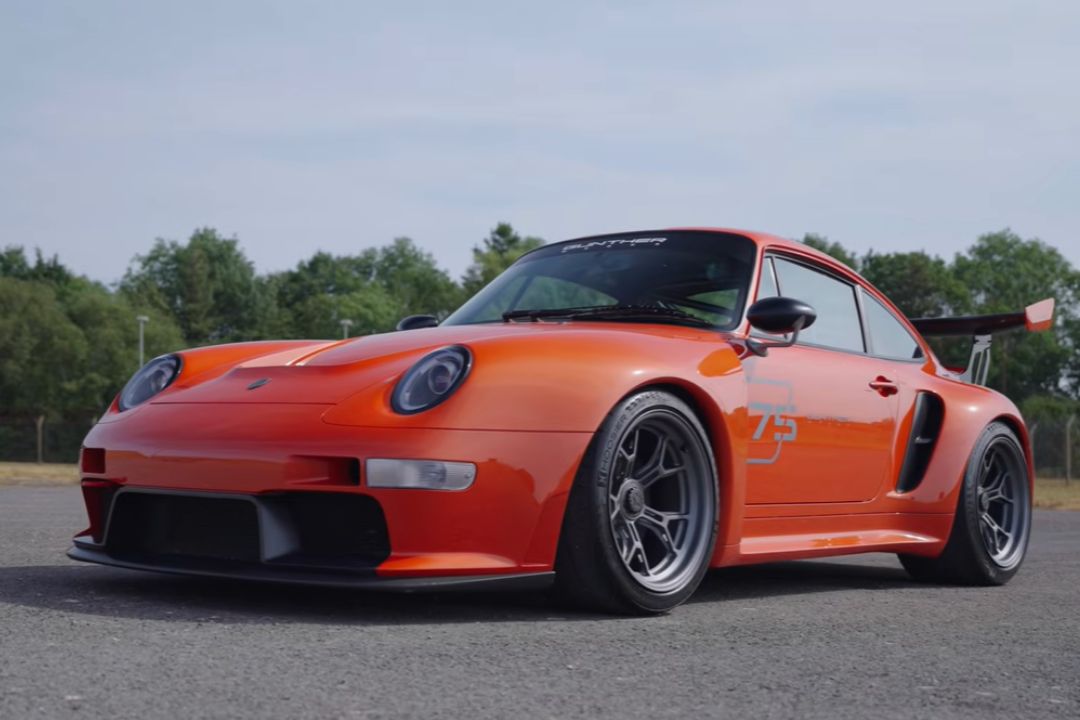
The Gunther Werks Turbo starts life as a Porsche 911 from the 993 generation, then gets rebuilt almost entirely from the ground up. Customers hand over their donor car along with roughly £1.7 million, which comes out to somewhere around $2.3 million at current exchange rates, and Gunther Werks turns it into something closer to a modern race car wearing a classic 911’s silhouette.
The changes start with the engine. Gunther Werks bores out the original 3.6 liter flat six to 4.0 liters, adds a pair of turbochargers with water to air intercoolers, and mounts the cooling fan horizontally in a nod to old Porsche race cars. A dial on the dash lets the driver choose between three power levels: 550 horsepower in Comfort, 650 in Sport, and 850 in Track. The whole car weighs in at 1,225 kilograms, about 150 kilograms lighter than the donor car it started as.
When the Pedal Just Kept Going
Watson had barely selected Sport mode when he hit the brakes and felt nothing come back. He described it as though the brakes had lost all compression, like something inside the system had simply given out. He was candid that he was relieved it had not happened during the high speed run moments earlier.
The car had to be pulled from testing on the spot. A damaged brake line was later confirmed as the cause, the kind of failure that can show up on any car pushed hard enough, but one that hits differently on a hand built prototype. Gunther Werks shipped the car away for repairs, and testing did not resume for two weeks.
Watson pointed out that this is part of why prototypes get driven this hard in the first place. Development cars exist to find weak points before they ever reach a paying customer, and in this case, that is exactly what happened.
Finishing the Job
Once the car came back, Watson picked up where he left off, running the same battery of tests through Sport and Track modes. In Sport, the Turbo dropped its 0 to 60 time to 3.45 seconds and its half mile trap speed climbed to 151 mph. Switching to Track mode and the full 850 horsepower took things further still, with a 3.30 second 0 to 60 run and a half mile trap speed of 162.7 mph.
A brake test from 60 mph stopped the car in 34 meters, with Watson noting the pedal took real physical effort to work given how little assistance the system offered.
What Watson Actually Liked About It
Away from the runway, one detail stood out more than any spec sheet number. The prototype Watson drove still used steel doors rather than the carbon fiber doors planned for customer cars, and he made a point of saying he hoped Gunther Werks would keep it that way. Steel gives the door that heavy, old school Porsche clunk when it shuts, the kind of sound a lighter carbon door simply cannot replicate.
Inside, carbon fiber trim replaced most of the leather typically found in a car like this, a decision tied to founder Peter Nam’s background running a company that specialized in carbon fiber components before starting Gunther Werks. On the road, Watson said the car did not feel like it carried a price tag anywhere near what it actually costs, meaning that as a compliment. Its small, compact footprint made it easy to drive hard without feeling intimidated behind the wheel, and he found himself gravitating toward Sport mode as the ideal setting for everyday roads, with Track reserved for anyone chasing every last bit of performance.
By the end of the test, Watson’s verdict was simple: buy it. The brakes had failed, the car had spent two weeks away getting repaired, and he still wanted one.
More from Fast Lane Only: