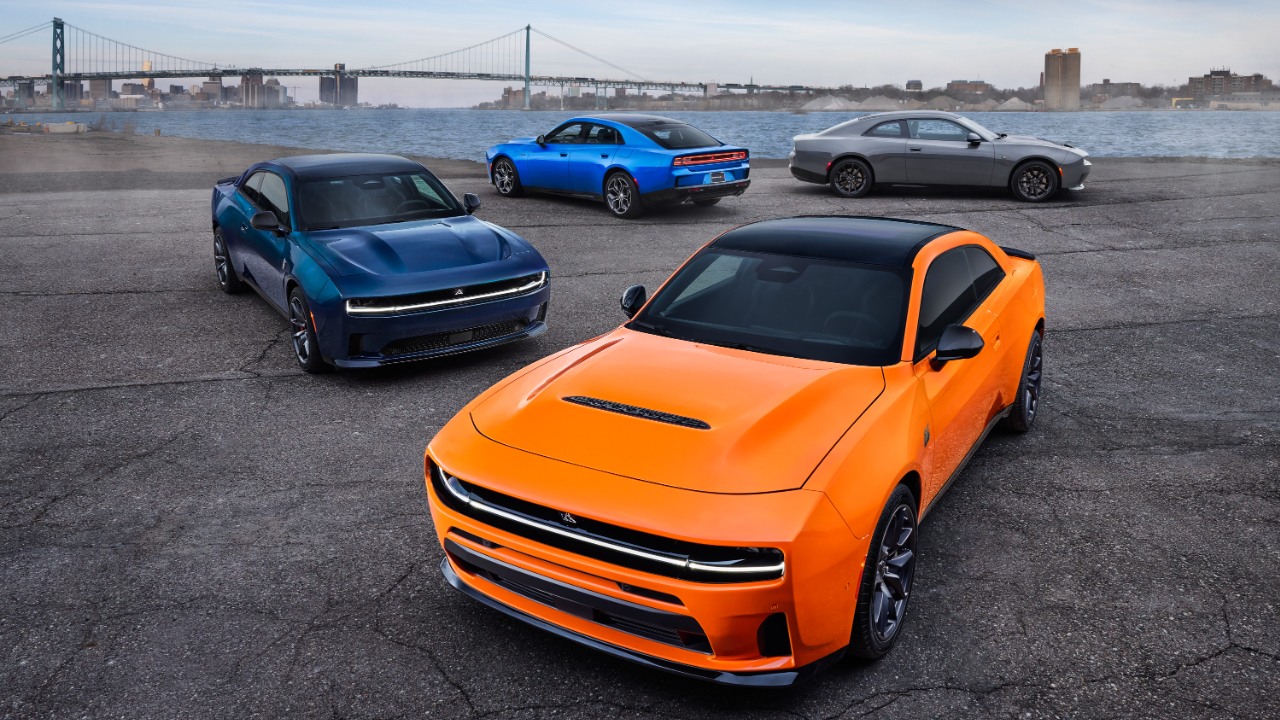
American muscle has long been defined by big-displacement V8 engines, but Dodge is now testing that tradition on two fronts. In garages across the country, owners are bolting superchargers onto 3.6‑liter V6 Chargers and Challengers, while the factory itself is pivoting to high output six‑cylinder Hurricane power in the next‑generation Charger. The question is no longer whether a six can be fast, but whether a supercharged V6 Dodge can genuinely displace the V8 as the performance benchmark.
The answer depends on how performance is measured: raw speed, sound and character, long‑term durability, or the dollars spent to get there. Once those factors are weighed, the “V8 killer” label starts to look less like a simple verdict and more like a series of trade‑offs that different drivers will value very differently.
How much power a boosted V6 really brings
On paper, a supercharged 3.6‑liter Pentastar Dodge Charger or Challenger can absolutely run with traditional V8s. Aftermarket kits such as the RIPP system advertise 11‑12 psi of boost and a gain of “170+HP” on a stock “Automatic 3.6 Pentastar Dodge Charger/ Challenger,” a jump that moves the car from modest output into territory that overlaps many factory V8 R/T models. In enthusiast circles, owners of boosted sixes argue that a well tuned setup can be “faster than any stock V‑8” in straight line runs, and some describe these cars as the “ultimate sleeper” because they look like ordinary V6 trims while delivering far stronger acceleration.
That performance edge is not theoretical. A V8 HEMI owner who documented a drive in a supercharged V6 commented on how “sick” the car sounded and how aggressively it pulled on an acceleration ramp, underscoring that forced induction can transform the character of the Pentastar from rental‑spec cruiser to serious performance machine. Even outside Mopar circles, enthusiasts point out that a supercharged six can “make more HP, and considerably more low” than a naturally aspirated eight of similar vintage, especially when the V8 is a base model rather than a top tier engine. In terms of sheer horsepower and midrange shove, a properly built blown V6 can therefore match or exceed many older V8 Dodges.
The cost and risk calculus for owners
Raw numbers, however, are only part of the story. When owners compare supercharging a V6 Challenger or Charger with simply buying a V8 R/T, cost and risk quickly enter the conversation. One detailed comparison of “supercharging your V6 Challenger or Charger” versus stepping into an R/T notes that while the kit can deliver big power, the total bill often includes supporting upgrades such as fuel system changes, tuning, and potentially stronger driveline components. Enthusiasts on Dodge forums warn that “You’d have to really love the vehicle, and expect zero return on investment,” with one Comments Section voice stressing that “Not many people” will pay extra for a modified V6 when it comes time to sell.
There is also the question of mechanical stress. In a Challenger discussion, one V6 owner cautions that “You’re going to blow the engine” if the setup is pushed too hard, even while acknowledging that “a supercharged V6 will definitely give you more power” and that companies like RIPP have viable kits. On a separate technical forum, an Imperator Admin posting under the name MountainManJoe flatly advises “none” when asked which supercharger to choose, arguing that “The Pentastar is already a troubled engine” and adding “I wouldn’t push it,” despite having “21627Posts” and “77” associated with the profile. These warnings do not mean every boosted V6 will fail, but they highlight that chasing V8‑level performance from a six can carry reliability and financial risks that a factory V8 buyer largely avoids.
Community attitudes: sound, status, and simplicity
Even when a supercharged V6 matches a V8 on a dyno sheet, many Dodge loyalists still gravitate toward eight cylinders for reasons that are more emotional than empirical. In a widely shared Charger thread, one commenter sums up the prevailing sentiment with the line “With the way the market is if you wanna buy a V8 just buy a V8,” a phrase repeated in another discussion that pits V6 and V8 Chargers against each other. For these drivers, the deeper exhaust note, the heritage of the HEMI badge, and the simplicity of buying power off the showroom floor outweigh the appeal of building a boosted six.
That preference shows up whenever owners debate whether to supercharge a 3.6 Charger or trade into a newer V8. In one r/Dodge exchange titled “Supercharge current 3.6 charger or buy a newer V8?,” participants point out that moving from a Charger V6 to a Challenger V8 is often the cleaner path, especially when factoring in insurance, resale, and the complexity of tuning. Another Comments Section on a Challenger thread about “Is doing a v8 swap on a v6 worth it or is it better to supercharge the v6” features a user named NotAliasing who calls upgrading “to a scat pack honestly” the “Best bang for your buck,” noting that a full V8 swap requires changing “the entire” supporting system. In practice, many enthusiasts still see the factory V8 as the more straightforward and socially validated route to performance, even if a boosted six can be quicker in specific scenarios.
Factory sixes are catching up to V8s
While owners argue in forums and Facebook groups, Dodge itself is rewriting the muscle car formula with the Hurricane family of six‑cylinder engines. The next generation Dodge Charger Sixpack uses a 3.0‑liter twin turbo Hurricane High Output engine that “The Dodge Charger Sixpack” and related reporting peg at “550” horsepower in H.O. form, with The Standard Output version rated at “420” horsepower. Another overview of the “Hurricane Twin Turbo” notes that the “3.0‑liter V6 Hurricane Twin Turbo has a standard output of 420 horsepower and a high‑output version with 540 horsepower,” figures that place these sixes squarely in the territory once reserved for big HEMI V8s.
These factory sixes are not niche experiments. A breakdown of the future Charger lineup describes the “Twin Turbo Hurricane High Output” engine in the Charger SixPack H.O. at “550 horsepower” and the “420-hp” Dodge Charger SixPack S.O. using a “3.0L Twin Turbo Hurricane Standard Output” configuration. Another dealer‑focused summary notes that the Hurricane engine is “Made of a straight or inline six‑cylinder engine” and is intended to power Dodge, Jeep, and RAM “into the future,” while a performance‑oriented blog highlights that the High Output variant delivers “550” horsepower with a balance of “power, fuel efficiency, and quick response.” In other words, Dodge is now offering showroom sixes that rival or exceed many of its own outgoing V8s, without requiring owners to gamble on aftermarket hardware.
Where the “V8 killer” idea really holds up
When the discussion zooms out from Dodge to engine architecture in general, the traditional advantages of eight cylinders still matter. Technical guidance from Nissan notes that Vehicles with a V8 “tend to have more horsepower than vehicles with a V6,” and that “V8 engines generally have more torque,” especially for heavy hauls and towing. That pattern is baked into physics: more cylinders and displacement usually mean more low‑rpm torque and less stress per cylinder at a given output. For drivers who prioritize long‑term durability under load, or who want the effortless feel of a big engine barely working, a naturally aspirated V8 remains a compelling choice.
Yet the same guidance also concedes that the difference “can be minimal in some models,” which is exactly where modern sixes, both supercharged and twin turbo, start to look like genuine challengers. In Mopar communities, enthusiasts such as Matthew Worrell and Rivers Charles Butler Jr argue that “the powertrain is the only thing that ma…” separates trims in some Dodge products, a tacit admission that if a six can deliver comparable power, the rest of the car may feel effectively the same. Social media debates over the practicality of V6 versus V8 Mopars often come down to how much a driver values the intangible aspects of a V8, such as sound and heritage, versus the measurable performance and efficiency gains of a boosted six.
More from Fast Lane Only