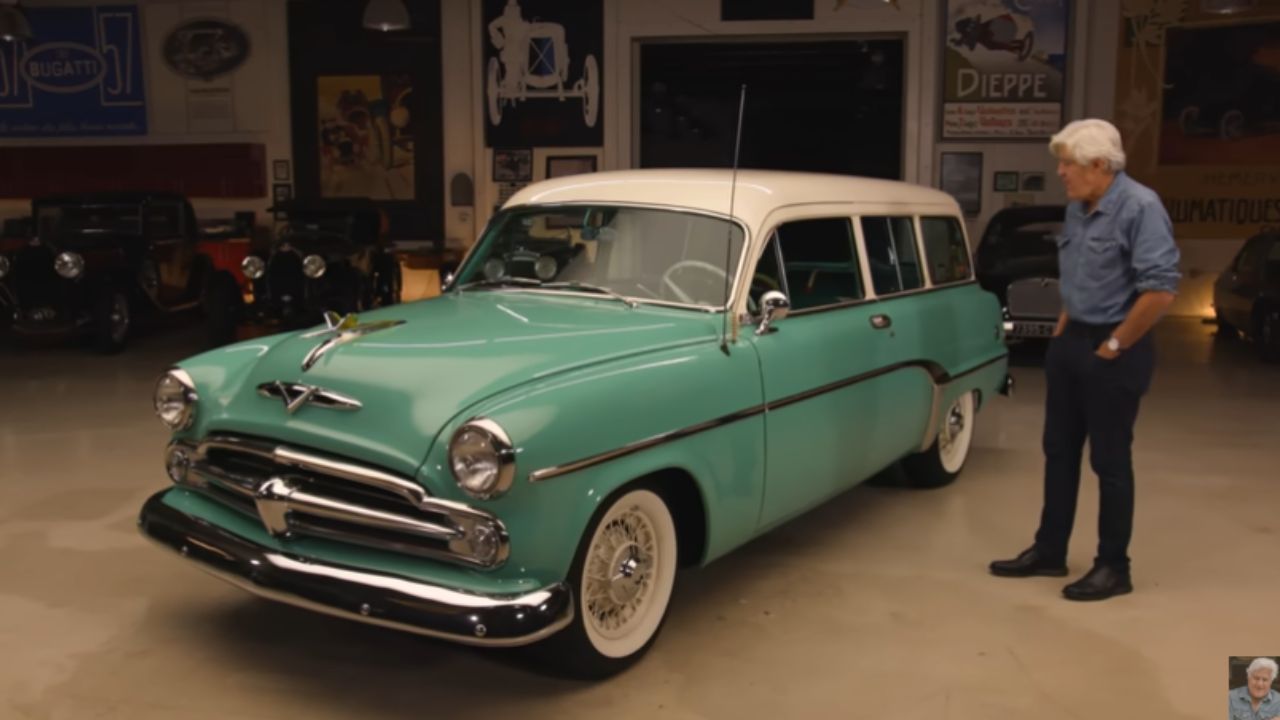
Jay Leno has a knack for pulling obscure machinery out of the shadows, but even by his standards, a mid‑century Hemi station wagon feels like a magic trick. The car in question, a 1950s Dodge family hauler with a small-displacement V8 under the hood, looks like it should be parked outside a hardware store, not idling in a world‑famous garage. I see it as a reminder that the Hemi legend was built not only on drag strips and NASCAR ovals, but also on unassuming wagons that quietly did the school run.
The “innocent” wagon with a secret under the hood
What makes this particular car so charming is how ordinary it appears at first glance. Jay Leno describes it as one of the more “innocent-looking” vehicles in his collection, and I understand why, because the long roof and upright glass give it the stance of a dutiful suburban shuttle rather than a performance icon. In his detailed walkaround of the Dodge Coronet Sub, he leans into that contrast, treating the car as a time capsule from an era when a family wagon could quietly carry cutting‑edge engineering.
Under that modest sheetmetal sits Dodge’s early 241 cubic inch Red Ram Hemi, a compact V8 rated at around 150 horsepower that was a revelation in a segment dominated by flatheads and straight‑sixes. I like how this small‑block configuration shows a different side of the Hemi story, one where clever combustion chamber design mattered as much as brute displacement. The fact that this wagon carries a 241 cubic inch engine with roughly 150 horsepower helps explain why it feels so eager despite its family‑car brief, and it underlines how ambitious Dodge was about spreading the Red Ram Hemi across its lineup.
A family workhorse that did it all
I am especially drawn to how Leno frames this wagon as a Swiss Army knife of mid‑century life. In his own words, “This is my 1954 Dodge Coronet wagon, back in the day, these wagons did everything. Family hauler, road-trip machine, hardware store runner,” and that list of chores captures the car’s original mission better than any spec sheet. When I watch him share that sentiment around his Dodge Coronet, I see a storyteller using one car to summon an entire era of American daily life, where a single vehicle had to cover every base for a growing Family.
That utilitarian spirit is baked into the Suburban‑style bodywork, which stretches the Coronet platform into a long‑roof layout with generous cargo space and a low, flat floor. I picture it loaded with camping gear one weekend and lumber the next, the Red Ram Hemi humming away up front while kids clamber over the rear bench. When Leno walks around the Dodge Suburban variant and points out how it had to move a roughly 3,400 lb car with a relatively small engine, it reinforces how this powertrain was engineered for flexibility rather than outright speed, a balance that suited real‑world family duty perfectly.
Details that bring the 1950s back to life
What really sells the illusion of time travel for me are the period touches that Leno and his team have preserved. The wagon wears period‑correct stickers, whitewall tires, and factory wire wheels, each detail nudging the viewer a little further back into the 1950s. Those choices are not just cosmetic, they are part of a philosophy that treats the car as a rolling historical document, and they make the whole package feel like it just rolled out of a mid‑century driveway. The way the visual details are curated turns a simple walkaround into a lesson in how families actually lived with these cars.
Inside, the cabin layout reflects a time before cupholders and touchscreens, when big steering wheels and thin pillars defined the driving experience. I find that the generous glass area and straightforward controls make the car feel friendlier than many modern SUVs, even if it lacks their electronic safety nets. Leno often talks about how older cars encourage you to learn their quirks, and in his broader deep dive on this wagon he leans into that idea, describing how you bond with an older automobile precisely because it demands a bit of mechanical sympathy and patience.
A Hemi that prefers smiles to stopwatches
From a performance standpoint, I like that this wagon reframes what a Hemi can be. Instead of chasing quarter‑mile times, the 241 cubic inch Red Ram Hemi in this car focuses on smooth torque and relaxed cruising, a personality that suits a long‑roof perfectly. When Leno takes it out on the road, the way he feeds in throttle and listens for the engine’s response feels more like a conversation than a test drive. That is the charm of a Red Ram Hemi tuned for everyday use, it delivers enough power to keep up with traffic while still inviting you to enjoy the scenery.
It also highlights how different the 1950s performance landscape really was. A family wagon with around 150 horsepower might sound modest today, but in its time it represented a meaningful step up from the flathead engines that had dominated the previous decade. I find that context important, because it explains why Dodge invested in spreading Hemi technology across cars that were not overtly sporty. When Leno compares this friendly Hemi to the more aggressive big‑block versions that came later, he is really tracing a line from this unassuming wagon to the muscle‑car era, showing how a supposedly forgotten configuration helped lay the groundwork for the brand’s later reputation.
Rarity, memory, and why this wagon matters
Part of the fascination here is just how obscure this configuration has become. Leno himself notes that the Dodge wagon he is showcasing is so rare he has never met anyone who has even heard of someone owning one, which is a remarkable statement from a man who has spent decades immersed in car culture. I take that as a sign of how thoroughly these workhorses disappeared once their useful lives ended, recycled and replaced by newer family haulers without anyone thinking to preserve them. Hearing him describe this Dodge as something almost no one remembers puts its survival into sharper relief.
That rarity is exactly why I think this wagon deserves the spotlight it is getting now. By taking a deep dive into the car on his show, Jay Leno is not just indulging his own curiosity, he is rescuing a small but meaningful chapter of the Dodge Hemi story from oblivion. The fact that he is doing it with a 1954 Dodge Coronet Suburban‑style wagon, a car that once blended into the background of American life, makes the gesture feel even more generous. When I watch Jan clips of Leno easing the car out of his garage and onto the street, I see more than a forgotten Hemi wagon coming out of hiding, I see a living reminder that automotive history is often written in the margins, on the tailgates of family cars that quietly did it all.
More from Fast Lane Only