In a sport defined by speed and volatility, Jimmie Johnson managed to turn stock car racing into something that looked almost inevitable. Across a decade and a half at the top of the NASCAR Cup Series, he converted raw pace, strategic discipline, and relentless consistency into seven championships that reshaped the record book and the expectations for what a modern dynasty could be. His run did not just match the legends of earlier eras, it forced the series to reckon with a new standard of sustained excellence.
To understand how those seven titles came together, it helps to look beyond the trophy count and into the structure that supported them: the partnership with Hendrick Motorsports, the chemistry with crew chief Chad Knaus, and the way Johnson adapted to changing formats and competition. The dynasty he built was not a single surge of dominance but a layered project, constructed season by season, that still frames how I think about greatness in the Cup Series.
The making of a seven-time champion
Jimmie Kenneth Johnson arrived in the Cup Series as more than just another prospect, but there was little hint that he would eventually stand alongside the sport’s most decorated champions. He developed from a promising American stock car racer into a driver whose résumé now sits in the same conversation as Richard Petty and Dale Earnhardt, the only other seven-time Cup champions listed among the all-time NASCAR Cup Series winners. That climb required not just speed but an ability to deliver in every phase of a long season, from the opening races through the pressure of the playoffs.
What separates Johnson in the historical record is not only the total of seven titles but the way he collected them in a compressed window. He became the dominant driver of the 2000s in NASCAR, stringing together five straight Cup championships at the height of his powers, a streak that no other driver has matched in the modern era of the series. Those five consecutive crowns, followed by two more in 2013 and 2016, turned his career from impressive to generational and cemented his place among the sport’s most accomplished champions on the official SEVEN TIME honor roll.
Hendrick Motorsports, the No. 48, and a machine built to win
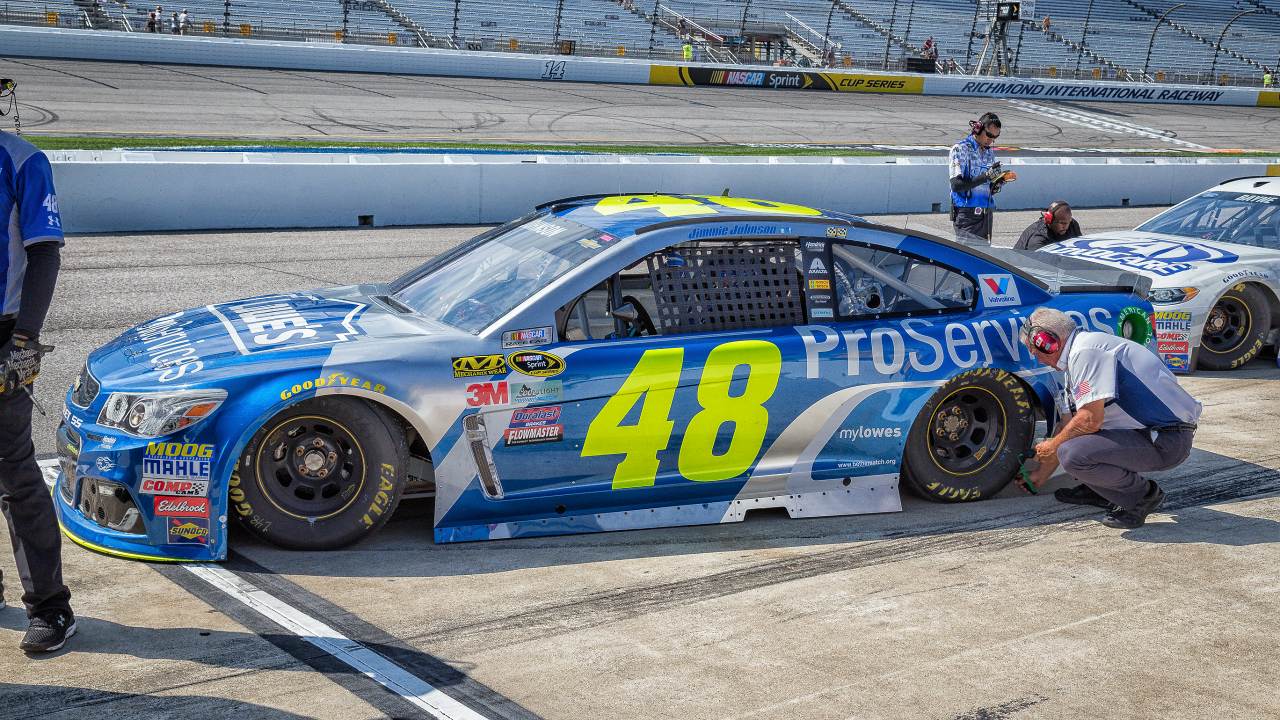
Behind every title run was a meticulously engineered operation, and for Johnson that meant the 48 team of Hendrick Motorsports. Over the course of his Cup career with that group, he recorded 83 wins in 686 starts, tying him with his childhood hero, Cale Yarborough for fifth on the all-time victory list, a statistic that underlines how often the 48 car was not just competitive but the class of the field. Those numbers reflect a program that could execute on every type of track, from short ovals to superspeedways, and in every phase of a race weekend.
The partnership with Hendrick Motorsports also gave Johnson the stability and resources to keep evolving as the series changed around him. The team’s ability to adapt to new car generations, shifting rules, and different championship formats allowed Johnson to keep stacking wins and titles even as the competitive landscape tightened. His own site describes how, over the span of more than three decades in racing, Jimmie remains a fierce competitor both on and off the track, and that longevity is rooted in the infrastructure and culture that Hendrick built around the 48 program, as reflected in the detailed career overview on his Hendrick Motorsports and Over the biographies.
Five in a row and the evolution of a dynasty
The heart of Johnson’s dynasty is the unprecedented run of five consecutive Cup titles, a streak that turned a strong team into a historic one. Winning any championship in the Cup Series requires surviving a long schedule and a deep field, but repeating that feat year after year, under intense scrutiny and with every rival targeting the 48, elevated Johnson into a different category. That stretch of dominance, recognized in contemporary coverage of his decision to retire from full-time Cup racing after the 2020 season, is routinely cited as the defining achievement of his career and a central reason he is viewed as the dominant driver of his era in NASCAR.
What made those five straight titles even more impressive was the context in which they occurred. Johnson and his team were not simply repeating a formula in a static environment, they were adjusting to evolving competition, new playoff structures, and the constant pressure that comes with being the benchmark. Later in his career, he added two additional titles in 2013 and 2016 to become just the third seven-time Cup champion, a milestone that, combined with his earlier streak, has been described as one of the greatest dynasties in NASCAR history. That framing, highlighted in retrospective analysis of NASCAR’s last dynasty, shows how the five-in-a-row run became the foundation for a broader era of sustained control.
Adapting across eras and formats
One of the most striking aspects of Johnson’s seven titles is how they spanned multiple eras of rules and championship formats. He competed under a variety of systems that determined the Cup champion, yet remained a constant presence at the top of the standings, which is why official Hall of Fame material emphasizes that in an era of change in NASCAR, there was one constant, Jimmie Johnson. That ability to thrive regardless of the structure around him separates his record from those built entirely within a single points format and underscores his versatility as a competitor, as noted in the NASCAR Hall profile.
That adaptability also fueled ongoing debates about how to compare his seven championships with those of earlier legends who raced under different systems. Discussions among fans have wrestled with whether Johnson’s titles, earned in the era of playoff-style formats and evolving sponsorship structures, carry the same weight as the Winston Cup championships of previous generations. In one Comments Section of an Archived fan debate, contributors argue over the validity of his seven compared with other eras, a conversation that, if anything, highlights how central his record has become to the sport’s historical arguments.
Legacy, Hall of Fame status, and what remains
By the time Johnson stepped away from full-time Cup competition, his legacy was already secure, but the formal recognition has continued to build. He is a member of the NASCAR Hall of Fame Class of 2024 along with his former crew chief Chad Knaus and veteran figures from the sport, an honor that codifies what his on-track record had long suggested. The Hall’s own material frames Johnson as a true Hall of Fame résumé, and the pairing of driver and crew chief in the same class underscores how central their partnership was to the dynasty that defined the 48 car, as detailed in the Hall’s Hall of Fame Class of feature.
Beyond the formal accolades, Johnson’s career has become a reference point for younger fans and aspiring drivers who encounter his story in simplified form. Kid-focused biographies describe Jimmie Johnson as one of the greatest drivers in NASCAR history and present quick facts that highlight his seven championships and long tenure at the top, reinforcing his status for a new generation of readers who may have missed his peak years. Those summaries, such as the Quick facts for kids, sit alongside more detailed statistical breakdowns of his career results that track his progression across series and seasons, including the comprehensive Career record of Jimmie Johnson.
What remains, as I look back on his seven titles and the dynasty they built, is a sense that Johnson redefined what a modern Cup champion could be. He combined the relentless winning of earlier icons like Richard Petty with a professionalism and adaptability suited to a more complex, commercially driven era of the sport. The numbers, from 83 wins in 686 starts with Hendrick Motorsports to seven championships across changing formats, tell one story. The way rivals, fans, and institutions continue to measure greatness against his standard tells another, and together they explain why Jimmie Johnson’s era still looms so large over the Cup Series.