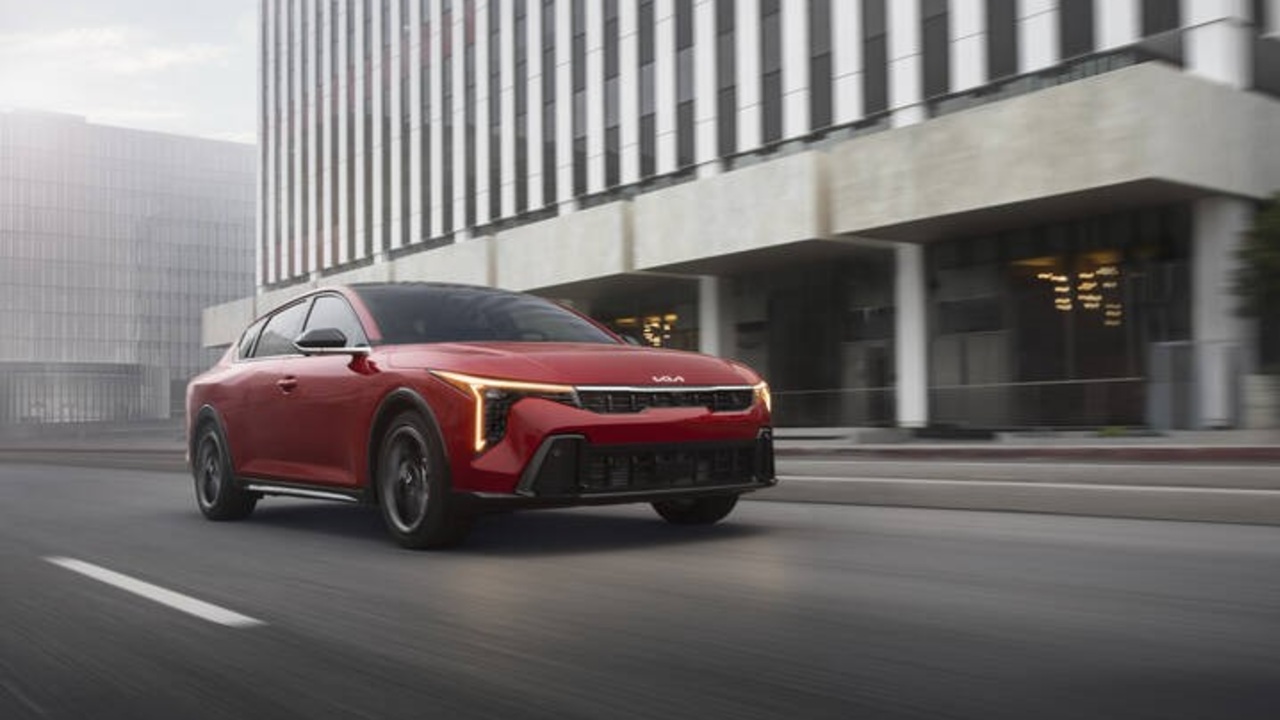
Kia is threading a narrow path between enthusiast appeal and market reality with its new K4 family. The K4 hatchback is arriving in the United States as an affordable, practical compact, and Kia is openly leaving the door ajar for a manual transmission if enough buyers speak up. The long-roof K4 Sportswagon, however, is being steered firmly toward Europe, where a stick shift is already confirmed but American buyers are unlikely to see the car at all.
The split strategy highlights how sharply tastes diverge between regions, even for a single model line. In the United States, the K4 hatchback is being positioned as a mainstream alternative to compact sedans and crossovers, while the wagon is framed as a space‑efficient workhorse for Europe, built in Mexico but not destined for American showrooms. For drivers who still care about shifting their own gears, the message is mixed: there is a chance to keep the manual alive in the U.S. hatch, but the most wagon‑obsessed buyers may have to watch from afar.
The K4 hatchback arrives as a mainstream compact, not a niche toy
Kia’s own materials make clear that the K4 hatchback is meant to be a volume player rather than a cult favorite. The company highlights the 2026 K4 Hatchback GT-Line Turbo as a pre‑production model, noting that it is shown with optional features and that the Hatchback GT-Line Turbo configuration will not have every option on every trim. That positioning, along with a rollout that begins with limited inventory late in 2025 before broader availability in early 2026, underscores that the hatch is being integrated into Kia’s core U.S. lineup rather than treated as a low‑volume experiment.
Pricing reinforces that mainstream intent. According to detailed Release Date and Pricing information, the 2026 Kia K4 Hatchback will go on sale in early 2026, with the EX trim starting at exactly $26,085 and the Full line extending up to a GT-Line Turbo model at a higher price point. Those figures place the K4 hatch squarely in the heart of the compact segment, where value and practicality matter more than exotic hardware. Under the skin, the broader K4 range uses a 2.0‑liter four‑cylinder engine that produces 147 horsepower, and in formal testing its Performance and Driving Feel has been rated at 6.6 out of 10, a combination that signals competent, everyday usability rather than track‑day theatrics.
A manual for the U.S. hatch is not here yet, but the door is open
For American enthusiasts, the most intriguing part of the K4 story is not what is on the spec sheet today, but what Kia is willing to consider. Reporting on early product briefings indicates that the K4 Hatchback is launching in the United States without a manual transmission, a decision that aligns with the broader shift toward automatics in this class. However, Kia representatives have acknowledged that a manual is possible if U.S. buyers show sufficient interest, a conditional promise that turns customer demand into the deciding factor rather than engineering feasibility.
That stance reflects a broader pattern in the compact market, where manufacturers have steadily trimmed manual offerings as take rates fall, yet still respond when a vocal minority proves its commitment. The K4 hatch’s relatively modest power output of 147 horsepower and its 6.6 Performance and Driving Feel score suggest that a manual would be less about outright speed and more about engagement, giving drivers a way to extract more character from an otherwise sensible package. If Kia follows through, a manual K4 hatch could occupy a rare niche as an affordable, practical compact with a stick, especially as rivals continue to abandon three‑pedal options.
The K4 Sportswagon is built for Europe, even though it is made in Mexico
While the U.S. hatchback story is still being written, the K4 Sportswagon’s trajectory is already sharply defined, and it points away from American roads. The wagon, sometimes referred to as the K4 Sportwagon, has been unveiled for Europe with several engine options and the explicit choice of a manual transmission. Reporting notes that it is Made in Mexico, but only for Europe, a striking example of how production geography no longer guarantees market availability. Kia itself emphasizes that the Sportwagon offers nearly six cubic feet more cargo space than the conventional hatch, positioning it as the load‑lugging member of the family.
Additional analysis of the Sportswagon underlines its packaging advantage. One detailed look at the model describes it with the phrase This Small Kia Can Carry Lots Of Things, and explains that its wheelbase allows it to straddle both the C and D segments, which for Ameri buyers would roughly translate to a compact‑plus footprint with midsize‑like interior utility. Built in Mexico but shipped across the Atlantic, the wagon is tailored to European preferences for low‑slung, efficient family cars, even as American buyers are steered toward crossovers and the hatchback instead of a traditional long roof.
Europe gets the manual wagon that U.S. enthusiasts wanted
The sharpest sting for American wagon fans is that Europe is not only getting the K4 Sportswagon, it is getting it with the very configuration many U.S. drivers have been requesting. Reporting on the European model notes that it is cheap, it has a manual, and it is a wagon for Europe and that it is sad buyers elsewhere cannot access the same formula. The Sportwagon’s manual is paired with a compact, efficient powertrain and the extra cargo volume that nearly six cubic feet of additional space provides, creating a rare combination of practicality and driver involvement.
Commentary from enthusiasts has framed the K4 Sportwagon as proof that manual wagons are not dead yet, at least on the other side of the Atlantic. One analysis points out that the car is Made in Mexico, but only for Europe, and that later in the year it will also be offered with an automatic that uses a torque converter, broadening its appeal without displacing the six‑speed manual. For drivers in markets like the United States, that mix of affordability, space and a stick shift is precisely what has been missing as crossovers and continuously variable transmissions have taken over. The fact that such a car exists, but is locked to Europe, sharpens the sense that the U.S. market is being curated away from enthusiast‑friendly configurations.
Why Kia’s split strategy matters for compact‑car buyers
The divergence between the K4 hatchback and the K4 Sportswagon is not simply a quirk of product planning, it is a window into how Kia reads regional demand. Back in 2024, Kia pleasantly surprised observers by signaling that its two‑box‑shaped K4 hatchback would bring a new affordable, low‑slung alternative to the crossover tide, a move that hinted at some willingness to cater to traditional car buyers. Subsequent reporting on the K4 hatch and wagon, including detailed conversations with Kia personnel, shows that the company is now calibrating that strategy: the hatch is being offered broadly in the United States with the possibility of a manual if interest materializes, while the wagon is being reserved for Europe, where long roofs and stick shifts still command meaningful share.
For American shoppers, the practical takeaway is straightforward. Those who want a compact Kia with a hatch and three pedals will need to make their preferences known, because the K4 Hatchback is launching without a manual and Kia has tied any future offering to demonstrable demand. The wagon, by contrast, appears effectively off the table for the U.S., despite being built in Mexico and engineered to carry lots of things with its expanded cargo area. In that context, the K4 lineup becomes a case study in how global automakers balance enthusiast wishes against sales data, and how a single platform can yield very different products depending on which side of the Atlantic a buyer calls home.
More from Fast Lane Only