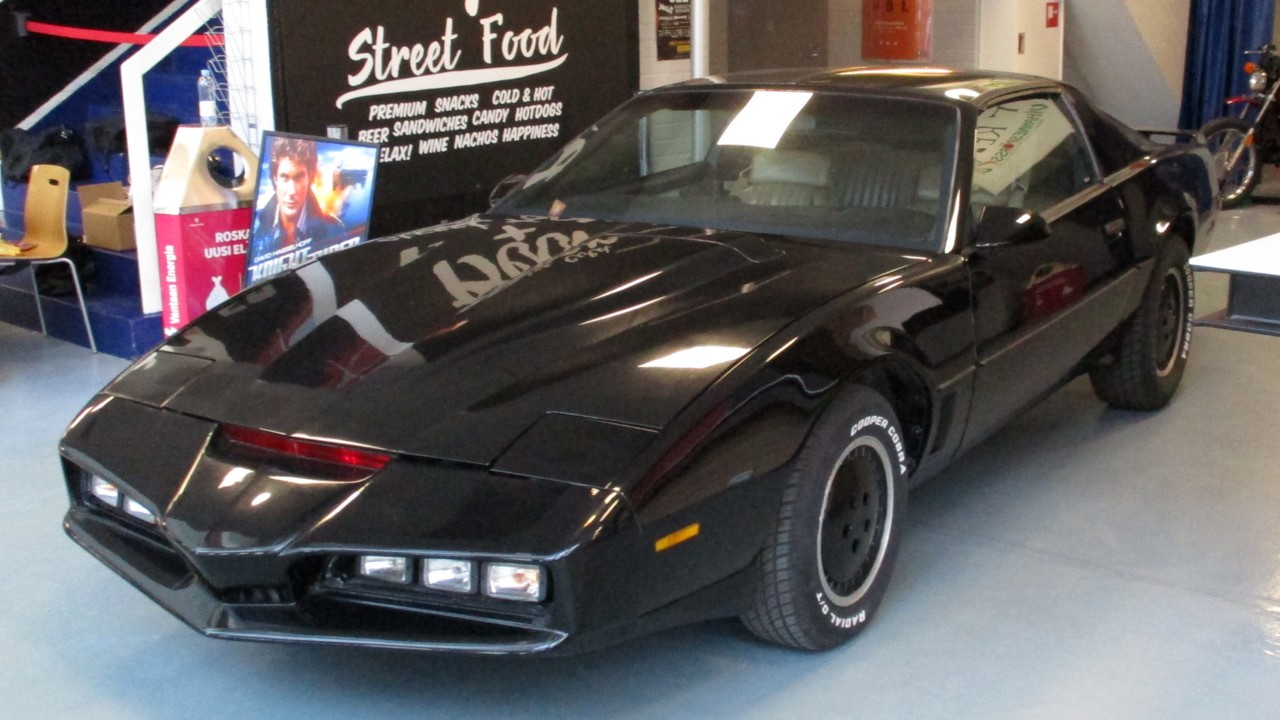
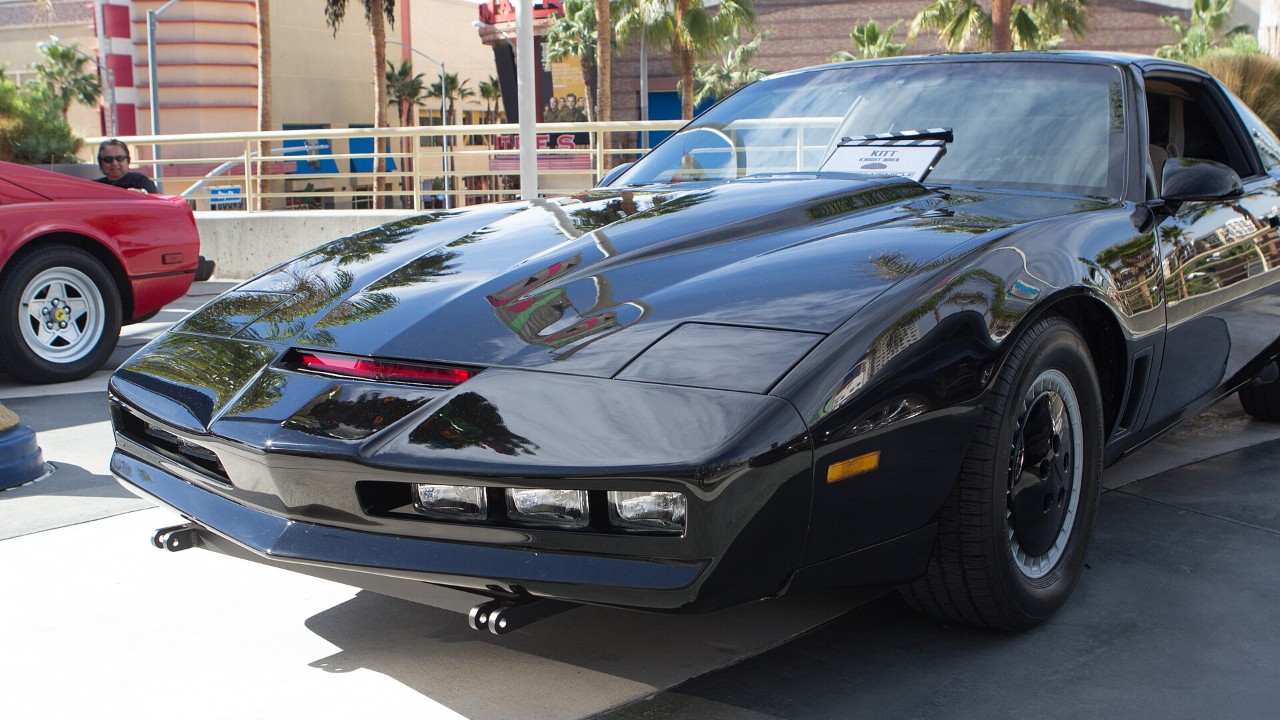
The red light that swept back and forth across KITT’s nose was not a new idea. Glen A. Larson created Knight Rider, and he had already given the Cylons of Battlestar Galactica a similar sweeping red eye. So the KITT scanner was, in effect, a wink from one Larson show to the next.
Knight Rider premiered on NBC on September 26, 1982. Battlestar Galactica had arrived four years earlier, on ABC on September 17, 1978, and it lasted a single season. Clearly, Larson had liked that moving red light enough to bring it back, this time on a black Pontiac Trans Am.
The idea stuck. In fact, fans now call the effect the “Larson Scanner,” and hobbyists still wire up rows of lights to copy it. Here is how a robot’s eye ended up on the nose of a TV star’s Pontiac Firebird.
Where the KITT scanner came from
NBC’s own page for the classic series describes Battlestar Galactica as the story of the last surviving warship, chased across space by warrior robots called Cylons. Each of those robots wore a single red eye that slid from side to side. According to Motor1’s German edition, Larson had first used that red scanner design on the masks of the Cylon soldiers.
David Hasselhoff, who played Michael Knight, tells the same story in his autobiography. As Mental Floss summarized it, the red strobe lights on the car’s hood were a nod to the scanner lights that were the trademark of Larson’s Cylons. Gizmodo made the same point in 2008, writing that KITT’s scanner owed a lot to those cyclops-like Cylon eyes. On the car, the light also did a second job. It showed that KITT was awake, almost like a pulse.
How a Cylon eye landed on a Pontiac Trans Am
The car under the light was not Larson’s first choice. He first pictured a Datsun 280ZX for KITT, according to TVLine. Motor1 cites Car and Driver for the same detail. In the end, a deal with General Motors brought in the Pontiac Trans Am instead.
Even so, that deal nearly fell apart. Hagerty’s account of the deal says Pontiac’s sales promotion manager, Jim Graham, first turned the show down. However, Eric Dahlquist kept pushing. He ran Vista Group, Pontiac’s West Coast public relations agency in Sherman Oaks, California. Pontiac’s Bill Hoglund then said he would sign the paperwork if Dahlquist could make it happen.
Then, on April 16, 1982, Dahlquist got an anonymous call telling him to be at the PMT lot at 4 p.m. Hoglund had signed the order for three loaded black 1982 Trans Ams, and the cars left that lot for the show. Those were early examples of the third-generation Firebird, which Pontiac built from 1982 to 1992, as Motor1 notes.
The famous nose started on a napkin. Pontiac design chief John Schinella sketched KITT’s front end, cycling red light included, on a cocktail napkin. Supervising producer Harker Wade said it was “exactly what Glen wants.” Chuck Koch, then Vista Group’s vice president of client services, put the link plainly for Hagerty: “It was modeled after the Cylon Warrior from Larson’s show Battlestar Galactica.”
Building the cars behind the light
Turning a showroom Trans Am into KITT took real money and time. Mental Floss reports that the production kept around four KITT cars going at a time. Each one also cost about $18,000 to modify, and by season three each car took eight weeks to finish.
Michael Scheffe, an independent studio designer hired by Larson, designed and built KITT’s elaborate interior, Hagerty says. First, he fitted interiors in two cars and built a stationary buck for close-up shots. Later, he helped with a slight refresh of the cars for the fourth and final season.
Meanwhile, the stunt cars came from an unlikely place. In November 1982, a train derailment damaged a load of new Firebirds, and Koch and Wade bought about a dozen of them. Almost all were plain Firebirds rather than Trans Ams. As a result, they were repaired, used as stunt KITTs and later crushed. George Barris, whose company helped build the 1960s Batmobile, also gets credit in some accounts, including Hasselhoff’s book, though Koch disputes Barris’s role in the original design.
A personality to go with the KITT scanner
The light gave KITT a face. However, the voice gave it a personality. William Daniels voiced the car, and TVLine says that voice was first modeled on HAL, the computer from 2001: A Space Odyssey. Still, Daniels’s name never appeared in the opening or closing credits, according to Mental Floss. He once said he could knock off an episode in about 45 minutes.
Larson always saw the pairing as an old Western on wheels. “I wanted to do The Lone Ranger with a car,” he said, as quoted by Mental Floss. In his telling, KITT played Tonto to Michael Knight. The car’s name had also changed along the way. Knight Industries Two Thousand began life as T.A.T.T., short for Trans Am Two Thousand.
Glen Larson’s red light outlived him
Larson died in November 2014 at age 77, of complications from esophageal cancer. By then, his credits ran from Battlestar Galactica and Knight Rider to Magnum, P.I. and The Six Million Dollar Man. Hackaday marked his death by noting that a row of lights sweeping back and forth would always be his legacy.
Better yet, the cars he dreamed up have lasted, too. Hagerty counts three original black Trans Ams from that April 1982 order, and all three of the original KITTs survive today.
More from Fast Lane Only